Chocolate Crinkle Cookies
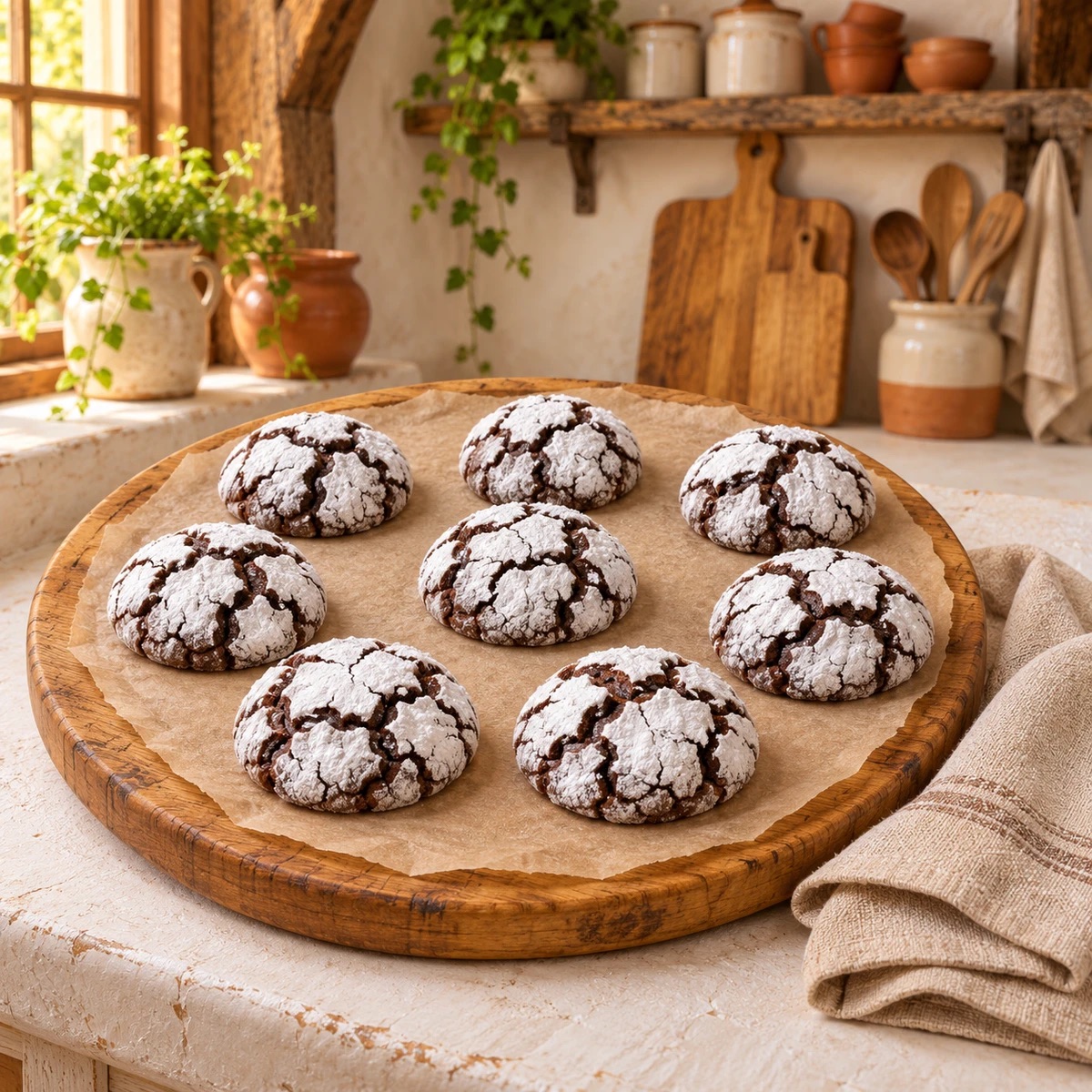
Chocolate crinkle cookies look like small rounds of dark fudge rolled through fresh snow, and in the oven that white coat splits into deep cracks that show off the soft, brownie-like center underneath.
These chocolate crinkle cookies are made from cocoa powder, sugar, oil and eggs, so there’s no butter to soften and no mixer to pull out. A whisk, a spatula and one big bowl do all the work.
The dough starts out sticky, almost like thick brownie batter. A few hours in the refrigerator turn it firm enough to scoop and roll, first in granulated sugar and then in a thick layer of powdered sugar.
The result is a batch of chocolate crinkle cookies with crisp, sugary edges, a moist, fudgy middle and a striking black-and-white look that brightens any cookie plate, from a weekday lunchbox to a holiday tray.

Why You’ll Love These Chocolate Crinkle Cookies
A fudgy, brownie-like middle. Cocoa powder and oil keep the centers of chocolate crinkle cookies soft and moist, while the sugar coating gives the outside a delicate crunch.
No mixer and no softened butter. Everything is whisked by hand in one large bowl, and the dry ingredients are folded in with a spatula.
Pantry ingredients only. Cocoa, flour, sugar, eggs, oil and baking powder are all you need for chocolate crinkle cookies. Powdered sugar handles the decoration.
Made for planning ahead. The dough waits in the refrigerator for up to 2 days, and the shaped balls freeze well, so fresh chocolate crinkle cookies are never far away.

Perfect For
Chocolate crinkle cookies are a classic on holiday cookie trays, and they hold their shape well in gift tins and boxes for neighbors, teachers and friends. At a cookie exchange, their snowy cracks stand out next to frosted and sprinkle-topped cookies. For more festive baking ideas, take a look at my holiday recipes.
Chocolate crinkle cookies are just as welcome the rest of the year. Pack them for a bake sale, a school lunch or a picnic, set them out with coffee after dinner, or bring a batch to a birthday party for the chocolate lovers in the room.

Chocolate Crinkle Cookies at a Glance
| Flavor | Deep cocoa with a hint of vanilla and a sweet sugar coating |
| Texture | Crisp, sugary edges and a soft, fudgy center |
| Difficulty | Easy |
| Prep Time | 20 minutes |
| Chill Time | 3 hours (or up to 2 days) |
| Bake Time | 26 minutes (two sheets, 11 to 13 minutes each) |
| Total Time | 3 hours 46 minutes, including chilling |
| Servings | 24 cookies |
| Method | Chilled, rolled in sugar and baked |
| Cuisine | American |
| Best For | Cookie trays, gift tins, cookie exchanges and lunchboxes |
Before You Start
Plan for the chill. The dough for chocolate crinkle cookies is too soft to roll straight from the bowl. Mix it in the morning and bake in the afternoon, or mix it the night before.
Take the eggs out early. Room-temperature eggs blend smoothly into the cocoa mixture. If you forget, set them in a bowl of warm tap water for 5 to 10 minutes.
Weigh the cocoa and flour if you can. Both are easy to over-measure with a cup. A kitchen scale gives you 45 g of cocoa and 125 g of flour every time. If you use cups, spoon the powder into the cup and level it without packing.
Check your baking powder. Old baking powder is one of the most common reasons chocolate crinkle cookies stay flat and smooth. Stir ½ teaspoon into a few tablespoons of hot water: if it bubbles right away, it’s still good.
What Makes These Chocolate Crinkle Cookies Work
Cocoa Powder and Oil
Cocoa powder brings plenty of chocolate flavor without adding much fat, and oil stays liquid at room temperature. Together they give chocolate crinkle cookies their soft, moist, almost brownie-like center, even a few days after baking.
Two Kinds of Sugar
In these chocolate crinkle cookies, most of the sugar is granulated, which helps the edges turn crisp and the tops set into a thin shell. A little brown sugar adds moisture and a gentle caramel note that rounds out the cocoa.
A Long Chill
Straight out of the bowl, the dough is too sticky to handle. Chilling firms it up so you can roll neat balls, and cold dough spreads more slowly in the oven, which gives you thick, puffy chocolate crinkle cookies instead of thin ones.
A Double Sugar Coat
Each ball is rolled first in granulated sugar and then in plenty of powdered sugar. The granulated layer acts as a thin barrier between the moist dough and the powdered sugar, so the white coat stays bright instead of melting into the cookie.
Why the Tops Crack
The sugar coating dries out the surface of each ball, so the outside sets quickly in the hot oven. Meanwhile, the baking powder and eggs make the inside puff and spread. The set shell can’t stretch, so it breaks into pieces, and the dark dough shows through between the white patches. That contrast is the signature look of chocolate crinkle cookies.

From Scratch vs. Cake Mix Crinkles
Crinkle cookies can also start with a box of cake mix, like my red velvet crinkle cookies. That shortcut is quick, and the color is hard to beat.
These from-scratch chocolate crinkle cookies take only a few minutes longer to mix, and you choose every ingredient. Real cocoa powder gives a deeper, darker chocolate flavor, and you can adjust the sweetness, the salt and the type of cocoa to suit your taste.
Ingredient Notes and Substitutions
Each ingredient has a clear job in chocolate crinkle cookies. Here’s what to choose and which swaps work.
Cocoa powder. Use unsweetened cocoa powder, either natural or Dutch-processed. Natural cocoa is acidic, with a reddish-brown color and a sharp flavor, while Dutch-processed cocoa is neutral, darker and smoother. Because this dough rises with baking powder, either one works in the same amount. Natural cocoa gives a lighter, reddish cookie with a bolder chocolate bite, and Dutch-processed cocoa gives a darker cookie with a mellow flavor.
Sugars. Granulated sugar gives the cookies their crisp edges. Light brown sugar adds moisture and a little caramel flavor. You can use 1 cup (200 g) of granulated sugar in total if you don’t have brown sugar; the chocolate crinkle cookies will be slightly less chewy.
Oil. Any neutral oil works, such as vegetable, canola or sunflower oil. Avoid strongly flavored oils like extra-virgin olive oil, which can compete with the chocolate.
Eggs. Use large eggs, about 50 g each without the shell. They bind the dough and help it puff in the oven, which is part of what creates the cracks.
Flour and baking powder. All-purpose flour gives the right structure. Make sure the baking powder is fresh, since it provides the lift that splits the sugar coating.
Vanilla and salt. Vanilla rounds out the cocoa, and a small amount of salt keeps the chocolate flavor from tasting flat.
Ingredients You’ll Need
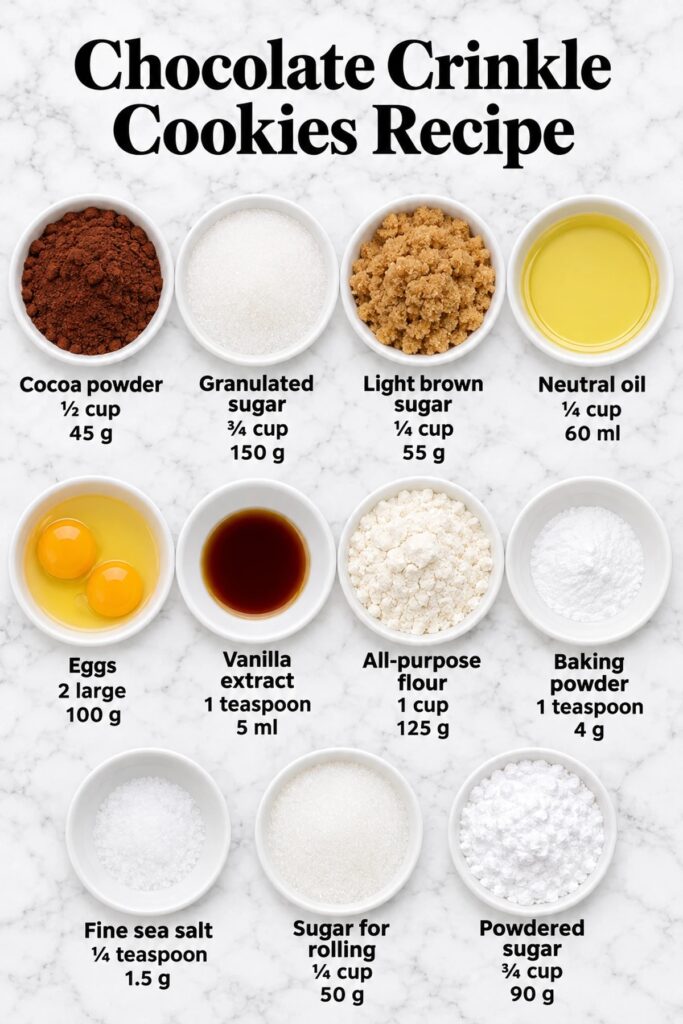
These amounts make 24 chocolate crinkle cookies, each rolled from about 22 g of dough, a heaping tablespoon.
For the Dough
- ½ cup (45 g) unsweetened cocoa powder, natural or Dutch-processed
- ¾ cup (150 g) granulated sugar
- ¼ cup (55 g) packed light brown sugar
- ¼ cup (60 ml) neutral oil, such as vegetable or canola
- 2 large eggs (100 g without shells), at room temperature
- 1 teaspoon (5 ml) pure vanilla extract
- 1 cup (125 g) all-purpose flour
- 1 teaspoon (4 g) baking powder
- ¼ teaspoon (1.5 g) fine sea salt
For Rolling
- ¼ cup (50 g) granulated sugar
- ¾ cup (90 g) powdered sugar
Kitchen Equipment Needed
• Large mixing bowl and whisk – mix the cocoa, sugars, oil and eggs
• Medium bowl – holds the flour, baking powder and salt
• Rubber spatula – folds in the dry ingredients and scrapes the bowl
• Kitchen scale – weighs the cocoa, flour and dough balls
• Plastic wrap or a lidded container – covers the dough while it chills
• 1-tablespoon cookie scoop or measuring spoon – portions the dough evenly
• Two small shallow bowls – hold the granulated and powdered sugar for rolling
• Two baking sheets lined with parchment paper – bake the cookies
• Wire cooling rack – cools the chocolate crinkle cookies evenly
How to Make Chocolate Crinkle Cookies
Here’s the full method, from the first whisk to the cooling rack. Each step ends with what you should see, so you can check your progress as you go.
Step 1: Whisk the Cocoa, Sugars and Oil
In a large bowl, whisk the cocoa powder, granulated sugar, brown sugar and oil until no dry cocoa remains. Break up any small lumps of brown sugar against the side of the bowl.
What you should see: A thick, dark, slightly grainy paste, like damp sand, with no pockets of dry cocoa.
Step 2: Add the Eggs and Vanilla
Add the eggs one at a time, whisking well after each, then whisk in the vanilla. Keep whisking for about 30 seconds after the second egg, until the mixture looks smooth.
What you should see: A smooth, glossy, dark brown mixture that falls from the whisk in a thick ribbon.
Step 3: Fold in the Dry Ingredients
In a medium bowl, whisk the flour, baking powder and salt. Add them to the cocoa mixture and fold with a rubber spatula just until you can’t see any dry flour. Scrape the bottom of the bowl as you go.
What you should see: A soft, sticky, shiny dough that looks like very thick brownie batter and won’t hold a shape yet.
Step 4: Chill the Dough
Cover the bowl with plastic wrap, or scrape the dough into a shallow lidded container, and refrigerate for at least 3 hours, or up to 2 days.
What you should see: A firm, cold dough that holds a clean edge when you dig in a spoon and feels only slightly tacky.
Step 5: Heat the Oven and Set Up the Sugars
Heat the oven to 350°F (175°C) with a rack in the center. Line two baking sheets with parchment paper. Put the granulated sugar for rolling in one small bowl and the powdered sugar in another.
What you should see: Two lined baking sheets and two bowls of sugar side by side, ready for a quick roll-and-coat line.
Step 6: Scoop and Roll the Dough Balls
Take the dough out of the refrigerator. Scoop a heaping tablespoon, about 22 g, and roll it quickly between your palms into a smooth ball about 1¼ inches (3 cm) wide. Roll it in the granulated sugar, then in the powdered sugar, pressing gently so a thick layer sticks. Work with 12 balls at a time and return the dough to the fridge between batches.
What you should see: Round, even balls covered in a thick, completely white coat of powdered sugar, with no dark dough peeking through.

Step 7: Arrange on the Baking Sheet
Place 12 coated balls on one prepared sheet, about 2 inches (5 cm) apart, in staggered rows. They spread to about 2½ inches (6 cm), so give them room.
What you should see: Twelve snowy white balls, evenly spaced on the parchment, none of them touching.

Step 8: Bake
Bake one sheet at a time on the center rack for 11 to 13 minutes, turning the sheet front to back halfway through. The chocolate crinkle cookies are ready when they’ve spread and cracked, the edges look set and the centers still look a little soft and moist inside the cracks. While the first sheet bakes, roll the second batch of balls.
What you should see: Puffed, round cookies with wide cracks of dark chocolate running between white patches of sugar, firm edges and slightly soft centers.

Step 9: Cool on a Rack
Let the chocolate crinkle cookies rest on the baking sheet for 5 minutes, since they’re fragile while hot. Then move them to a wire rack to cool completely, about 20 minutes. They settle slightly and the centers firm up as they cool.
What you should see: Slightly flattened cookies with crisp, sugary edges, clear white-and-dark cracks and a soft, fudgy center when you break one open.

How to Know They’re Done
Use these checkpoints at each stage, so your chocolate crinkle cookies come out the way you want them.
| What to Check | Ready When |
|---|---|
| Cocoa, sugars and oil | Thick, dark paste with no dry cocoa |
| After the eggs | Smooth, glossy and ribbon-like |
| Finished dough | Soft and sticky, no dry flour |
| Chilled dough | Firm, cold and only slightly tacky |
| Coated balls | Thick, fully white powdered sugar coat |
| Tops in the oven | Wide cracks, dark dough showing through |
| Edges | Set and firm to a light touch |
| Centers | Puffed and still slightly soft |
If the tops haven’t cracked by 11 minutes, give them 1 more minute and check again. If the centers look dry and the cracks look dull, the chocolate crinkle cookies are overbaked; next time, take them out a minute or two earlier.
Tips for the Best Chocolate Crinkle Cookies
Keep the dough cold. Cold dough rolls cleanly and holds the sugar well. If it turns soft and sticky while you work, put it back in the refrigerator for 10 to 15 minutes.
Coat them right before baking. Powdered sugar slowly absorbs moisture from the dough. Roll each batch just before it goes into the oven, not an hour ahead.
Be generous with the powdered sugar. A thick coat gives bold white cracks. If you can see brown through the sugar, roll the ball a second time.
Use a scale for even cookies. Balls of the same weight bake in the same time, so every cookie on the sheet is done at once.
Bake on dry days if you can. Humidity softens the powdered sugar, and the white coat can fade or turn sticky. On a damp day, store the chocolate crinkle cookies in an airtight container as soon as they’re cool.
Common Mistakes and How to Fix Them
These are the problems that most often get in the way of good chocolate crinkle cookies, each with a simple fix.
| Mistake | How to Fix It |
|---|---|
| Skipping or shortening the chill The dough is too sticky to roll, and the cookies spread thin. | Chill the dough for at least 3 hours, until it’s firm and only slightly tacky. |
| A thin powdered sugar coat The tops look gray or brown instead of white. | Roll in granulated sugar first, then press on a thick coat of powdered sugar. |
| Old baking powder or a cool oven The cookies stay smooth and don’t crack. | Test the baking powder before you start, and let the oven heat fully to 350°F (175°C). |
| Overmixing the flour The cookies turn dry and cakey. | Fold the dry ingredients in with a spatula just until no flour is visible. |
| Overbaking The centers turn dry and crumbly. | Take them out when the edges are set and the centers still look soft inside the cracks. |
Variations
The basic dough for chocolate crinkle cookies is easy to adapt. Keep the chill and the double sugar coat the same, and try one of these.
Peppermint Chocolate Crinkles
Whisk ½ teaspoon (2.5 ml) of pure peppermint extract into the dough with the vanilla. They taste like a chocolate mint and pair well with a piece of peppermint bark on a dessert plate.
Mocha Crinkles
Whisk 1 teaspoon (2 g) of instant espresso powder into the cocoa and sugars in Step 1. The coffee deepens the chocolate flavor without tasting strongly of coffee.
Orange Chocolate Crinkles
Rub the finely grated zest of 1 orange (about 1 teaspoon, 2 g) into the granulated sugar with your fingertips before whisking. The bright citrus is lovely with dark cocoa.
Double Chocolate Crinkles
Fold ½ cup (85 g) of mini semi-sweet chocolate chips into the dough after the flour. Mini chips keep the balls round and smooth, so the sugar coat stays even. You’ll get about 28 cookies instead of 24.
Serving Suggestions
Serve chocolate crinkle cookies with a cold glass of milk, a cup of coffee or a mug of tiramisu latte. They’re also lovely next to a scoop of vanilla ice cream or a few fresh raspberries.
For a mixed cookie tray, set them beside golden shortbread cookies, jam-filled thumbprint cookies, soft snowball cookies and spiced gingerbread cookies. The dark, crackled tops of chocolate crinkle cookies make the paler cookies look even brighter.
If you’re building a chocolate-lovers’ dessert table, add a pan of fudgy chocolate brownies and a plate of chocolate chip cookies. For more ideas for the cookie season, browse my list of the best Christmas cookies.
Storage
Store cooled chocolate crinkle cookies in an airtight container at room temperature for up to 4 days. Lay them in a single layer, or place a sheet of parchment between the layers so the sugar coats don’t rub off.
Over time, the powdered sugar slowly absorbs moisture from chocolate crinkle cookies and can look less white. A light dusting of powdered sugar through a small sieve brings back the snowy look before serving.
The unbaked dough keeps, tightly covered, in the refrigerator for up to 2 days. Scoop and roll it straight from the fridge.
Freezing
Dough balls: Scoop and roll the dough into balls, but don’t coat them in sugar yet. Set them on a lined baking sheet, freeze for about 1 hour until firm, then move them to a labeled freezer bag or container. Most cookie dough can be kept frozen for up to six months, but for the best flavor, bake your chocolate crinkle cookies within 3 months.
To bake from frozen, let the balls stand at room temperature for 20 to 30 minutes, just until the surface is slightly tacky, so the sugars stick. Roll them in granulated sugar, then powdered sugar, and bake as usual, adding 1 to 2 minutes if needed.
Baked cookies: Cool the chocolate crinkle cookies completely, then freeze them in a single layer in a freezer container, with parchment between the layers, for up to 3 months. Thaw them in the closed container at room temperature, and give them a fresh dusting of powdered sugar if the coat looks dull.
Frequently Asked Questions
Why didn’t my chocolate crinkle cookies crack?
The most common reasons are old baking powder, an oven that wasn’t fully heated or a thin sugar coat. Test the baking powder, let the oven preheat completely and roll each ball in granulated sugar first and then in a thick layer of powdered sugar.
Why did the powdered sugar melt into the cookies?
Powdered sugar absorbs moisture from the dough. The granulated sugar layer underneath slows this down, and so does coating the balls just before baking. Humid weather can also make the coat fade, so store the cookies airtight once they’re cool.
Should I use natural or Dutch-processed cocoa for chocolate crinkle cookies?
Either one works here, because the dough rises with baking powder rather than baking soda. Dutch-processed cocoa gives darker cookies with a smooth, mellow taste, while natural cocoa gives a slightly lighter, reddish color and a sharper chocolate flavor.
Can I use butter instead of oil?
Yes. Replace the oil with 4 tablespoons (57 g) of melted and slightly cooled unsalted butter. The chocolate crinkle cookies taste more buttery and are a little firmer once cool, and the chilled dough becomes firmer, so let it stand for 5 to 10 minutes before scooping.
Why is the dough so sticky?
That’s normal. The dough for chocolate crinkle cookies is closer to a thick batter before it chills. Give it the full 3 hours in the refrigerator, and if it softens while you roll, chill it again for 10 to 15 minutes.
Can I double the recipe?
Yes. To double the batch of chocolate crinkle cookies, double every ingredient and chill the dough in two shallow containers so it firms up evenly. Bake one sheet at a time, keeping the rest of the dough cold until it’s time to roll.
Can I make these cookies gluten-free?
Yes. Replace the all-purpose flour with the same weight, 125 g, of a 1:1 gluten-free baking blend that contains xanthan gum. Check that your cocoa and baking powder are labeled gluten-free as well.
Final Thoughts
A bowl of cocoa, a few eggs and a patient chill are all it takes to turn simple pantry ingredients into dark, fudgy cookies with crisp, snowy cracks. The double roll in sugar is the small step that makes the biggest difference.
Keep a bag of dough balls in the freezer and you can bake a dozen whenever a tin needs filling or a friend drops by. Leave them classic, or add peppermint, orange or espresso as the mood takes you.
Did your cookies split into wide, snowy canyons or fine little lines, and did you stay classic or roll out a mocha batch? Tell me in the comments how your chocolate crinkle cookies turned out and who reached for the first one.
If you try this recipe, please leave a star rating along with your comment below. It takes a few seconds and helps other readers find the recipe.

Chocolate Crinkle Cookies
These chocolate crinkle cookies are soft, fudgy cocoa cookies rolled in sugar, with snowy white cracks across every dark top. With crisp, sugary edges and a moist, brownie-like center, they’re the perfect balance of rich chocolate and gentle sweetness. Made with cocoa, oil and pantry staples, these chocolate crinkle cookies are easy to mix by hand, and the dough waits in the fridge or freezer until you’re ready.
Ingredients
For the Dough
- ½ cup (45 g) unsweetened cocoa powder, natural or Dutch-processed
- ¾ cup (150 g) granulated sugar
- ¼ cup (55 g) packed light brown sugar
- ¼ cup (60 ml) neutral oil, such as vegetable or canola
- 2 large eggs (100 g without shells), at room temperature
- 1 teaspoon (5 ml) pure vanilla extract
- 1 cup (125 g) all-purpose flour
- 1 teaspoon (4 g) baking powder
- ¼ teaspoon (1.5 g) fine sea salt
For Rolling
- ¼ cup (50 g) granulated sugar
- ¾ cup (90 g) powdered sugar
Instructions
- In a large bowl, whisk the cocoa powder, granulated sugar, brown sugar and oil until no dry cocoa remains.
- Whisk in the eggs one at a time, then the vanilla, until smooth and glossy.
- Whisk the flour, baking powder and salt in a medium bowl. Fold them into the cocoa mixture with a spatula just until no dry flour remains.
- Cover and refrigerate the dough for at least 3 hours, or up to 2 days, until firm.
- Heat the oven to 350°F (175°C) with a rack in the center. Line two baking sheets with parchment. Put the granulated and powdered sugar for rolling in two small bowls.
- Scoop the cold dough into 24 heaping tablespoons (about 22 g each) and roll into smooth balls. Roll each ball in granulated sugar, then in a thick coat of powdered sugar.
- Place 12 balls on each sheet, about 2 inches (5 cm) apart. Keep the second batch cold until it’s time to coat and bake.
- Bake one sheet at a time for 11 to 13 minutes, turning it halfway, until the tops are cracked, the edges are set and the centers still look slightly soft.
- Cool on the sheet for 5 minutes, then move the cookies to a wire rack to cool completely.
Notes
- Cocoa: Natural or Dutch-processed unsweetened cocoa both work. Dutch-processed cocoa makes darker, milder cookies; natural cocoa makes slightly lighter, sharper-tasting ones.
- Chilling: The dough is very soft before chilling. Chill it for at least 3 hours, and return it to the fridge if it softens while you roll.
- Coating: Roll in granulated sugar first, then in a thick coat of powdered sugar, just before baking, so the white coat stays bright.
- No cracks: Fresh baking powder and a fully preheated oven are the keys to deep cracks.
- Make ahead: Refrigerate the covered dough for up to 2 days. Freeze uncoated dough balls for up to 3 months; let them stand 20 to 30 minutes, coat and bake.
- Storage: Store baked cookies airtight at room temperature for up to 4 days, or freeze them for up to 3 months.
- Nutrition: Values are per cookie (1 of 24), including an estimated 20 g of granulated sugar and 50 g of powdered sugar from the coating that clings to the cookies.
Nutrition Information:
Yield: 24 Serving Size: 1 cookieAmount Per Serving: Calories: 94Total Fat: 3gSaturated Fat: 0gCholesterol: 16mgSodium: 49mgCarbohydrates: 17gFiber: 1gSugar: 11gProtein: 1g