

Gingerbread Cookies
Gingerbread cookies fill the kitchen with the smell of ginger, cinnamon and molasses long before they come out of the oven, and they taste just as warm as they smell.
These ones have soft, tender centers, lightly crisp edges and a deep, spiced flavor that is sweet without being heavy. The dough rolls out smoothly, holds a sharp cutter edge and bakes into cookies that keep their shape, so they are as good for gingerbread men as they are for stars, trees and hearts.
The one thing that makes the biggest difference is time in the refrigerator. The dough is soft and a little sticky straight from the bowl, and a long chill turns it into something firm that you can roll and cut cleanly.
The recipe makes about 24 cookies with a 3½-inch (9 cm) cutter. Hands-on work takes about 30 minutes, the dough chills for 3 hours, and the baking takes 20 minutes, with royal icing as an optional finish.

Why You’ll Love These Gingerbread Cookies
Soft with a crisp edge. The molasses keeps the centers tender and chewy, while the edges set just enough to hold their shape.
Deep, warm spice. Ginger, cinnamon and cloves give the cookies a classic holiday flavor, and dark molasses adds a rich, almost caramel-like depth.
Clean, sharp shapes. Once the dough is chilled, it cuts neatly and the cookies hold every detail from the cutter.
A project for everyone. Rolling, cutting and decorating is easy to share with kids, friends or a whole cookie-swap crowd.

Perfect For
These gingerbread cookies are made for holiday cookie boxes, cookie exchanges, gift tins, school parties and a quiet afternoon with a hot drink. The dough can wait in the refrigerator for up to 3 days, so you can split the work: mix it one day and roll, cut and decorate the next.
If you are building a full Christmas tray, they sit beautifully beside sugar cookies, snowball cookies and spritz cookies, and you will find more ideas in my list of the 10 best Christmas cookies.

Gingerbread Cookies at a Glance
| Flavor | Warm ginger, cinnamon and cloves with deep molasses sweetness |
| Texture | Soft and chewy centers with lightly crisp edges |
| Difficulty | Easy |
| Prep Time | 30 minutes |
| Chilling Time | 3 hours |
| Bake Time | 20 minutes (2 batches of 8 to 10 minutes) |
| Total Time | 3 hours 50 minutes |
| Servings | About 24 cookies (3½-inch cutter) |
| Method | Mixed, chilled, rolled, cut and baked |
| Best For | Holiday cookie boxes, gifts and decorating with kids |
Before You Start
Use unsulphured molasses. Light and dark molasses both work in this dough, but blackstrap is the most bitter of the three kinds, and its flavor would take over the cookies.
Plan the chilling time. The dough needs at least 3 hours in the refrigerator, so start early or mix it the day before.
Soften the butter. It should give slightly when you press it but still feel cool. Butter that is warm or greasy makes a soft dough that is hard to roll.
Keep the dough for baking. The FDA says that raw flour, dough and batter should never be eaten or tasted, so keep the spoon-licking for the royal icing.
Line the baking sheets. Parchment paper keeps the bottoms from darkening too much and makes it easy to slide the cookies off.
What Makes These Gingerbread Cookies Work
Molasses for Flavor and Softness
Molasses gives gingerbread its color, its deep flavor and its soft texture, because it holds on to moisture as the cookies cool. It is also slightly acidic, which reacts with the baking soda and helps the cookies puff gently.
Three Spices in Balance
Ground ginger brings the heat, cinnamon adds sweetness and cloves add a warm, almost peppery depth. One tablespoon each of ginger and cinnamon and a small amount of cloves give a clear gingerbread flavor that is not overpowering.
Brown Sugar and Butter
Packed brown sugar adds a little extra molasses flavor and moisture, and salted butter carries the spices and gives the cookies a rich, tender bite.
A Long Chill
The dough is soft when you mix it. Three hours in the refrigerator firms the butter so that you can roll it thin, cut it cleanly and bake cookies that do not spread.

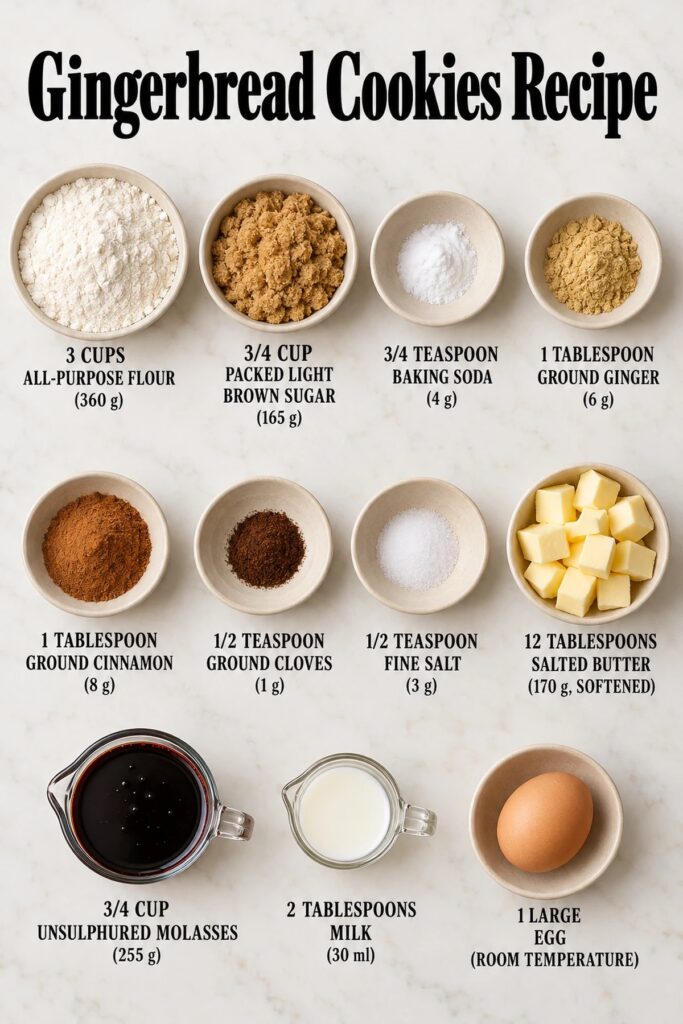
Ingredients for Gingerbread Cookies
For the Dry Ingredients
- 3 cups (360 g) all-purpose flour
- ¾ cup (165 g) packed brown sugar
- ¾ teaspoon baking soda
- 1 tablespoon ground ginger
- 1 tablespoon ground cinnamon
- ½ teaspoon ground cloves
- ½ teaspoon fine salt
For the Wet Ingredients
- 12 tablespoons (170 g) salted butter, softened
- ¾ cup (255 g) unsulphured molasses
- 2 tablespoons (30 ml) milk
- 1 large egg, at room temperature
For the Royal Icing (Optional)
- 3 cups (360 g) powdered sugar
- 2 tablespoons meringue powder
- 4 to 5 tablespoons warm water, plus more as needed
Ingredient Notes and Substitutions
Molasses: Unsulphured light or dark molasses both work, and dark gives a deeper, slightly less sweet cookie. Skip blackstrap, which is too bitter for this recipe. Measure it in a greased or lightly oiled cup so that it slides out cleanly.
Spices: Fresh ground spices give the best flavor, so replace any jar that has been open for more than a year. If you want a gentler cookie, reduce the ginger to 2 teaspoons.
Butter: Real butter gives the right flavor and texture, and margarine or a butter substitute changes both. If you only have unsalted butter, use ¾ teaspoon of salt instead of ½ teaspoon.
Brown sugar: Light or dark brown sugar both work. Break up any lumps with your fingers so that the sugar spreads evenly through the flour.
Egg: A large egg at room temperature blends into the butter and molasses more smoothly than a cold one.
Meringue powder: It makes a royal icing that dries hard without raw egg whites. Look for it in the baking aisle or near the cake decorating supplies.
Kitchen Equipment Needed
• Large mixing bowl and a medium bowl
• Whisk
• Electric hand mixer or stand mixer
• Plastic wrap
• Rolling pin
• Gingerbread cookie cutters (about 3½ inches / 9 cm)
• 2 baking sheets
• Parchment paper
• Thin metal spatula
• Wire cooling rack
• Piping bags and small round tips (for the icing)
How to Make Gingerbread Cookies
Step 1: Mix the Dry Ingredients
In a large bowl, whisk the flour, brown sugar, baking soda, ginger, cinnamon, cloves and salt until the mixture is evenly combined and the brown sugar has no lumps.
Step 2: Mix the Wet Ingredients
In a separate bowl, beat the softened butter, molasses, milk and egg with a mixer for about 1 to 2 minutes, until smooth. It may look a little separated at first, which is normal.
Step 3: Make the Dough
Add the dry ingredients to the wet ingredients in two or three additions, mixing on low speed until a soft, slightly sticky dough forms. Stop mixing as soon as no dry flour is left.
Step 4: Chill the Dough
Divide the dough in half, shape each half into a flat disc about 1 inch (2.5 cm) thick, and wrap each one tightly in plastic wrap. Refrigerate for at least 3 hours, or up to 3 days.
Step 5: Preheat and Prepare
Heat the oven to 350°F (175°C) and line 2 baking sheets with parchment paper. If the dough feels too hard to roll, let it sit at room temperature for 10 to 15 minutes.
Step 6: Roll the Dough
Keep one disc in the refrigerator while you work with the other. Roll the dough on a lightly floured surface, or between two sheets of parchment, to a thickness of ¼ inch (6 mm).

Step 7: Cut the Shapes
Cut out shapes with floured cookie cutters and use a thin spatula to move them to the baking sheets, spacing them about 1 inch (2.5 cm) apart. Gather the scraps, press them together, and roll and cut them once more. If the dough feels soft, chill the cut shapes for 10 minutes before baking.

Step 8: Bake
Bake one sheet at a time on the middle rack for 8 to 10 minutes, until the edges are firm and the centers look set. Repeat with the second disc of dough on a cool baking sheet.
Step 9: Cool
Let the cookies cool on the baking sheet for 5 minutes, then move them to a wire rack to cool completely.

Step 10: Make the Royal Icing (Optional)
Beat the powdered sugar, meringue powder and 4 tablespoons of warm water with a mixer on low speed for 30 seconds, then on high speed for 3 to 5 minutes, until the icing is thick and holds stiff peaks. Add more water ½ teaspoon at a time if you need a thinner icing for filling in shapes. Keep the bowl covered with a damp towel while you work, because the icing dries quickly.
Step 11: Decorate
Spoon the icing into piping bags and decorate the cooled cookies. Let the icing dry completely, about 6 to 8 hours at room temperature, before stacking or storing them.
How to Know They’re Done
Gingerbread is already dark, so the color is a poor guide. Use this table to check the signs instead.
| What to Check | Ready When |
|---|---|
| Edges | Firm to the touch, not soft or shiny |
| Centers | Set and slightly puffed, with no wet spots |
| Tops | Matte, with a few fine cracks |
| Aroma | Strong and warm with ginger and cinnamon |
| Bottoms | Slightly darker than the tops but not burnt |
| After 5 minutes on the sheet | Firm enough to lift with a spatula without bending |
If the centers still look wet or shiny when the timer rings, give the cookies another minute. If the edges start to look dry or very dark, bake the next batch for a minute less.
Tips for the Best Gingerbread Cookies
Weigh the flour. A kitchen scale gives you 360 g every time, which keeps the cookies tender instead of dry.
Roll an even thickness. Cookies of the same thickness bake at the same rate. Rolling pin guides or two wooden rulers on either side of the dough make this easy.
Work with one disc at a time. The dough you are not rolling stays firm in the refrigerator, and the dough you are rolling stays easy to handle.
Use as little flour as you can. Too much flour on the surface makes the cookies tough and dry. Rolling between sheets of parchment avoids this completely.
Freeze the shapes for sharper edges. A 10-minute rest in the freezer before baking helps the cutouts keep their outline.
Bake one sheet at a time. The middle rack gives the most even heat, and a cool sheet keeps the next batch from spreading.
Cool before you decorate. Icing melts and slides off warm cookies, so wait until they are completely cool.
Common Mistakes and How to Fix Them
| Mistake | How to Fix It |
|---|---|
| Skipping the chill The dough is too soft to cut, and the shapes spread in the oven. | Chill the dough for at least 3 hours, and chill the cut shapes for 10 minutes if they feel soft. |
| Rolling too thin or unevenly The thin parts burn and the cookies turn hard and brittle. | Roll to an even ¼ inch (6 mm), using rolling pin guides or rulers if you like. |
| Adding too much flour while rolling The cookies bake up dry and tough. | Dust the surface lightly, or roll the dough between two sheets of parchment. |
| Overbaking The edges turn dark and bitter and the cookies lose their soft center. | Take them out when the edges are firm and the centers look set, then let them finish on the hot sheet for 5 minutes. |
| Using blackstrap molasses The cookies taste bitter and a little harsh. | Use unsulphured light or dark molasses. |
Variations
Thicker, Softer Gingerbread Cookies
Roll the dough to ⅜ inch (1 cm) and bake for 10 to 12 minutes. The cookies come out thicker and more tender in the center.
Extra-Spiced Gingerbread Cookies
Add ½ teaspoon of ground nutmeg and 1 teaspoon of finely grated orange zest to the dry ingredients for a brighter, more fragrant cookie.
Sparkling Gingerbread Cookies
Skip the icing and brush the cutouts lightly with milk, then sprinkle them with coarse sugar before baking. They bake with a crunchy, glittery top.
Mini Gingerbread Cookies
Use a 2-inch (5 cm) cutter and bake for 7 to 8 minutes. The recipe makes about 50 small cookies.
Serving Suggestions
Serve the cookies with a cold glass of milk for a classic treat, or with hot coffee or tea. They are lovely beside a warm mug of apple cider or a creamy pumpkin spice latte on a cold afternoon.
For gifts, stack the cooled and fully dried cookies in a tin with parchment between the layers, and tuck in a few linzer cookies for a mixed box.
Storage
Room temperature: store undecorated cookies in an airtight container for up to 1 week. Store decorated cookies in a single layer, or with parchment between the layers, once the icing has dried completely.
Make ahead: the dough keeps in the refrigerator for up to 3 days. Let it sit at room temperature for 15 minutes before you roll it.
Freezing
Baked cookies: freeze undecorated cookies in a freezer bag for up to 3 months, then thaw them at room temperature for about 30 minutes before decorating.
Cookie dough: wrap the discs tightly in plastic wrap and then in a freezer bag, and freeze for up to 3 months. Thaw them overnight in the refrigerator.
Frequently Asked Questions
Can I make the dough ahead of time?
Yes. Keep the wrapped discs in the refrigerator for up to 3 days, and let them sit at room temperature for 15 minutes before you roll them.
Why are my gingerbread cookies puffy?
Puffy cookies usually come from dough that was too warm or from overmixing. Chill the dough fully, and mix only until the flour disappears.
Can I make gingerbread cookies without egg?
You can try a flax egg. Stir 1 tablespoon of ground flaxseed into 3 tablespoons of water and let it sit for 5 minutes before you use it. The cookies will be a little more fragile.
Why are my gingerbread cookies hard?
Hard cookies are usually baked too long, rolled too thin or made with too much flour on the surface. Roll to ¼ inch, use as little flour as you can and take the cookies out when the edges are firm.
What can I use instead of molasses?
Molasses is what makes gingerbread taste like gingerbread, so it is worth buying. Dark corn syrup or honey will work in a pinch, but the cookies will be lighter in color and milder in flavor.
What size cutter should I use?
A 3½-inch (9 cm) cutter makes about 24 cookies. Smaller cutters make more cookies and need less time in the oven, so start checking them after 7 minutes.
How long does royal icing take to dry?
Thin icing needs about 6 to 8 hours at room temperature to dry completely, and thicker piped details dry a little faster. Leave the cookies uncovered on a flat surface until the icing is hard to the touch.
Final Thoughts
Good gingerbread cookies come from unsulphured molasses, a balanced mix of ginger, cinnamon and cloves, a long chill and a short bake that keeps the centers soft.
Once you have the base down, you can roll them thicker, add orange zest, make a tray of minis or keep a disc of dough in the freezer for the next cookie swap.
I’m curious whether yours ended up on a holiday cookie tray, in a gift tin or in the hands of the kids who decorated them, so let me know in the comments.
If you try this recipe, please leave a star rating along with your comment below. It takes a few seconds and helps other readers find the recipe.

Gingerbread Cookies
These gingerbread cookies are soft, spiced comfort with a deep molasses flavor. Easy to roll and cut, they’re the perfect balance of warm spice and gentle sweetness, with an optional royal icing finish. Makes 24 cookies, so these gingerbread cookies are a must-have for Christmas cookie swaps, holiday baking, or anytime you crave a classic winter treat.
Ingredients
For the Dry Ingredients
- 3 cups (360 g) all-purpose flour
- ¾ cup (165 g) packed brown sugar
- ¾ teaspoon baking soda
- 1 tablespoon ground ginger
- 1 tablespoon ground cinnamon
- ½ teaspoon ground cloves
- ½ teaspoon fine salt
For the Wet Ingredients
- 12 tablespoons (170 g) salted butter, softened
- ¾ cup (255 g) unsulphured molasses
- 2 tablespoons (30 ml) milk
- 1 large egg, at room temperature
For the Royal Icing (Optional)
- 3 cups (360 g) powdered sugar
- 2 tablespoons meringue powder
- 4 to 5 tablespoons warm water, plus more as needed
Instructions
- Whisk the flour, brown sugar, baking soda, ginger, cinnamon, cloves and salt in a large bowl until evenly combined.
- In a separate bowl, beat the softened butter, molasses, milk and egg with a mixer for 1 to 2 minutes, until smooth. It may look a little separated at first, which is normal.
- Add the dry ingredients to the wet ingredients in two or three additions, mixing on low speed until a soft, slightly sticky dough forms.
- Divide the dough in half, shape each half into a flat disc about 1 inch (2.5 cm) thick and wrap tightly in plastic wrap. Refrigerate for at least 3 hours, or up to 3 days.
- Heat the oven to 350°F (175°C) and line 2 baking sheets with parchment paper. If the dough is too hard to roll, let it sit at room temperature for 10 to 15 minutes.
- Keep one disc in the refrigerator while you work with the other. Roll the dough on a lightly floured surface, or between two sheets of parchment, to ¼ inch (6 mm) thick.
- Cut out shapes with floured cookie cutters and move them to the baking sheets, spacing them about 1 inch (2.5 cm) apart. Re-roll the scraps once. If the dough feels soft, chill the cut shapes for 10 minutes before baking.
- Bake one sheet at a time on the middle rack for 8 to 10 minutes, until the edges are firm and the centers look set. Repeat with the second disc on a cool baking sheet.
- Cool the cookies on the baking sheet for 5 minutes, then transfer them to a wire rack to cool completely.
- Optional icing: beat the powdered sugar, meringue powder and 4 tablespoons of warm water on low speed for 30 seconds, then on high speed for 3 to 5 minutes, until stiff peaks form. Thin with more water, ½ teaspoon at a time, for filling in shapes, and keep the bowl covered with a damp towel while you work.
- Decorate the cooled cookies with the icing. Let the icing dry completely, about 6 to 8 hours at room temperature, before stacking or storing.
Notes
- Molasses: Use unsulphured light or dark molasses. Blackstrap molasses is too bitter for this recipe.
- Chilling: Chill the dough for at least 3 hours, and up to 3 days. If it is too firm to roll, let it sit at room temperature for 10 to 15 minutes.
- Rolling: Roll the dough to an even ¼ inch (6 mm), ideally between two sheets of parchment, and use as little flour as you can. Keep the second disc in the refrigerator while you work.
- Cutting: If the dough feels soft after cutting, chill the shapes for 10 minutes before baking. Re-roll the scraps only once.
- Baking: Bake one sheet at a time for 8 to 10 minutes, until the edges are firm and the centers look set. Thicker or larger cookies need 1 to 2 minutes longer.
- Yield: The recipe makes about 24 cookies with a 3½-inch (9 cm) cutter. Smaller cutters make more cookies and bake faster.
- Icing: Royal icing needs 6 to 8 hours to dry completely before you stack or store the cookies.
- Storage: Store undecorated cookies in an airtight container for up to 1 week, and decorated cookies in a single layer once the icing is dry. Freeze undecorated cookies or wrapped dough discs for up to 3 months.
- Nutrition: Values are estimates for 1 undecorated cookie (1 of 24), without the optional royal icing.
Recommended Products
As an Amazon Associate and member of other affiliate programs, I earn from qualifying purchases.


Nutrition Information:
Yield: 24 Serving Size: 1 cookieAmount Per Serving: Calories: 168Total Fat: 6gSaturated Fat: 4gCholesterol: 23mgSodium: 149mgCarbohydrates: 27gFiber: 1gSugar: 15gProtein: 2g




2 Comments