
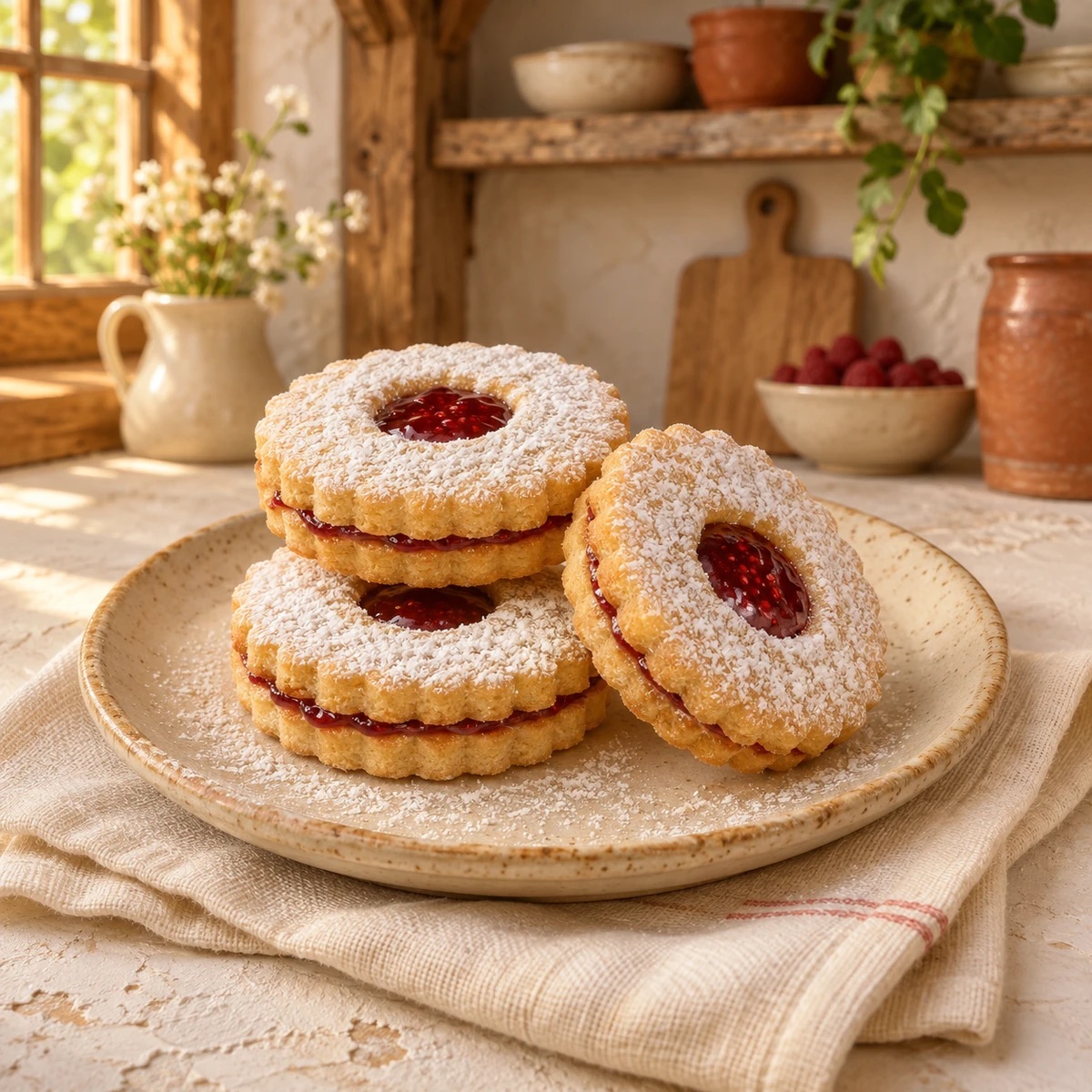
Linzer Cookies
Linzer cookies are tender almond sandwich cookies with a small window cut out of the top, so the raspberry jam inside glows like a stained-glass panel under a snowy layer of powdered sugar. They taste buttery and lightly spiced with cinnamon, and they are soft enough to bite through without crumbling everywhere.
The cookie borrows its name and flavors from the Linzer torte, which Linz Tourism describes as the oldest known cake named after a city, with its name first appearing in 1653. The cookie version keeps the same almond, cinnamon and jam combination in a smaller shape that is easy to share and pack into tins.
The dough is soft and buttery, so the real secret is a long chill. Two hours in the refrigerator turns it into something you can roll thin and cut cleanly, and thin rounds bake into cookies that stay tender instead of heavy.
Most of the 3 hours and 50 minutes is hands-off chilling and cooling. The rest is rolling, cutting and filling, which is the fun part, especially when you pick a heart or a star for the window.

Why You’ll Love These Linzer Cookies
They look like holiday jewels. The little window and the snowy sugar make a cookie that stands out on any tray, with very little decorating.
Buttery almond flavor with a bright center. Ground almonds and a touch of cinnamon give the dough warmth, and the raspberry jam adds a sweet-tart contrast in every bite.
Easy to spread over several days. The dough keeps in the refrigerator for up to 3 days and freezes for up to 3 months, so you can bake when it suits you.
Simple ingredients. Butter, sugar, eggs, flour, ground almonds and jam are all you need, plus a small cutter for the windows.

Perfect For
Linzer cookies belong on Christmas cookie trays, in gift tins and in holiday cookie boxes, where the red jam shows off against the white sugar. They also work for cookie swaps, because they look special and travel well once the jam has settled.
Swap the round window for a heart and they suit Valentine’s Day, or make them for a bridal shower, a tea party or a coffee break. They are sweet enough for dessert but light enough to enjoy with a cup of tea.

Linzer Cookies at a Glance
| Flavor | Buttery almond with cinnamon and sweet-tart raspberry jam |
| Texture | Tender and short, with a thin crisp edge that softens after filling |
| Difficulty | Medium |
| Prep Time | 40 minutes |
| Chill Time | 2 hours |
| Bake Time | 25 minutes (2 batches of 10 to 12 minutes) |
| Cooling and Assembly | 45 minutes |
| Total Time | 3 hours 50 minutes |
| Servings | 24 sandwich cookies |
| Method | Baking |
| Cuisine | International (Austrian-inspired) |
| Best For | Christmas cookie boxes, gift tins and holiday parties |
Before You Start
Plan for the chilling time. The dough needs at least 2 hours in the refrigerator, so make it in the morning or the day before you want to bake.
Soften the butter, but keep it cool. Butter at about 65°F to 68°F gives slightly when pressed but does not look shiny. Butter that is too warm makes a sticky dough and cookies that spread.
Skip the raw dough taste. Because the dough contains raw eggs and flour, the FDA says not to taste or eat raw dough or batter. Save your tasting for the baked cookies.
Choose your cutters. You need a 2½-inch round cutter, plain or fluted, and a small cutter of about 1 inch for the windows. A circle, heart or star all work, as long as the jam shows through.
What Makes Linzer Cookies Work
A Long, Cold Chill
The dough is rich in butter and eggs, so it starts out soft. Chilling firms the butter, which lets you roll thin, cut sharp edges and keep the windows from closing up in the oven.
Ground Almonds Instead of More Flour
Replacing part of the flour with ground almonds adds flavor and a tender, slightly sandy crumb. It also keeps the cookie from turning tough, even if you re-roll the scraps once.
Thin, Even Rounds
Rolling the dough to about ³⁄₁₆ inch (5 mm) keeps the cookie and the jam in balance. Rounds that are too thick feel heavy, and rounds that are too thin break when you fill them.

Ingredient Notes and Substitutions
Butter. Use unsalted butter so you control the salt. Salted butter works in a pinch, and then you can leave out the ¼ teaspoon of salt.
Eggs. Large eggs at room temperature blend into the butter more smoothly. If you forget, set cold eggs in a bowl of warm water for 5 minutes.
Flour. Spoon the flour into the cup and level it, or weigh 300 g. Too much flour makes the cookies dry and the dough crack when you roll it.
Ground almonds. Use finely ground blanched almonds or almond flour. If you grind your own, pulse the almonds with 2 tablespoons of the flour from the recipe so they turn into a fine powder and not an oily paste.
Jam. Seedless raspberry jam is the classic choice. Pick a thick jam, not a thin jelly, so it stays in place between the cookies. Apricot and strawberry jam also work well.
Powdered sugar. A fine dusting is all you need. Sift it over the cooled tops right before filling, so the sugar stays white.
Ingredients for Linzer Cookies
For the Dough
- 1 cup (226 g) unsalted butter, softened
- ⅔ cup (133 g) granulated sugar
- 2 large eggs, at room temperature
- 1 teaspoon pure vanilla extract
- 2½ cups (300 g) all-purpose flour
- 1 cup (100 g) finely ground almonds
- ½ teaspoon ground cinnamon
- ¼ teaspoon fine salt
For the Filling and Dusting
- ½ cup (160 g) seedless raspberry jam
- ¼ cup (30 g) powdered sugar, for dusting

Kitchen Equipment Needed
• Large mixing bowl
• Medium mixing bowl
• Hand mixer or stand mixer
• Rolling pin
• Parchment paper
• 2½-inch round cutter, plain or fluted
• Small cutter of about 1 inch, for the windows
• 2 rimmed baking sheets
• Wire rack
• Fine-mesh sieve, for the powdered sugar
• Small offset spatula or teaspoon, for the jam
How to Make Linzer Cookies
Step 1: Cream the Butter and Sugar
In a large bowl, beat the softened butter and granulated sugar with a hand mixer on medium speed for 2 to 3 minutes, until pale, creamy and fluffy. Scrape down the bowl once or twice so no butter hides at the bottom.
Step 2: Add the Eggs and Vanilla
Beat in the eggs one at a time, mixing until each is fully absorbed, then add the vanilla. If the mixture looks slightly curdled, don’t worry; the flour will bring it back together.
Step 3: Mix the Dough
In a medium bowl, whisk the flour, ground almonds, cinnamon and salt. Add the dry mixture to the butter mixture in two additions, mixing on low speed until just combined and no dry flour remains. The dough will be soft and slightly sticky.
Step 4: Chill the Dough
Divide the dough in half and shape each half into a flat disk about 1 inch thick. Wrap the disks in plastic wrap and refrigerate for at least 2 hours, or up to 3 days. A flat disk chills faster and rolls out more easily than a ball.
Step 5: Heat the Oven and Roll the Dough
Heat the oven to 350°F (175°C) with racks in the upper and lower thirds, and line two baking sheets with parchment paper. Work with one disk at a time and keep the other in the refrigerator. Place the dough between two sheets of parchment and roll it to about ³⁄₁₆ inch (5 mm) thick. If the edges crack, let the dough sit for 5 minutes and try again.
Step 6: Cut the Rounds and the Windows
Peel off the top sheet of parchment and cut rounds with the 2½-inch cutter. Place them about 1 inch apart on the prepared baking sheets. Use the small cutter to remove the center from half of the rounds. Gather the scraps, chill them for a few minutes, re-roll once and repeat with the second disk. You need 24 solid rounds and 24 rounds with windows. If the dough feels soft at any point, slide the sheet into the refrigerator for 10 minutes.

Step 7: Bake the Cookies
Bake for 10 to 12 minutes, switching the pans between racks and turning them halfway through, until the edges are lightly golden and the centers look pale and set. If you only have two pans, bake in two batches and keep the remaining cut rounds in the refrigerator. Let the cookies cool on the pan for 5 minutes, then move them to a wire rack to cool completely.

Step 8: Dust the Tops
Once the cookies are completely cool, sift powdered sugar over the cookies with windows, using a fine-mesh sieve. Dust only the tops, because sugar on the bottoms would mix into the jam.
Step 9: Fill and Sandwich
Spread about 1 teaspoon of jam over each solid cookie, leaving a small border around the edge. Set a dusted cookie on top and press gently until the jam reaches the edges of the window. Let the cookies rest for 30 minutes before serving so the jam settles.

How to Know It’s Done
Use these checkpoints from the dough to the final sandwich.
| What to Check | Ready When |
|---|---|
| Mixed dough | Soft and cohesive, holding together when pressed, with no dry flour left in the bowl |
| Chilled dough | Firm and cool, rolling out without sticking and cracking only slightly at the edges |
| Rolled dough | About ³⁄₁₆ inch (5 mm) thick, cutting cleanly without tearing |
| Baked cookies | Edges lightly golden and centers pale and set, with no dark browning |
| Cooled cookies | Completely cool to the touch, with no warmth on the underside, before dusting and filling |
| Filled cookies | A thin, even layer of jam that reaches the window without squeezing out the sides |
If the cookies bake with golden centers, the dough was rolled too thin or the oven runs hot. Next time, check them a minute earlier.
Tips for the Best Linzer Cookies
Roll between parchment sheets. This keeps the dough from sticking and means you don’t need extra flour, which can dry out the cookies.
Use the same cutter for every round. Matching sizes make the sandwiches line up neatly, with no overhang on one side.
Cut the windows while the dough is cold. Cold dough gives sharp edges, and the small shapes lift out cleanly instead of smearing.
Weigh the flour if you can. At 300 g, the dough stays soft and the cookies stay tender. Packed cups of flour add up quickly.
Fill at the right time. Fill the cookies the day you serve them for a crisper edge, or a day ahead for a softer, more melded cookie.
Common Mistakes and How to Fix Them
| Mistake | How to Fix It |
|---|---|
| Skipping the chill The dough turns sticky, and the cookies spread and lose their windows. | Chill the dough for at least 2 hours, and refrigerate the cut rounds for 10 minutes if they feel soft. |
| Rolling unevenly Thin spots break or burn, and thick spots stay pale and heavy. | Roll between parchment to about ³⁄₁₆ inch (5 mm) and turn the dough often so it stays even. |
| Dusting warm cookies The sugar melts into the surface and the tops look wet and patchy. | Wait until the cookies are completely cool, then sift the sugar on right before filling. |
| Using runny jam The jam leaks out the sides and soaks into the cookies. | Choose a thick, seedless jam and use only about 1 teaspoon per cookie, leaving a small border. |
| Overbaking The cookies turn dry, hard and too brown to look pretty. | Take them out when the edges are lightly golden; they firm up as they cool. |
Variations
Apricot or Strawberry Jam
Use thick apricot jam for a golden filling, or fill the cookies with homemade strawberry jam that you have cooked down until it is spoonable and not runny.
Hazelnut Linzer Cookies
Replace the ground almonds with the same weight of finely ground hazelnuts. The cookie tastes richer and a little toastier, and it goes well with raspberry jam.
Chocolate-Hazelnut Linzer Cookies
Fill the cookies with chocolate-hazelnut spread instead of jam, using about 1 teaspoon per cookie. Skip the powdered sugar dusting if you like a less sweet cookie.
Serving Suggestions
Arrange linzer cookies on a platter with gingerbread cookies, sugar cookies, snowball cookies and meringue cookies for a holiday tray with different colors and textures. For more ideas, browse these Christmas cookie recipes.
They are lovely next to a candy platter with peppermint bark, and they pair well with a warm mug of apple cider or a cup of tea. Dust them with a little extra powdered sugar right before serving.
Storage
Store filled linzer cookies in an airtight container at room temperature for up to 5 days, with parchment paper between the layers. If you want the sugar to look fresh, dust the tops again just before serving.
Unfilled baked cookies keep in an airtight container for up to 1 week. Fill them the day you plan to serve them.
Freezing
Wrap the dough disks tightly and freeze them for up to 3 months. Thaw in the refrigerator overnight before rolling. You can also freeze the baked, unfilled cookies in a freezer container for up to 2 months, then thaw them at room temperature before dusting and filling.
Frequently Asked Questions
Why did my linzer cookies spread?
The butter was probably too soft or the dough was not chilled long enough. Chill the dough for at least 2 hours, and refrigerate the cut rounds for 10 minutes before baking.
What jam is best for linzer cookies?
Seedless raspberry jam is the classic choice. Look for a thick jam, because a thin jelly soaks into the cookies. Apricot and strawberry jam also work.
Can I use whole almonds instead of ground almonds?
Yes, if you grind them yourself. Use blanched almonds and pulse them with 2 tablespoons of the flour until the mixture looks like fine sand, so the almonds don’t turn oily.
How far ahead can I make linzer cookies?
Make the dough up to 3 days ahead, or freeze it for up to 3 months. You can also bake the cookies a few days early and fill them the day you serve them.
Do filled linzer cookies need to be refrigerated?
No. They keep at room temperature in an airtight container for up to 5 days, because the jam is thick and the cookies are low in moisture.
Why are my linzer cookies hard?
Too much flour, rolling the dough too many times or overbaking is the usual cause. Weigh the flour, re-roll the scraps only once and take the cookies out when the edges are lightly golden.
Why does the powdered sugar disappear?
Powdered sugar absorbs moisture from the cookie and the jam. Dust the tops only after they are completely cool, and add a light extra dusting right before serving.
Final Thoughts
Linzer cookies prove that a few simple ingredients can look and taste like a bakery treat. Butter, almonds, cinnamon and raspberry jam turn into a cookie that is tender, fragrant and pretty enough to give as a gift.
Once you have rolled and cut the dough a time or two, the process becomes easy. Change the jam, switch the window shape or use hazelnuts, and the method stays the same, so it can become your go-to for holiday baking.
Tell me in the comments which jam you tucked behind the little window and what shape you chose for the cutout.
If you try this recipe, please leave a star rating along with your comment below. It takes a few seconds and helps other readers find the recipe.

Linzer Cookies
These linzer cookies are buttery almond sandwich cookies with a snowy dusting of powdered sugar and a little window that shows off the raspberry jam inside. You chill a soft cinnamon-almond dough, roll it thin, cut out rounds with a window in half of them, then bake and fill them with jam. Ready in about 3 hours 50 minutes, these linzer cookies make 24 sandwich cookies for cookie boxes and holiday parties.
Ingredients
For the Dough
- 1 cup (226 g) unsalted butter, softened
- ⅔ cup (133 g) granulated sugar
- 2 large eggs, at room temperature
- 1 teaspoon pure vanilla extract
- 2½ cups (300 g) all-purpose flour
- 1 cup (100 g) finely ground almonds
- ½ teaspoon ground cinnamon
- ¼ teaspoon fine salt
For the Filling and Dusting
- ½ cup (160 g) seedless raspberry jam
- ¼ cup (30 g) powdered sugar, for dusting
Instructions
- Beat the softened butter and granulated sugar with a hand mixer on medium speed for 2 to 3 minutes, until pale and fluffy.
- Beat in the eggs one at a time, then the vanilla.
- Whisk the flour, ground almonds, cinnamon and salt. Add to the butter mixture in two additions and mix on low until just combined.
- Divide the dough in half, shape into flat disks, wrap and refrigerate for at least 2 hours, or up to 3 days.
- Heat the oven to 350°F (175°C) and line two baking sheets with parchment. Roll one disk between parchment sheets to about 3/16 inch (5 mm) thick.
- Cut rounds with a 2½-inch cutter and place 1 inch apart on the sheets. Cut a 1-inch window from the center of half of the rounds. Re-roll the scraps once and repeat with the second disk, making 24 solid rounds and 24 rounds with windows.
- Bake for 10 to 12 minutes, until the edges are lightly golden. Cool on the pan for 5 minutes, then cool completely on a wire rack.
- Sift powdered sugar over the cooled cookies with windows.
- Spread about 1 teaspoon of jam on each solid cookie, top with a dusted cookie and press gently. Let rest for 30 minutes before serving.
Notes
- Chill the dough. The dough needs at least 2 hours in the refrigerator and keeps for up to 3 days.
- Measure the flour. Spoon and level the flour or weigh 300 g so the cookies stay tender.
- Choose a thick jam. Seedless raspberry jam works best, and about 1 teaspoon per cookie is enough.
- Storage. Store filled cookies in an airtight container at room temperature for up to 5 days. Unfilled baked cookies keep for up to 1 week.
- Freezing. Freeze the dough disks for up to 3 months, or the baked unfilled cookies for up to 2 months.
- Nutrition. Values are for one assembled sandwich cookie (two rounds with jam and powdered sugar), based on 24 cookies per recipe.
Nutrition Information:
Yield: 24 Serving Size: 1 sandwich cookieAmount Per Serving: Calories: 186Total Fat: 10gSaturated Fat: 5gCholesterol: 36mgSodium: 34mgCarbohydrates: 21gFiber: 1gSugar: 10gProtein: 3g



One Comment