Eggnog Cookies
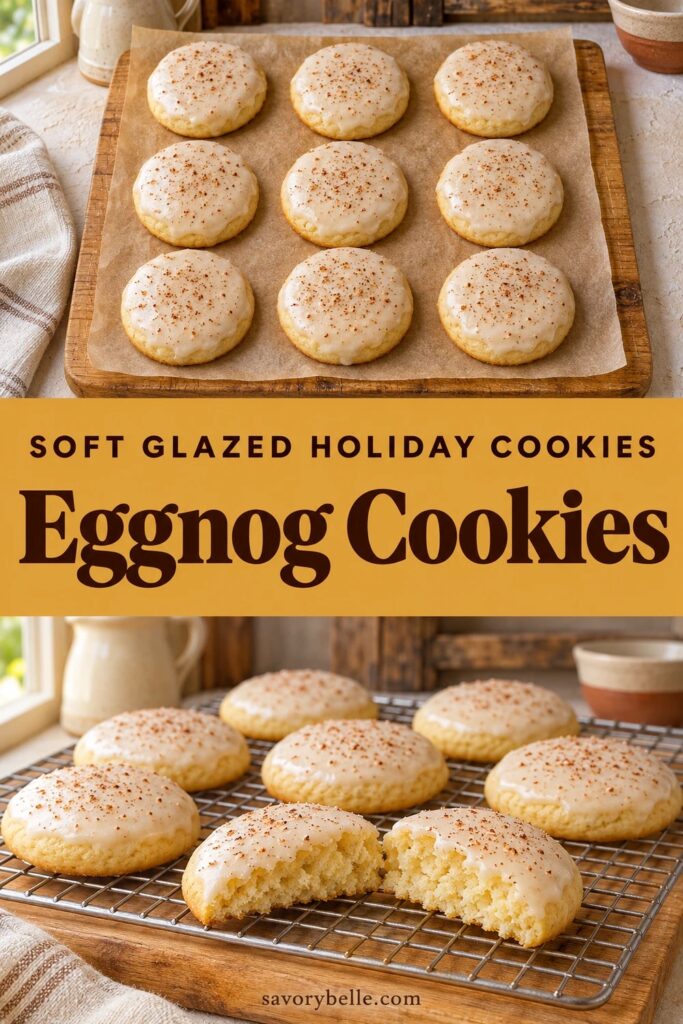
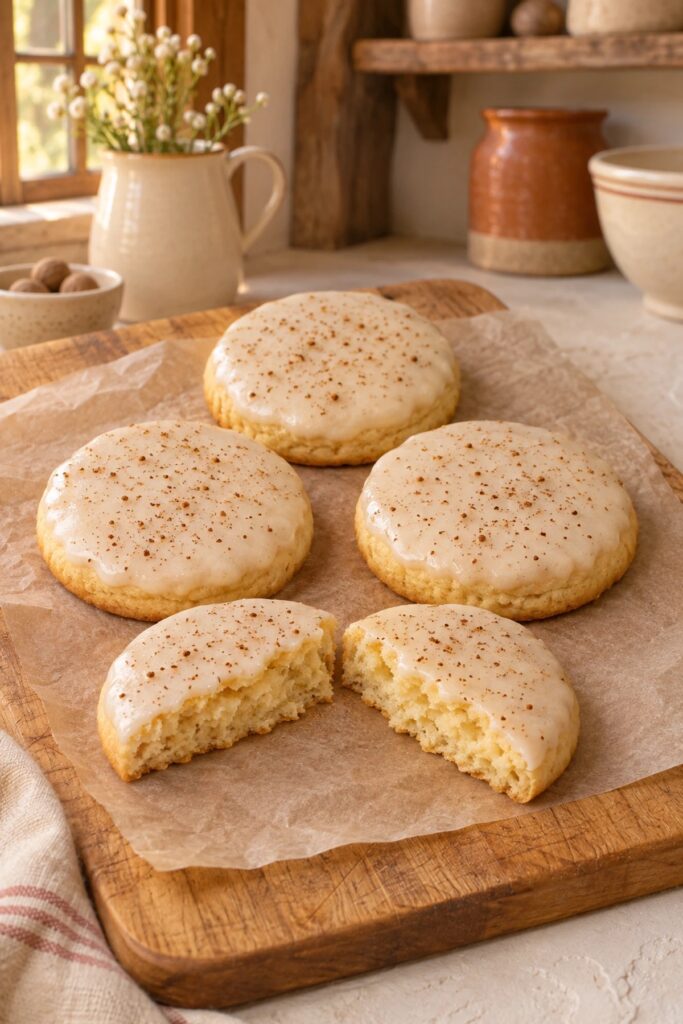
Eggnog cookies taste like the creamy holiday drink turned into something you can hold: soft, pale golden butter cookies warm with nutmeg, under a thin eggnog glaze that sets with a gentle sheen.
Real eggnog goes into the dough, where it adds richness and a tender crumb, and into the glaze, where its flavor is easiest to taste. A generous spoonful of nutmeg and a light dusting of freshly grated nutmeg on top do the rest.
It all starts with a simple creamed butter dough made with egg yolks, chilled for just 30 minutes so it rolls into neat balls. They bake into thick, round cookies with set edges and centers that stay soft for days.
This batch makes 24 eggnog cookies about 2¾ inches (7 cm) wide. If you like a cookie tray that looks finished without any piping or decorating, this is a good one to add.

Why You’ll Love These Eggnog Cookies
Soft and tender all the way through. Egg yolks and a little eggnog keep the crumb moist and cake-soft in the middle, while the edges set just enough to hold a neat round shape.
Eggnog in every layer. The dough, the glaze and the nutmeg on top all point to the same flavor, so each bite tastes like a sip of the holiday drink, only sweeter and softer.
A glaze that sets. The glaze goes on thick but pourable and firms up in about 30 minutes, so you can pack the eggnog cookies in a tin or box without smudging them.
Easy holiday baking. Eggnog cookies need one bowl for the dough, one for the glaze and a short chill. There’s no rolling pin, no cutters and no piping bag involved.
Perfect For
Eggnog cookies are made for December. Bring them to a cookie exchange, set them out at a holiday open house, or pack a few in parchment-lined boxes for neighbors and teachers.
Baking a batch of eggnog cookies is also a cozy way to use up the last of a carton of eggnog after a party. For more seasonal ideas, from cookies to sides for the big dinner, browse my holiday recipes.

Eggnog Cookies at a Glance
| Flavor | Buttery and sweet, with warm nutmeg, vanilla and creamy eggnog |
| Texture | Soft and tender inside, set at the edges, with a thin glaze on top |
| Difficulty | Easy |
| Prep Time | 25 minutes |
| Chill Time | 30 minutes (or up to 2 days) |
| Bake Time | 24 minutes (two sheets, 10 to 12 minutes each) |
| Cool and Set Time | About 50 minutes |
| Total Time | 2 hours 9 minutes |
| Servings | 24 cookies, about 2¾ inches (7 cm) wide |
| Oven | 350°F (175°C) |
| Cuisine | American |
| Best For | Holiday cookie trays, cookie exchanges and gift boxes |
Before You Start
Let the eggnog come to room temperature. Pour the eggnog you need into a cup about 30 minutes ahead. Cold eggnog hitting soft butter makes it firm up into small lumps, and the batter looks broken.
Soften the butter. Take it out of the refrigerator about an hour before baking. It should hold a fingerprint easily but still feel cool, not shiny or greasy.
Separate the eggs while they’re cold. Yolks separate more cleanly from cold eggs. Cover the yolks and let them sit while the butter softens, and save the whites for another recipe.
Weigh the flour if you can. A scale gives you exactly 281 g. If you use cups, spoon the flour into the cup and level it off without packing, since extra flour makes eggnog cookies dry and dome-shaped.
Grate the nutmeg last. If you have whole nutmeg, grate the topping just before glazing. Freshly grated nutmeg smells much stronger than ground nutmeg from a jar.
What Makes These Eggnog Cookies Work
Just Enough Eggnog in the Dough
Eggnog is mostly milk, cream, sugar and egg, so it acts like a rich liquid in the dough. A modest ⅓ cup keeps the crumb soft and moist without turning the dough sticky or making eggnog cookies spread into thin puddles.
Egg Yolks Instead of Whole Eggs
Yolks bring fat and richness, while the whites are mostly water and protein that set firm in the oven. Leaving the whites out gives a tender, almost custardy center, while whole eggs would make eggnog cookies puffier and more cake-like.
Nutmeg Up Front
Nutmeg is the spice most people think of when they taste eggnog. A full teaspoon goes into the dough with just a pinch of cinnamon, and fresh nutmeg on the glaze gives the first bite a warm, sweet aroma.
A Short Chill
Thirty minutes in the refrigerator firms the butter just enough to roll smooth balls. Cooler dough spreads more slowly in the oven, so the eggnog cookies stay thick with soft middles.
The Glaze Brings the Flavor Home
The eggnog flavor in baked eggnog cookies is gentle. The glaze is where it really shows up: the eggnog in it is never baked, so it tastes creamy and fresh.
How They Compare to Snickerdoodles and Sugar Cookies
Eggnog cookies are soft butter cookies, a little like classic sugar cookies, but they’re dropped instead of rolled and cut, and the eggnog and yolks make them richer and more tender.
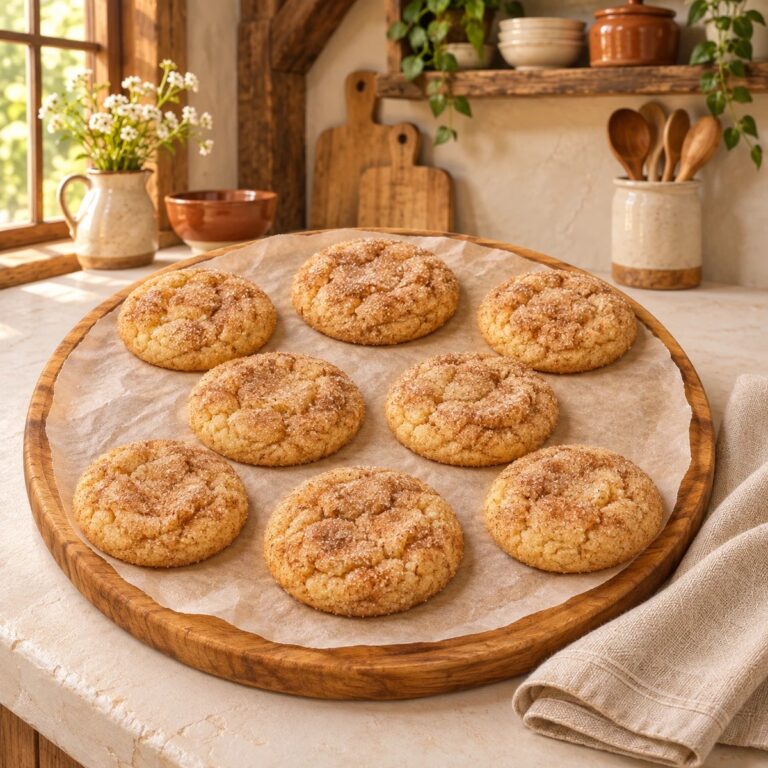
They’re also close cousins of soft snickerdoodles. Both are warmly spiced, but snickerdoodles get their tang from cream of tartar and a cinnamon-sugar crust, while eggnog cookies lean on nutmeg and finish with a creamy glaze instead of a crackled coating.
Ingredient Notes and Substitutions
Most of the ingredients for eggnog cookies are already in a baker’s pantry in December. Here’s what to buy and which swaps work.
Eggnog. Use a full-fat store-bought eggnog for the richest flavor; light eggnog works too.
This recipe is written for nonalcoholic carton eggnog, and store-bought eggnog is typically pasteurized, while homemade eggnog should start from a cooked egg base. If you make your own, choose a cooked recipe.
Butter. Unsalted butter lets you control the salt. If you only have salted butter, cut the added salt to a small pinch.
Sugar. Granulated sugar keeps eggnog cookies pale golden and soft. Brown sugar works but makes them darker and more caramel-flavored, which hides the eggnog.
Egg yolks. Two large yolks, about 36 g in all. Don’t throw out the whites: they keep in the refrigerator for a few days, and they’re just what you need for a batch of crisp meringue cookies.
Flour. All-purpose flour gives the right structure. Cake flour makes the cookies too fragile to glaze, and bread flour makes them chewy.
Baking powder. This is the only leavening, and it gives a gentle, even rise. Check the date on the can, since old baking powder makes flat, dense cookies.
Nutmeg and cinnamon. Ground nutmeg flavors the dough, and freshly grated whole nutmeg goes on top. The cinnamon is only a background note, so don’t increase it, or it will take over.
Rum extract (optional). Half a teaspoon adds the warm, rum-like note of a spiked eggnog without any rum. If you prefer, leave it out and add ½ teaspoon more vanilla instead.
Ingredients for Eggnog Cookies
These amounts make 24 eggnog cookies, each rolled from about 33 g of dough, a ball about 1½ inches (4 cm) wide.
For the Cookies
- ¾ cup (170 g) unsalted butter, at room temperature
- 1 cup (200 g) granulated sugar
- 2 large egg yolks (36 g), at room temperature
- 2 teaspoons (8 g) pure vanilla extract
- ½ teaspoon (2 g) rum extract, optional
- ⅓ cup (85 g) eggnog, at room temperature
- 2¼ cups (281 g) all-purpose flour
- 1½ teaspoons (6 g) baking powder
- ½ teaspoon (3 g) fine sea salt
- 1 teaspoon (2 g) ground nutmeg
- ¼ teaspoon (1 g) ground cinnamon
For the Eggnog Glaze
- 1½ cups (180 g) powdered sugar
- 3 tablespoons (48 g) eggnog, plus 1 to 2 teaspoons more if needed
- ¼ teaspoon (0.5 g) freshly grated nutmeg, for dusting

Kitchen Equipment Needed
• Stand mixer with a paddle, or a hand mixer – creams the butter and sugar
• Large and medium mixing bowls – hold the dough and the dry ingredients
• Whisk – combines the flour, baking powder, salt and spices, then mixes the glaze
• Rubber spatula – scrapes the bowl so everything mixes evenly
• Kitchen scale – weighs the flour and the dough balls
• Medium cookie scoop (about 2 tablespoons) – portions the dough evenly
• Two baking sheets lined with parchment paper – bake the cookies
• Wire cooling rack set over a sheet of parchment – cools the cookies and catches glaze drips
• Small bowl and a microplane or small grater – for the glaze and the fresh nutmeg
How to Make Eggnog Cookies
Here’s the full method for eggnog cookies, from mixing the dough to the set glaze. Each step ends with what you should see, so you know you’re on track before you move on.
Step 1: Whisk the Dry Ingredients
In a medium bowl, whisk the flour, baking powder, salt, ground nutmeg and cinnamon for about 30 seconds, so the leavening and spices are spread evenly.
What you should see: An even, pale beige powder flecked with tiny specks of spice, with no streaks or clumps of nutmeg.
Step 2: Cream the Butter and Sugar
In a large bowl, beat the softened butter and granulated sugar on medium speed for about 3 minutes, stopping once to scrape down the bowl.
What you should see: A light, fluffy, pale yellow mixture that has grown slightly in volume and feels only a little gritty between your fingers.
Step 3: Add the Yolks, Flavorings and Eggnog
Beat in the egg yolks one at a time, then the vanilla and the rum extract, if using. With the mixer on low, pour in the room-temperature eggnog in a slow stream and beat until blended, about 30 seconds.
What you should see: A creamy, pale yellow batter. It may look slightly curdled once the eggnog goes in, and that’s fine: it smooths out as soon as the flour is added.
Step 4: Mix in the Dry Ingredients
Add the flour mixture in two parts, mixing on low just until no dry flour remains. Finish with a few folds of the spatula, reaching to the bottom of the bowl.
What you should see: A thick, soft, smooth dough, a little sticky to the touch and pale cream in color, with no pockets of flour or streaks of eggnog.
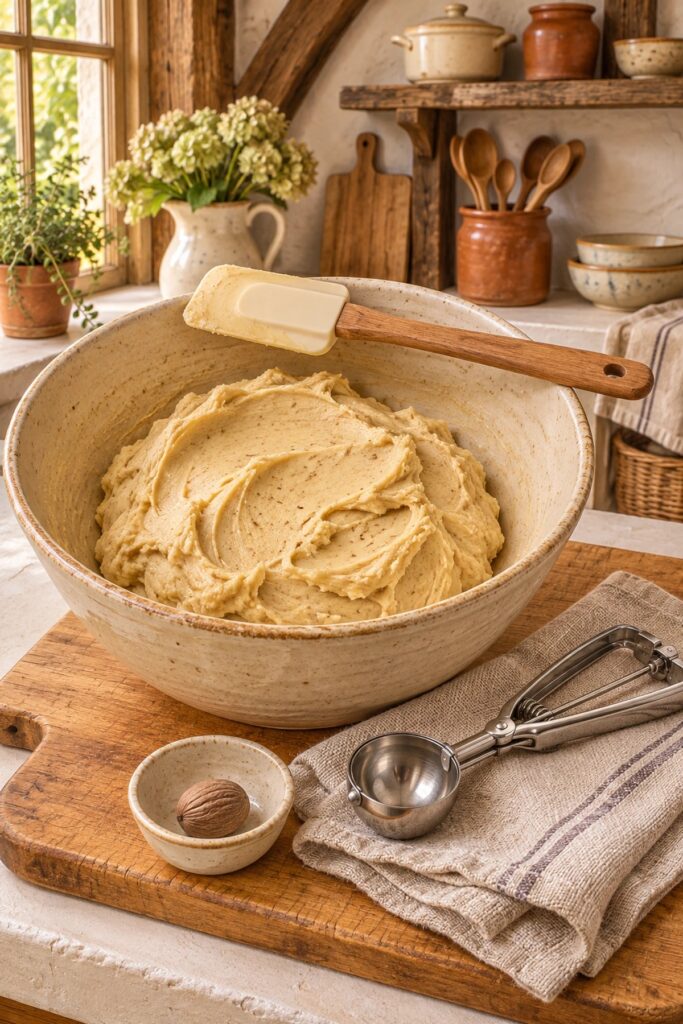
Step 5: Chill the Dough and Heat the Oven
Cover the bowl and refrigerate the dough for 30 minutes. Meanwhile, heat the oven to 350°F (175°C) with a rack in the center and line two baking sheets with parchment paper.
What you should see: A firmer dough that holds a clean edge when you dig in the scoop and barely sticks to your fingers.
Step 6: Scoop and Roll
Scoop the dough into 24 balls of about 33 g each, about 2 level tablespoons, and roll each one smooth between your palms. Place 12 on each sheet in staggered rows, about 2½ inches (6 cm) apart.
What you should see: Twelve round, smooth, pale cream balls, 1½ inches (4 cm) wide, evenly spaced on the parchment with none of them touching.

Step 7: Bake
Bake one sheet at a time for 10 to 12 minutes, starting to check at 10 minutes. Keep the second sheet in the refrigerator until its turn. Eggnog cookies are ready when the edges are set and the tops have lost their wet shine, even though the centers still feel soft.
What you should see: Puffed, round cookies about 2¾ inches (7 cm) wide, pale on top with a faint golden ring at the very bottom edge, and dry-looking, matte centers.
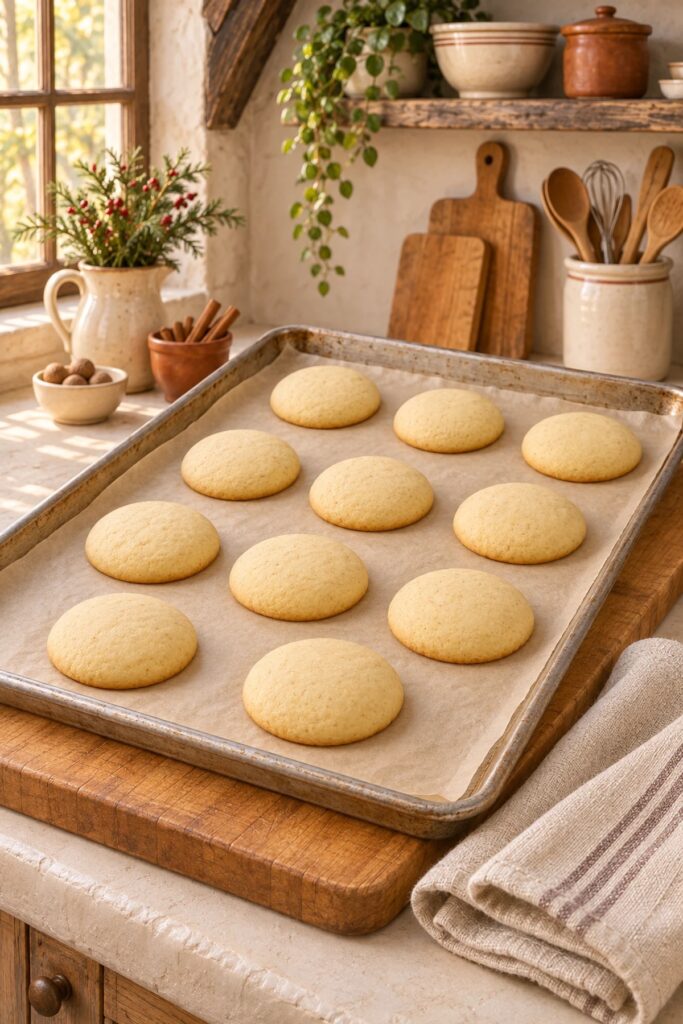
Step 8: Cool Completely
Let the eggnog cookies rest on the baking sheet for 5 minutes, then move them to a wire rack set over a sheet of parchment. Let them cool completely, about 20 minutes, before glazing.
What you should see: Slightly settled, soft cookies with smooth tops that feel cool, not warm, when you touch the center of one.
Step 9: Glaze and Dust with Nutmeg
Whisk the powdered sugar with 3 tablespoons of eggnog until smooth. If it’s too thick to flow, add more eggnog 1 teaspoon at a time.
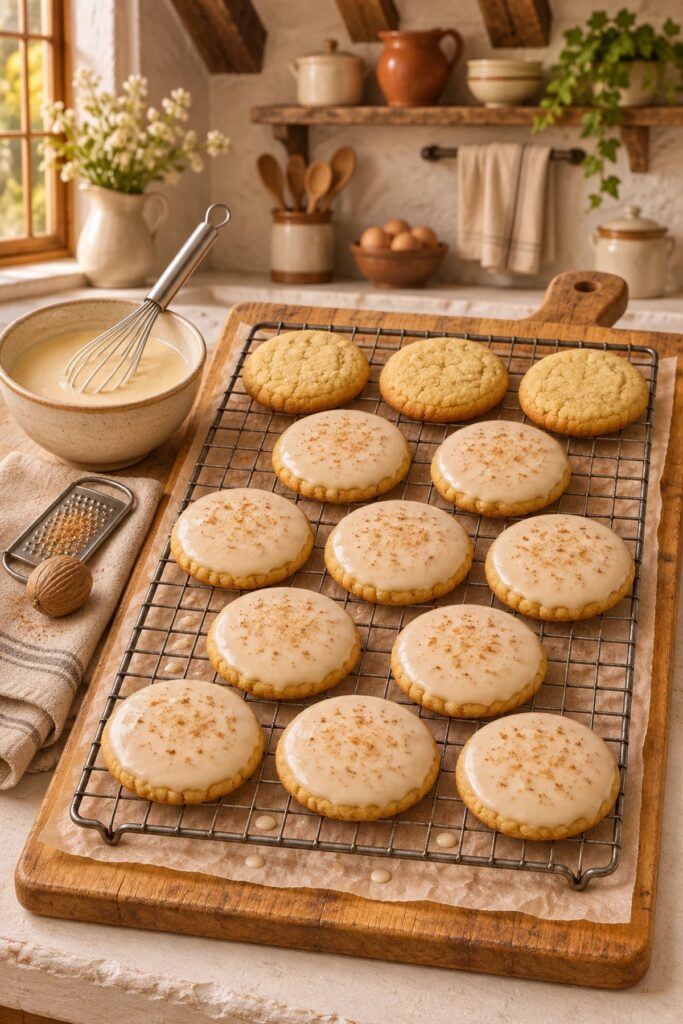
Dip the top of each cookie into the glaze, let the extra drip back into the bowl, and set it on the rack. Dust with freshly grated nutmeg while the glaze is still wet, then let it set for about 30 minutes.
What you should see: A thick but pourable, ivory glaze that falls from the whisk in a ribbon, then a smooth white coat on each cookie that leaves a thin golden rim showing and firms to a soft sheen.
How to Know They’re Done
Use these checkpoints from the mixing bowl to the cooling rack, so your eggnog cookies come out soft, round and neatly glazed.
| What to Check | Ready When |
|---|---|
| Creamed butter and sugar | Pale, fluffy and slightly increased in volume |
| Finished dough | Thick, smooth, no dry flour or eggnog streaks |
| Chilled dough | Firm enough to roll without sticking |
| Edges in the oven | Set, with a faint golden ring at the bottom |
| Tops | Puffed, pale and matte, no wet shine |
| Cooled cookies | Cool to the touch in the center |
| Glaze in the bowl | Thick, smooth and falls in a ribbon |
| Set glaze | Firm to a light touch, with a soft sheen |
If the centers still look wet and glossy at 12 minutes, give them 1 more minute. Eggnog cookies pulled too soon can sink in the middle as they cool, while cookies baked until the tops turn golden will be dry, so take the next sheet out a little earlier if that happens.
Tips for the Best Eggnog Cookies
Measure the eggnog, don’t guess. An extra splash makes the dough sticky and the cookies flat. Use a liquid measuring cup or weigh 85 g.
Keep the second sheet cold. Dough that sits in a warm kitchen while the first sheet bakes spreads more, so return it to the refrigerator between batches.
Use a scoop and a scale. Balls of the same weight bake in the same time, so every cookie on the sheet is ready at once and the glaze looks even.
Glaze only cold cookies. On warm eggnog cookies the glaze melts, turns see-through and slides off the sides. Wait until the centers feel cool.
Dust the nutmeg right away. Fresh nutmeg sticks only while the glaze is wet, so grate it over a few cookies at a time as you dip them.
Common Mistakes and How to Fix Them
These are the problems that most often get in the way of soft, neatly glazed eggnog cookies, each with a simple fix.
| Mistake | How to Fix It |
|---|---|
| Butter that is too warm The dough feels greasy and the cookies spread thin. | Use butter that holds a fingerprint but still feels cool, and chill the dough for the full 30 minutes. |
| Packing the flour The cookies stay tall, dry and dome-shaped. | Weigh 281 g, or spoon the flour into the cup and level it without pressing. |
| Overbaking The cookies turn golden on top and dry once cool. | Take them out as soon as the tops look matte and the edges are set, even if the centers feel soft. |
| Glazing warm cookies The glaze melts, soaks in and runs down the sides. | Let eggnog cookies cool completely, about 20 minutes, before you dip them. |
| Glaze that is too thin or too thick It turns see-through, or it sits in a heavy lump. | Add powdered sugar 1 tablespoon at a time to thicken it, or eggnog 1 teaspoon at a time to loosen it. |
Variations
The dough for eggnog cookies is easy to adapt. Keep the eggnog and the nutmeg, and try one of these.
Rum-Spiced Glaze
Add ¼ teaspoon (1 g) of rum extract to the glaze along with the eggnog. It gives the topping the warm flavor of a spiked holiday cup, with no rum in the bowl.
White Chocolate Chip
Fold ¾ cup (130 g) of white chocolate chips into the dough after the flour. Skip the glaze, or drizzle it thinly, since the chips add plenty of sweetness. You’ll get about 28 cookies.
Toasted Pecan
Fold ½ cup (55 g) of finely chopped toasted pecans into the dough. The nutty crunch goes well with the nutmeg, and the eggnog cookies look lovely with a thin drizzle of glaze instead of a full coat.
Nutmeg-Sugar Coated
Instead of glazing, roll each ball in 3 tablespoons (38 g) of granulated sugar mixed with ½ teaspoon (1 g) of nutmeg before baking. Rolled this way, eggnog cookies come out with a sparkly, spiced crust and are ready to eat as soon as they cool.
Mini Eggnog Cookies
Roll the dough into 15 g balls, about 1 tablespoon, and bake for 8 to 9 minutes. You’ll get about 52 bite-size cookies, ideal for a dessert table.
Serving Suggestions
A small glass of cold eggnog is the obvious partner, but eggnog cookies are just as good with hot coffee, black tea or a mug of homemade pumpkin spice latte on a cold afternoon.
On a holiday cookie tray, set them beside buttery shortbread cookies, spiced gingerbread cookies and jam-filled thumbprint cookies. Their pale, glazed tops look bright next to darker cookies like chocolate crinkle cookies. For more ideas, see my list of the best Christmas cookies.
For a gift, pack eggnog cookies in a single layer in a parchment-lined box, or in layers with a sheet of parchment between them once the glaze has fully set.
Storage
Once the glaze has set, store the eggnog cookies in an airtight container at room temperature for up to 3 days, with parchment between the layers. In the refrigerator, they keep for up to 5 days; let them sit out for 15 minutes before serving so they soften again.
The unbaked dough for eggnog cookies keeps, tightly covered, in the refrigerator for up to 2 days. If it’s very firm, let it sit on the counter for 10 to 15 minutes before scooping.
Plan for the leftover carton, too: store-bought eggnog keeps only 3 to 5 days in the refrigerator, so buy it close to baking day and use the rest for the glaze, a holiday breakfast or a glass alongside the cookies.
Freezing
Baked cookies: Freeze eggnog cookies unglazed. Cool them completely, then freeze them in a single layer, with parchment between the layers, in a freezer container for up to 3 months. Thaw them in the closed container at room temperature, then glaze and dust with nutmeg.
Dough balls: Scoop and roll the dough, freeze the balls on a lined baking sheet for about 1 hour until firm, then move them to a labeled freezer bag for up to 3 months. Bake straight from the freezer at 350°F (175°C), adding 1 to 2 minutes to the bake time.
Frequently Asked Questions
Can I really taste the eggnog in eggnog cookies?
In the cookie itself, the eggnog adds richness more than a strong flavor, since baking softens it. The eggnog glaze, the nutmeg and the optional rum extract are what make each bite taste clearly of eggnog, so don’t skip the glaze if that flavor is what you’re after.
Can I use homemade eggnog?
Yes, as long as it’s made with a cooked egg base. Homemade eggnog is often thinner than store-bought, so you may need a little less in the glaze. Use it within a few days of making it.
Can I use light or dairy-free eggnog?
Light eggnog works well in both the dough and the glaze. Plant-based nogs vary a lot in thickness and sweetness, so add the glaze liquid slowly and stop as soon as it falls from the whisk in a ribbon.
Why use only egg yolks?
Yolks add richness and keep eggnog cookies soft and tender without making them puffy. The eggnog already brings plenty of moisture, so the whites would only make the cookies more cake-like.
Is there rum in eggnog cookies?
No. They’re made with nonalcoholic store-bought eggnog, and the rum note comes only from the optional rum extract, a flavoring measured by the half teaspoon. Leave it out if you prefer and add ½ teaspoon of extra vanilla instead.
Why did my glaze soak into the cookies?
The cookies were still warm, or the glaze was too thin. Wait until the cookies feel cool in the center, and thicken the glaze with a spoonful of powdered sugar until it falls in a thick ribbon.
Can I double the recipe?
Yes. Double every ingredient and use a large mixing bowl so the butter and sugar have room to cream. Chill the dough in two containers and bake one sheet at a time, keeping the rest of the dough cold.
Final Thoughts
A short chill, a light hand with the eggnog in the dough and a generous coat of glaze are what make these cookies soft, round and full of holiday flavor. Once the dough is mixed, the rest is mostly waiting for the oven and the glaze.
Keep a bag of dough balls in the freezer and you can bake a fresh sheet of eggnog cookies whenever guests stop by in December. Leave them classic, add white chocolate or pecans, or roll them in nutmeg sugar for a faster finish.
Did your glaze set into a smooth ivory coat, and did you stir a little rum extract into it or keep it plain? Share how your batch turned out in the comments, along with the drink you poured to go with it.
If you try this recipe, please leave a star rating along with your comment below. It takes a few seconds and helps other readers find the recipe.

Eggnog Cookies
These eggnog cookies are soft, pale golden butter cookies warmed with nutmeg, with real eggnog in both the dough and the glaze. A short 30-minute chill keeps them thick and tender, and a pourable eggnog glaze sets with a soft sheen under a dusting of freshly grated nutmeg. Baked at 350°F for about 11 minutes per sheet, this batch makes 24 eggnog cookies for cookie trays, gift boxes and cookie exchanges.
Ingredients
For the Cookies
- ¾ cup (170 g) unsalted butter, at room temperature
- 1 cup (200 g) granulated sugar
- 2 large egg yolks (36 g), at room temperature
- 2 teaspoons (8 g) pure vanilla extract
- ½ teaspoon (2 g) rum extract, optional
- ⅓ cup (85 g) eggnog, at room temperature
- 2¼ cups (281 g) all-purpose flour
- 1½ teaspoons (6 g) baking powder
- ½ teaspoon (3 g) fine sea salt
- 1 teaspoon (2 g) ground nutmeg
- ¼ teaspoon (1 g) ground cinnamon
For the Eggnog Glaze
- 1½ cups (180 g) powdered sugar
- 3 tablespoons (48 g) eggnog, plus 1 to 2 teaspoons more if needed
- ¼ teaspoon (0.5 g) freshly grated nutmeg, for dusting
Instructions
- Whisk 2¼ cups (281 g) flour, 1½ teaspoons (6 g) baking powder, ½ teaspoon (3 g) salt, 1 teaspoon (2 g) nutmeg and ¼ teaspoon (1 g) cinnamon in a medium bowl.
- In a large bowl, beat ¾ cup (170 g) softened butter and 1 cup (200 g) sugar on medium speed for about 3 minutes, until light and fluffy.
- Beat in the 2 egg yolks one at a time, then the 2 teaspoons (8 g) vanilla and the rum extract, if using. On low speed, beat in ⅓ cup (85 g) room-temperature eggnog.
- Add the flour mixture in two parts and mix on low just until no dry flour remains.
- Cover and refrigerate the dough for 30 minutes. Meanwhile, heat the oven to 350°F (175°C) and line two baking sheets with parchment.
- Scoop the dough into 24 balls of about 33 g (2 tablespoons) and roll smooth. Place 12 on each sheet, about 2½ inches (6 cm) apart.
- Bake one sheet at a time for 10 to 12 minutes, until the edges are set and the tops look matte but the centers are still soft.
- Cool on the sheet for 5 minutes, then move to a wire rack and cool completely, about 20 minutes.
- Whisk 1½ cups (180 g) powdered sugar with 3 tablespoons (48 g) eggnog, adding more eggnog 1 teaspoon at a time if needed. Dip the top of each cookie, dust with grated nutmeg and let set for about 30 minutes.
Notes
- Eggnog: Use store-bought eggnog at room temperature. Measure it carefully: extra eggnog makes the dough sticky and the cookies spread. Homemade eggnog should be made with a cooked egg base.
- Butter: Use butter that holds a fingerprint but still feels cool. Warm, greasy butter makes flat cookies.
- Flour: Weigh the flour, or spoon it into the cup and level it. Too much flour makes the cookies dry and dome-shaped.
- Rum extract: It is optional. Leave it out and add ½ teaspoon more vanilla if you prefer.
- Doneness: Take the cookies out when the tops look matte and the edges are set; the centers firm up as they cool.
- Glaze: Glaze only completely cooled cookies, and adjust the glaze with powdered sugar or eggnog until it falls in a thick ribbon.
- Make ahead: Refrigerate the covered dough for up to 2 days. Freeze dough balls for up to 3 months and bake from frozen, adding 1 to 2 minutes.
- Storage: Store glazed cookies airtight at room temperature for up to 3 days or in the refrigerator for up to 5 days. Freeze unglazed baked cookies for up to 3 months and glaze after thawing.
- Nutrition: Values are per cookie (1 of 24), without the optional rum extract, and include an estimated 150 g of powdered sugar and 40 g of eggnog from the glaze that clings to the cookies, plus the nutmeg on top.
Nutrition Information:
Yield: 24 Serving Size: 1 cookieAmount Per Serving: Calories: 161Total Fat: 7gSaturated Fat: 4gCholesterol: 35mgSodium: 80mgCarbohydrates: 24gFiber: 0gSugar: 15gProtein: 2g