Palmiers
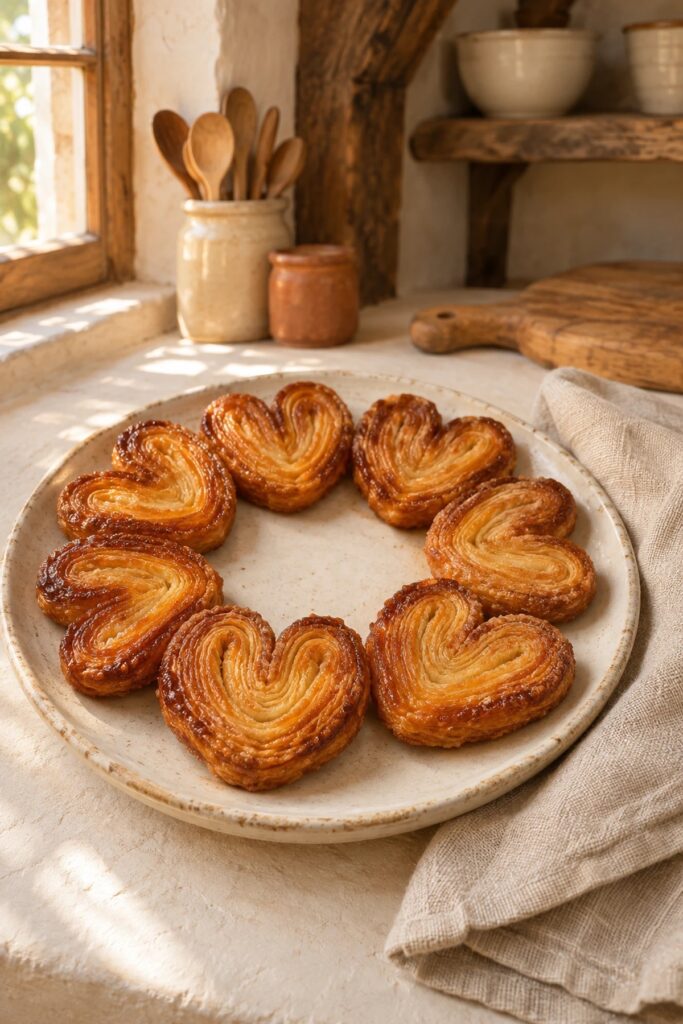
Palmiers are crisp, golden French cookies made from just puff pastry, sugar and a pinch of salt, folded into a log, sliced, and baked until the sugar turns into a shiny, deeply caramelized crust.
The magic is in the layers. Every bite of these palmiers starts with a crackle of caramel and ends with buttery, shatteringly thin pastry, and the whole recipe takes about 20 minutes of hands-on work because store-bought puff pastry has already done the hardest part for you.
The shape is the fun part. Palmier is the French word for palm tree, and folding the pastry toward the center twice gives each slice the classic palm-leaf (or little heart) outline. The key is cold dough, a generous coating of sugar, and a quick flip halfway through baking so both sides caramelize evenly.
They’re perfect for a holiday cookie tray, an afternoon coffee break, or any time you want something elegant for guests without turning on the mixer. Once you see how easy palmiers are, you’ll want to keep a box of puff pastry in the freezer.
Why You’ll Love These Palmiers
Only three ingredients. Puff pastry, sugar and a pinch of salt are all it takes to make palmiers, and most kitchens already have two of the three.
Crisp, never soggy. The sugar caramelizes against the hot pan and forms a glassy crust, so these palmiers snap when you bite into them and stay crisp for days when stored properly.
No dough to make from scratch. Frozen puff pastry gives you flaky layers without hours of folding butter into dough, which means palmiers fit into a busy afternoon.
Easy to change. Cinnamon, cardamom, orange zest, a dip in chocolate, or even a savory Parmesan version all work with the exact same method.

Perfect For
Palmiers work almost anywhere. They look polished on a holiday cookie tray next to thumbprint cookies and linzer cookies, yet they take far less effort than either one.
They also suit a brunch table, a baby shower, a tea party, or a gift box, because one batch makes about 40 palmiers and they hold their crunch for days. Their delicate sweetness is a natural partner for a cup of coffee, a latte, or hot chocolate.
If you need a light, not-too-heavy sweet after a big dinner, palmiers are the answer: a single cookie is just enough, and nobody has to cut a slice of anything.

Palmiers at a Glance
| Flavor | Buttery, caramelized sugar with a hint of salt |
| Texture | Crisp, flaky and shatteringly light |
| Difficulty | Easy |
| Prep Time | 20 minutes |
| Chill Time | 30 minutes |
| Bake Time | 40 minutes (two rounds) |
| Total Time | 1 hour 30 minutes |
| Servings | About 40 palmiers |
| Method | Baking |
| Cuisine | French |
| Best For | Cookie trays, coffee breaks, holiday gifting |
Before You Start
Thaw the puff pastry in the refrigerator overnight, or leave the folded sheets on the counter for 30 to 40 minutes. You want pastry that is cold but flexible: it should bend without cracking and should never feel warm or sticky.
Plan to bake the palmiers in two rounds. Two baking sheets fit about 10 palmiers each with room to spread, so the second half of the slices waits in the refrigerator while the first round bakes.
Line both baking sheets with parchment paper, and keep a thin metal spatula nearby for flipping. Use plain granulated sugar for the cleanest, crispest caramel.
Read through the folding steps once before you start. After that, the rest of the recipe moves quickly, and the cold dough is what makes all the difference.
What Makes These Palmiers Work
Cold Dough Means Flaky Layers
Puff pastry gets its lift from thin layers of butter between thin layers of dough. In a hot oven, the water in the butter turns to steam and pushes the layers apart. If the butter softens before baking, the layers blend together and palmiers bake up flat and greasy, so chilling the logs matters.
Sugar Does Two Jobs
Sugar rolled into the dough sweetens every layer, while the sugar on the cut sides melts in the oven and caramelizes into a crisp, glassy crust. Pressing the sugar in with a rolling pin helps it stick, so it doesn’t fall off when you fold.
The Flip Gives Even Caramel
Halfway through baking, the underside of each cookie is deeply golden while the top is still pale. Flipping the palmiers lets the second side caramelize, and it keeps the first side from burning against the pan.

Ingredient Notes and Substitutions
Puff pastry: One 17.3-ounce (490 g) package contains two sheets, and that is exactly what this recipe uses. All-butter puff pastry gives the richest flavor if you can find it, but a standard frozen puff pastry works well too. Homemade puff pastry works as well, as long as you use about the same weight and keep it cold.
Sugar: Granulated sugar is evenly fine and caramelizes quickly, which is what you want here. The recipe uses ¾ cup (150 g) for rolling and ¼ cup (50 g) for dipping, so each palmier gets sugar both inside and outside.
Salt: A tiny pinch of fine salt sharpens the sweetness and brings out the buttery flavor of the pastry. Don’t skip it, but don’t add more either.
Spices and flavor: Classic French palmiers are made with sugar alone, so that is how this recipe is written. If you like a spiced version, stir 1½ teaspoons (4 g) of ground cinnamon into the rolling sugar, or see the variations below.
Dairy-free: Some brands of puff pastry are made with vegetable oil instead of butter, so check the label if you need a dairy-free version of these palmiers.
Ingredients for Palmiers
For the Palmiers
- 1 package (17.3 ounces / 490 g) frozen puff pastry (2 sheets), thawed and cold
- ¾ cup (150 g) granulated sugar, divided for rolling and sprinkling
- ⅛ teaspoon (about 1 g) fine salt
For Dipping the Slices
- ¼ cup (50 g) granulated sugar

Kitchen Equipment Needed
• Two rimmed baking sheets – for baking the palmiers in two rounds
• Parchment paper – to prevent sticking and make cleanup easy
• Rolling pin – for rolling the pastry and pressing in the sugar
• Sharp chef’s or serrated knife – for clean, even slices
• Thin metal spatula – for flipping the palmiers
• Wire cooling rack – so the bottoms stay crisp
• Plastic wrap – for chilling the logs
How to Make Palmiers
Step 1: Thaw the Puff Pastry and Heat the Oven
Move the frozen puff pastry to the refrigerator the night before, or leave the folded sheets on the counter for 30 to 40 minutes. Place the oven racks in the upper and lower thirds, heat the oven to 400°F (205°C), and line two baking sheets with parchment.
What you should see: pastry that feels cool and flexible, and bends into a gentle curve without cracking or sticking to your fingers.
Step 2: Sugar the Surface and Roll Out the Pastry
Sprinkle 2 tablespoons (25 g) of sugar and a small pinch of the salt over a clean work surface. Unfold one sheet of puff pastry on top, then sprinkle another 4 tablespoons (50 g) of sugar over the pastry. Roll it into a rectangle about 9 by 12 inches (23 by 30 cm), pressing the sugar into the dough, and flip it once so both sides pick up sugar. Repeat with the second sheet.
What you should see: a smooth rectangle with the sugar pressed into the surface and no bare patches.
Step 3: Fold the Pastry Into a Log
With a long side facing you, fold the two long edges toward the center so they almost meet in the middle. Fold each edge in again so the folded edges meet, then fold one half over the other like closing a book. Press gently to seal the log.
What you should see: a tidy log about 12 inches (30 cm) long with several visible layers at each end and no loose flaps.

Step 4: Chill the Logs
Wrap each log in plastic wrap and refrigerate for at least 30 minutes, or up to 24 hours. Chilling firms the butter so the layers stay separate and the slices cut cleanly.
What you should see: firm logs that hold their shape when you press them lightly, with no soft or sticky spots.
Step 5: Slice and Dip in Sugar
Unwrap one log, trim the uneven ends, and slice it into ½-inch (1.25 cm) pieces with a sharp knife. Press both cut sides of each slice into the ¼ cup (50 g) of reserved sugar. Place the slices cut side up on a lined baking sheet, about 2 inches (5 cm) apart and about 10 per pan, and keep the rest of the slices and the second log in the refrigerator.
What you should see: slices with clear layers showing on top, sugar clinging to both cut faces, and plenty of space between them.

Step 6: Bake and Flip
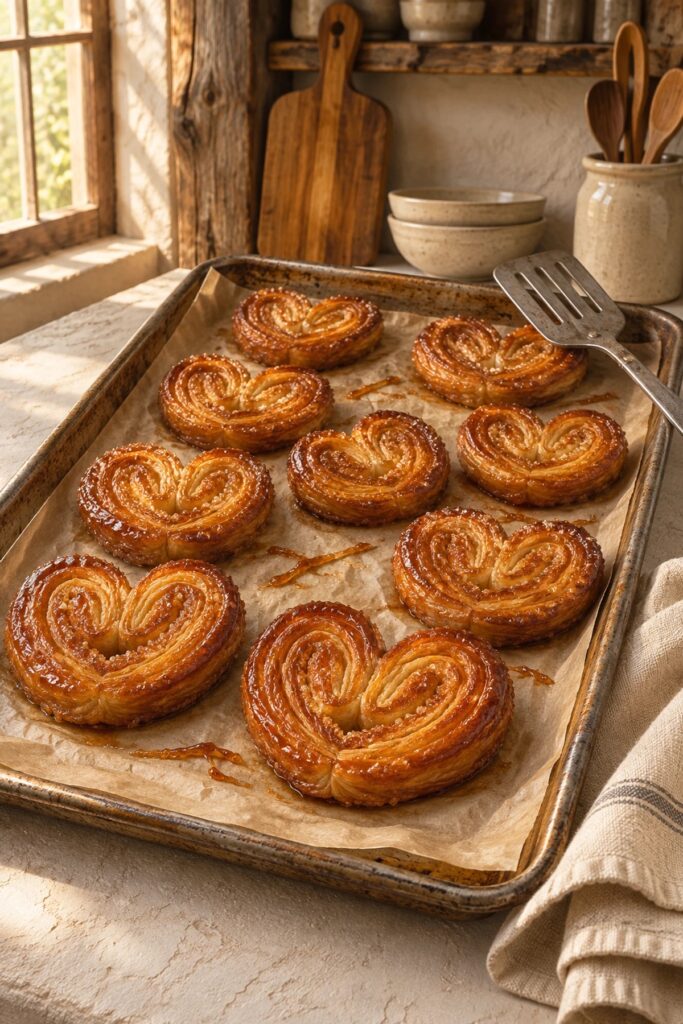
Bake the first round for 12 minutes, until the undersides are deep golden and the sugar is bubbling. Take the pans out, flip each palmier with a thin metal spatula, and bake for 3 to 6 minutes more, until both sides are deep golden brown. Switch the pans between racks when you flip, and watch closely at the end, since sugar goes from amber to burnt very quickly.
What you should see: puffed, deeply golden palmiers with a glossy amber sugar crust and clearly separated layers. The sugar around the edges should look dark amber, not black.
Step 7: Cool on a Rack
Move the palmiers to a wire rack right away with the spatula, because the caramel hardens fast and will stick to the parchment if they sit. Let them cool for about 10 minutes, then repeat with the second round of slices.
What you should see: palmiers that feel soft when hot and turn crisp as they cool, with a hard, glassy caramel shine.
How to Know It’s Done
| What to Check | Ready When |
|---|---|
| Color | Deep golden brown on both sides, with dark amber caramelized edges |
| Sugar | Bubbling and glossy at the flip, hard and glassy once cooled |
| Layers | Puffed, with visible separated layers and no pale, raw-looking streaks in the center |
| Texture | Crisp snap after 10 minutes of cooling |
If a palmier bends instead of snapping once it has cooled, it needs another minute or two in the oven. Return it to the pan and check again, since palmiers crisp up quickly once the sugar reaches the right color.
Tips for the Best Palmiers
Keep the dough cold. If the pastry softens while you roll or fold, slide it onto a tray and refrigerate it for 10 minutes. Cold butter is what keeps the layers flaky.
Be generous with sugar. Sugar that sits loosely on top falls off when you fold, which leaves pale spots. Pressing it in with the rolling pin keeps it where you want it.
Slice with a sharp knife. Use a gentle sawing motion so the layers don’t get squashed. A dull knife seals the edges and keeps the palmiers from puffing.
Leave room to spread. Palmiers expand in the oven, so keep them about 2 inches apart. Crowded slices bake into each other and lose their shape.
Watch the second side. Ovens vary, and the sugar can go from caramel to burnt in about a minute. Pull the pans as soon as the palmiers are a deep golden amber.
Common Mistakes and How to Fix Them
| Mistake | How to Fix It |
|---|---|
| Dough too warm The butter melts and the palmiers bake flat and greasy | Chill the logs for 30 minutes, and chill the cut slices for 10 minutes more if they feel soft |
| Too little sugar The palmiers come out pale and less crunchy | Press the sugar into the dough with a rolling pin, and dip both cut sides of every slice |
| Skipping the flip The bottoms darken too much while the tops stay pale | Flip each palmier at the 12-minute mark with a thin metal spatula |
| Slices too thick The centers stay doughy and soft | Cut slices ½ inch (1.25 cm) thick, or slightly thinner |
| Cooling on the pan The caramel hardens and the palmiers stick or break | Move them to a wire rack immediately after baking |
| Overbaking The sugar burns and tastes bitter | Pull the pans when the palmiers are deep golden amber, not dark brown |
Palmiers Variations
Cinnamon Sugar Palmiers
Stir 1½ teaspoons (4 g) of ground cinnamon into the ¾ cup (150 g) of rolling sugar, and use plain sugar for dipping. These palmiers taste like the best part of a cinnamon roll, with a crisp edge.
Cardamom and Orange Palmiers
Rub the zest of 1 small orange (about 1 tablespoon / 6 g) and ½ teaspoon (1 g) of ground cardamom into the rolling sugar with your fingertips. The result is fragrant, a little floral, and lovely with tea.
Chocolate-Dipped Palmiers
Melt 3 ounces (85 g) of semi-sweet chocolate and dip one end of each cooled palmier. Set them on parchment for about 20 minutes, until the chocolate is firm.
Savory Parmesan Palmiers
Replace the sugar with ¾ cup (75 g) of finely grated Parmesan and ½ teaspoon (1 g) of black pepper for rolling, and use ¼ cup (25 g) more Parmesan for dipping. If you love puff pastry appetizers, these savory palmiers are a great partner for cranberry brie bites on a party table.
Serving Suggestions
Serve palmiers with coffee, tea or hot chocolate. Their caramelized flavor is especially good beside a creamy tiramisu latte, and the crisp texture is a nice contrast to something smooth.
For a French-inspired brunch, set a plate of palmiers next to a stack of crêpes and some fresh fruit. Another French favorite that goes beautifully on the same table is madeleines.
On a holiday tray, palmiers pair well with meringue cookies and other crisp cookies. If you’re planning a full spread, our roundup of the best Christmas cookies has plenty more ideas.
Storage
Let the palmiers cool completely, then store them in an airtight container at room temperature. They’re best within 3 days, and still good for up to 5 days, though they gradually lose some of their snap.
Keep them separate from soft cookies. King Arthur Baking’s guide to cookie storage explains that crisp cookies absorb moisture from chewy ones and lose their crunch, so give palmiers their own container. I wouldn’t refrigerate baked palmiers, since the humidity softens the caramel.
To bring back the crunch, warm them on a rack in a 325°F (165°C) oven for about 5 minutes, then let them cool.
Freezing
Palmiers freeze very well before baking. Slice the logs, freeze the slices on a parchment-lined tray until firm, then move them to a freezer bag for up to 3 months. Bake them straight from the freezer at 400°F (205°C), adding a few extra minutes to each side.
Baked palmiers can also be frozen in an airtight container with parchment between the layers. Thaw them at room temperature for 30 minutes, then re-crisp them in the oven for a few minutes.
Frequently Asked Questions
What does palmiers mean?
Palmier is the French word for palm tree, and palmiers are named for the folded shape that looks like a palm leaf. In the United States, they’re also called elephant ears or palm leaf cookies.
How many palmiers does one package of puff pastry make?
One 17.3-ounce (490 g) package with two sheets makes about 40 palmiers when sliced ½ inch (1.25 cm) thick. You’ll get a few more if you cut the slices slightly thinner.
Can I make palmiers ahead of time?
Yes. The wrapped logs keep in the refrigerator for up to 24 hours, and the sliced, unbaked palmiers keep in the freezer for up to 3 months. Baked palmiers are best within 3 days.
Why did my palmiers come out flat and greasy?
The dough was probably too warm. When the butter softens before baking, the layers fuse instead of puffing. Chill the logs until firm, and refrigerate the slices for 10 minutes if they feel soft.
Why aren’t my palmiers crisp?
They were likely underbaked, cooled on the pan, or stored while still warm. Bake until both sides are deep golden, cool the palmiers on a wire rack, and store them only after they reach room temperature.
Can I use homemade puff pastry for palmiers?
Yes. Use about 1 pound (450 to 490 g) of homemade puff pastry, roll it to roughly the same size, and keep it very cold while you work.
How do I keep the sugar from burning on palmiers?
Bake at 400°F (205°C), leave space between slices, and flip them at the 12-minute mark. Pull them as soon as they’re deep golden amber, because sugar darkens fast in the last minute or two.
Final Thoughts
Palmiers prove that three simple ingredients can taste like a French bakery treat: crisp edges, buttery layers and a shiny caramel crust. They look impressive, yet the whole recipe is just rolling, folding, slicing and baking.
Once you know the fold, palmiers become the cookie you reach for when guests are coming, when the cookie tray needs one more flavor, or when you simply want something crisp with your coffee. The variations make it easy to bake a different batch each time.
Which version of these palmiers will you bake first: classic, cinnamon, chocolate-dipped or Parmesan? Leave a comment and tell me how many made it to the table.
If you try this recipe, please leave a star rating along with your comment below. It takes a few seconds and helps other readers find the recipe.

Palmiers
These palmiers are crisp, caramelized French cookies made from just three ingredients: puff pastry, sugar and a pinch of salt. With flaky, buttery layers and a shiny sugar crust, they’re the perfect balance of crunchy and tender. Easy to fold, slice and bake in about 90 minutes, these palmiers are a must-have for holiday cookie trays, coffee breaks, or anytime you crave something sweet and crisp.
Ingredients
For the Palmiers
- 1 package (17.3 ounces / 490 g) frozen puff pastry (2 sheets), thawed and cold
- ¾ cup (150 g) granulated sugar, divided for rolling and sprinkling
- ⅛ teaspoon (about 1 g) fine salt
For Dipping the Slices
- ¼ cup (50 g) granulated sugar
Instructions
- Thaw the puff pastry in the refrigerator overnight or on the counter for 30 to 40 minutes, until cold but flexible. Heat the oven to 400°F (205°C) with racks in the upper and lower thirds, and line two baking sheets with parchment.
- Sprinkle 2 tablespoons (25 g) of sugar and a small pinch of salt on a clean work surface. Unfold one sheet of pastry on top and sprinkle with 4 tablespoons (50 g) of sugar. Roll to about 9 by 12 inches (23 by 30 cm), pressing the sugar in and flipping once. Repeat with the second sheet.
- With a long side facing you, fold the two long edges to the center, fold them to the center again, then fold one half over the other like a book.
- Wrap each log and chill at least 30 minutes, or up to 24 hours.
- Trim the ends and slice each log ½ inch (1.25 cm) thick. Press both cut sides in the reserved ¼ cup (50 g) of sugar and place cut side up, 2 inches (5 cm) apart, about 10 per pan.
- Bake 12 minutes, flip each palmier with a thin metal spatula, and bake 3 to 6 minutes more until deep golden brown.
- Transfer to a wire rack right away and cool 10 minutes. Repeat with the remaining slices.
Notes
- Keep the dough cold. Chill the logs until firm, and chill the slices for 10 minutes if they soften.
- Yield and pans. One package makes about 40 palmiers. Bake about 10 per pan, 2 inches apart, in two rounds.
- Make ahead. Wrapped logs keep 24 hours in the refrigerator. Sliced, unbaked palmiers freeze up to 3 months and bake from frozen with a few extra minutes.
- Storage. Store cooled palmiers airtight at room temperature, best within 3 days and up to 5 days. Re-crisp in a 325°F (165°C) oven for about 5 minutes.
- Nutrition note: Values are for one palmier (1 of 40), assuming about 180 g of the sugar ends up on the cookies, and vary by puff pastry brand.
Nutrition Information:
Yield: 40 Serving Size: 1 palmierAmount Per Serving: Calories: 66Total Fat: 3gSaturated Fat: 2gCholesterol: 0mgSodium: 49mgCarbohydrates: 9gFiber: 0gSugar: 5gProtein: 1g