Crepe Recipe
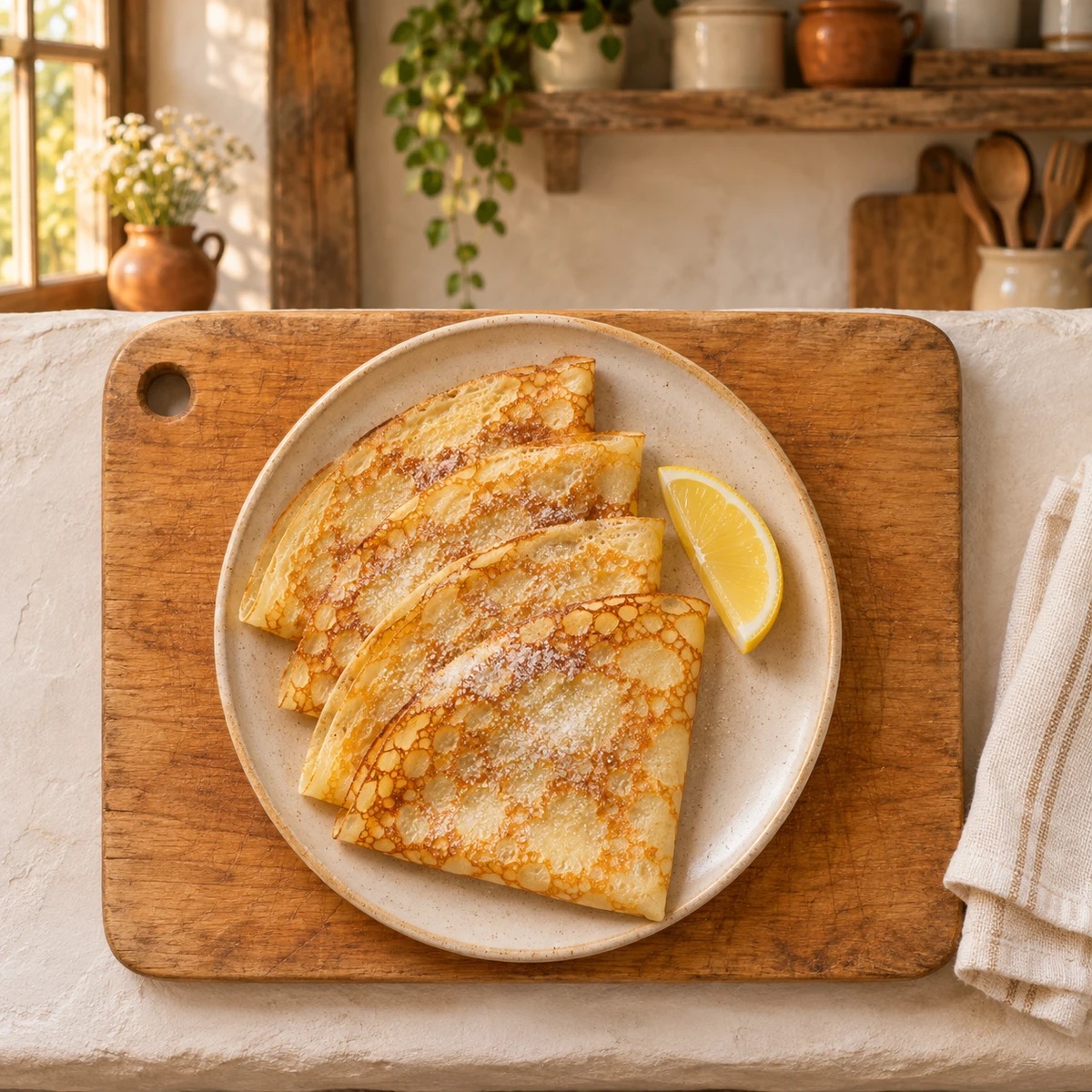
This crepe recipe makes thin, tender, lightly buttery crepes with golden, lacy edges, and the batter comes together in a blender in about 30 seconds.
Crepes are the elegant, paper-thin cousin of pancakes. They are soft enough to fold around almost anything, which is why one simple batter can become a dessert with lemon and sugar in the morning and a savory ham and cheese lunch later in the day.
The secret is not a special pan or a fancy technique. It is a thin batter, a short rest and a hot, lightly buttered skillet, and this crepe recipe walks you through each one so the first crepe is already pretty good and the rest are better.
You need only flour, eggs, milk, salt and butter, and you get about 8 crepes from 5 minutes of prep, 15 minutes of resting and about 20 minutes at the stove. That makes this crepe recipe an easy choice for weekend brunch, a holiday breakfast or a fast dinner, and you can make the batter the night before.

Why You’ll Love This Crepe Recipe
It is simple. This crepe recipe uses five ingredients you probably already have, plus a blender and one pan. There is no sifting, no whisking out lumps and no special crepe flour.
It is versatile. The batter in this crepe recipe is neutral, so the same crepes work with lemon and sugar, fresh berries and whipped cream, chocolate spread, or ham, cheese and mushrooms.
It is quick. This crepe recipe takes a minute for the batter, 15 minutes of rest and about 90 seconds per crepe, so the whole batch is done in 40 minutes.
It is make-ahead friendly. The batter for this crepe recipe keeps in the refrigerator overnight, and the cooked crepes freeze well, so a weekday breakfast can be as easy as warming a few in a dry skillet.

Perfect For
This crepe recipe feels special without asking much from you, so it suits slow weekend brunches, birthday breakfasts, Mother’s Day tables and holiday mornings when you want something nicer than toast. A platter of warm crepes with a few toppings in bowls turns breakfast into a small celebration.
A simple crepe recipe is just as useful on busy evenings. Fill a few crepes with ham and cheese, and you have a quick dinner, or roll up a sweet one with jam for dessert. If you love a French-inspired spread, serve them next to my madeleines and palmiers for an easy coffee-and-pastry table.

Crepe Recipe at a Glance
| Flavor | Lightly buttery and mildly sweet, a neutral canvas for any filling |
| Texture | Thin, soft and pliable, with delicate golden, lacy edges |
| Difficulty | Easy |
| Prep Time | 5 minutes |
| Resting Time | 15 minutes |
| Cook Time | 20 minutes |
| Total Time | 40 minutes |
| Servings | 8 crepes (8-inch) |
| Method | Stovetop, in a nonstick skillet |
| Cuisine | French-inspired |
| Best For | Brunch, dessert and quick lunches or dinners |
Before You Start
Melt the butter first. Melt 3 tablespoons of butter in a small bowl or saucepan. Two go into the batter and one is for the pan, and it needs a minute to cool slightly so it does not cook the eggs.
Use room-temperature ingredients if you can. Cold milk and eggs make the butter clump in the batter. Take the eggs and milk out 15 to 20 minutes ahead, or warm the milk for 20 seconds in the microwave.
Plan the rest. This crepe recipe needs 15 minutes on the counter, so melt the butter, blend the batter and then set out your fillings while you wait.
Pick the right pan. An 8-inch nonstick skillet gives you about 8 crepes from this batter. A 10-inch pan works too, but each crepe needs a little more batter and you will get about 6.
What Makes This Crepe Recipe Work
A Thin Batter
Every good crepe recipe starts with a batter that is closer to heavy cream than pancake batter. With 1 cup of flour and 1¼ cups of milk, plus two eggs, it flows quickly across the pan, which is how you get a crepe thin enough to fold without cracking.
A Short Rest
Resting is the step that separates a great crepe recipe from a so-so one. It gives the flour time to absorb the liquid and the gluten time to relax. That makes the crepes tender instead of rubbery, and it lets the tiny air bubbles from blending settle, so the surface cooks smooth.
Butter in the Batter and in the Pan
Melted butter in the batter keeps the crepes soft and flexible and adds a gentle, toasty flavor. A little more in the pan helps the crepe brown evenly and release without sticking.
Medium Heat
If the pan is too hot, the batter sets before you can spread it. If it is too cool, the crepe turns pale and tough. Medium heat gives you about 1 minute for the first side and 30 seconds for the second, which is just enough time to swirl and flip.

Ingredient Notes and Substitutions
A crepe recipe with only five ingredients depends on each one. Here is what to use and which swaps work.
All-purpose flour. Plain all-purpose flour is all this crepe recipe needs, and there is no need for a special crepe flour. Spoon it into the cup and level it, or weigh 125 g, because too much flour makes the crepes thick and chewy. For whole wheat crepes, swap half of the flour and let the batter rest for 30 minutes.
Eggs. Use 2 large eggs. They give the crepes structure so they hold together when you flip and fold. Store them on a refrigerator shelf rather than in the door, then let them sit on the counter for 15 minutes before you blend so they mix smoothly into the batter.
Milk. Whole milk makes the richest crepes, but any milk works, including 2 percent and plain unsweetened non-dairy milk. A thinner milk may need a few extra minutes of resting.
Butter. Unsalted butter lets you control the salt, and ¼ teaspoon of fine salt in the batter is enough to season the crepes without making them taste salty. If you only have salted butter, use it and cut the salt in half. If you like homemade butter, my homemade butter is wonderful in the pan.
Sugar and vanilla. The base crepes are neutral, so you can fill them either way. For sweet crepes, add 1 tablespoon (12 g) of granulated sugar and 1 teaspoon of vanilla extract to the blender.
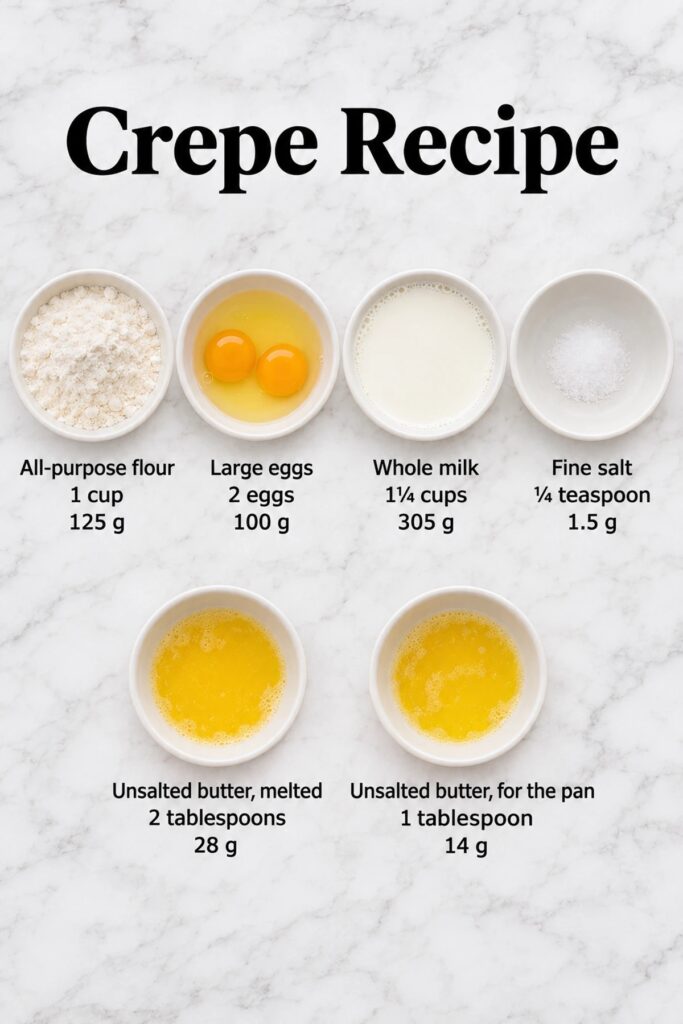
Ingredients for Crepes
This crepe recipe makes about 8 crepes in an 8-inch pan, so these amounts are enough for 4 servings of two crepes each.
- 1 cup (125 g) all-purpose flour
- 2 large eggs (100 g, without shells)
- 1¼ cups (305 g) whole milk
- ¼ teaspoon (1.5 g) fine salt
- 2 tablespoons (28 g) unsalted butter, melted
- 1 tablespoon (14 g) unsalted butter, for the pan
Kitchen Equipment Needed
• Blender – makes a smooth, lump-free batter in 30 seconds
• 8-inch nonstick skillet or crepe pan – cooks thin crepes without sticking
• ¼-cup measuring cup or small ladle – portions the batter evenly
• Thin silicone or metal spatula – slides under the delicate crepe for flipping
• Small saucepan or microwave-safe bowl – melts the butter
• Large plate – holds the finished crepes
• Kitchen scale – weighs the flour and milk
How to Make Crepes
Here is how to make this crepe recipe from the first blend to the last fold. Each step ends with what you should see, so you can check your progress as you go.
Step 1: Melt the Butter
Melt 3 tablespoons of unsalted butter in a small saucepan over low heat or in the microwave in 15-second bursts. Set 2 tablespoons (28 g) aside for the batter and keep 1 tablespoon (14 g) in the bowl for the pan.
What you should see: Clear, pale yellow melted butter, warm but not hot, with no browned bits.
Step 2: Blend the Batter
Add the flour, eggs, milk, salt and 2 tablespoons of melted butter to the blender. Blend on high speed for 30 seconds, then scrape down the sides and blend for 5 seconds more.
What you should see: A completely smooth, pale yellow batter about as thick as heavy cream, with no lumps of flour.

Step 3: Rest the Batter
Pour the batter into a pitcher or a bowl with a spout and let it rest on the counter for 15 minutes. If you are making this crepe recipe ahead, cover it and refrigerate for up to 24 hours, then give it a quick stir before using.
What you should see: A smooth batter with a few small bubbles on the surface that pop quickly, and a slightly thicker texture after resting.
Step 4: Heat the Pan
Heat an 8-inch nonstick skillet over medium heat for 2 to 3 minutes. Flick a few drops of water into the pan to test it. They should sizzle and dance, not vanish instantly or sit still.
What you should see: A pan that is evenly hot, with water drops that skitter across the surface for a few seconds.
Step 5: Butter the Pan
Brush or swirl a little of the reserved melted butter over the surface of the pan, about ½ teaspoon. You only need a thin film, and you will not need to butter the pan again for every crepe, just every second or third.
What you should see: A thin, glossy film of butter that shimmers without pooling.
Step 6: Pour the Batter
Pour a scant ¼ cup (about 50 ml) of batter into the center of the pan. Work quickly, because the batter starts to set the moment it touches the hot pan.
What you should see: A small pool of batter in the center that begins to set around the edges.
Step 7: Swirl the Pan
Lift the pan off the heat right away and tilt and rotate it so the batter runs to the edges and forms a thin, even circle. Return the pan to the heat. If you have a gap, add a few drops of batter to fill it in.
What you should see: A thin, even circle of batter that covers the pan from edge to edge, with a smooth, slightly glossy surface.

Step 8: Cook the First Side
Cook the crepe for about 1 minute, until the top looks dry and matte and the edges turn golden and begin to lift away from the pan. Do not poke it or move it around, because it needs this time to set.
What you should see: A dry-looking surface with edges that are golden and slightly curled, and a light golden underside when you peek.
Step 9: Flip the Crepe
Slide a thin spatula under the crepe, lift it and flip it in one confident motion. Cooking the second side takes only about 30 seconds.
What you should see: A pretty golden-brown, lacy pattern on the cooked side, and the crepe lying flat without tears.

Step 10: Cook the Second Side and Stack
Cook the second side for 20 to 30 seconds, until it has a few light golden spots. Slide the crepe onto a plate. Repeat with the remaining batter, adding a little butter to the pan every second or third crepe.
What you should see: A stack of thin, pale-gold crepes with golden freckles, each one soft and bendable.
Step 11: Keep the Crepes Warm
If you are not serving right away, keep the finished crepes warm on a baking sheet in a 200°F (95°C) oven, loosely covered with foil. They stay soft and pliable for up to 30 minutes.
What you should see: Warm, flexible crepes that fold without cracking, not dry or crisp at the edges.
Step 12: Fill and Fold
Lay a crepe on a plate, spoon the filling down the center or onto one half and fold it in half and then in half again into a triangle, or roll it up like a little scroll. Serve right away.
What you should see: A neat triangle or roll with the filling just visible at the edges, holding its shape without tearing.
How to Know It’s Done
Use these checkpoints to see when each part of this crepe recipe is ready, so you do not have to guess.
| What to Check | Ready When |
|---|---|
| Batter | Smooth and about as thick as heavy cream, with no flour lumps |
| Pan | Water drops sizzle and skitter across the surface |
| Poured crepe | Spreads into a thin circle that sets within seconds |
| First side | Top looks dry and matte, and the edges are golden and lifting |
| Second side | Light golden spots after 20 to 30 seconds |
| Finished crepe | Thin, soft and bendable, with a lacy golden pattern |
If the batter coats the back of a spoon like thin cream, it is the right consistency. If it is closer to pancake batter, whisk in milk, 1 tablespoon at a time, until it flows easily.
Tips for the Best Crepe Recipe Results
Treat the first crepe as a test. In every crepe recipe, the first crepe is often not perfect, because the pan is still adjusting. Use it to check the heat and the amount of batter, then adjust.
Measure the batter. Use a ¼-cup measure or a small ladle for every crepe in this crepe recipe, so each one has the same thickness and cooks in the same time.
Thin the batter if it thickens. After resting, the batter may thicken. Whisk in a tablespoon of milk at a time until it flows like heavy cream again.
Lower the heat if the crepes brown too fast. Crepes should be pale gold with freckles, not dark brown. Turn the heat down a little if the first side is browning in less than a minute.
Keep the cooked crepes warm. Stack them on a plate and cover loosely, or hold them in a low oven. Dry crepes crack when you fold them.
Common Mistakes and How to Fix Them
These mistakes show up most often in any crepe recipe, along with a quick fix for each one.
| Skipping the rest The crepes are chewy or tear when you flip them. | Rest the batter for at least 15 minutes, or overnight in the refrigerator. |
| Pan too hot The batter sets before you can spread it and the crepe is thick and brown. | Reduce to medium heat and let the pan cool for a minute between crepes if needed. |
| Batter too thick The crepes are heavy, like thin pancakes, and hard to spread. | Whisk in milk, 1 tablespoon at a time, until the batter flows like heavy cream. |
| Flipping too soon The crepe tears and sticks to the spatula. | Wait until the top looks dry and the edges are golden and lifting, then slide the spatula under. |
| Using too much flour The crepes turn out rubbery and dense. | Weigh 125 g of flour for this crepe recipe, or spoon it into the cup and level it instead of scooping. |
Crepe Recipe Variations
Once you know the base crepe recipe, these small changes turn it into a new crepe recipe for any meal.
Sweet Crepes
Add 1 tablespoon (12 g) of granulated sugar and 1 teaspoon of vanilla extract to the blender. These are perfect with fresh berries, a drizzle of honey or a spoonful of strawberry jam.
Savory Crepes
Use the base batter as is, with no sugar, and fill the crepes with ham, grated cheese and sautéed mushrooms. For a French-inspired brunch, serve them with a slice of quiche Lorraine.
Chocolate Crepes
Replace 2 tablespoons of the flour with 2 tablespoons of unsweetened cocoa powder and add 1 tablespoon of sugar. Fill with sliced strawberries and whipped cream for a quick dessert.
Whole Wheat Crepes
Replace half of the flour with whole wheat flour and let the batter rest for 30 minutes so the whole grain can soften. The crepes will be a little heartier and nuttier.
Serving Suggestions
This crepe recipe is made for toppings. For sweet crepes, squeeze lemon juice over the warm crepe and sprinkle with sugar, or fill with fresh berries and whipped cream. Chocolate spread with sliced bananas is another favorite, and you can finish with a dusting of powdered sugar.
For savory crepes, fill them with ham, grated cheese and sautéed mushrooms, or with scrambled eggs and spinach. Fold and warm them in the skillet for a minute to melt the cheese.
If you are building a bigger brunch table, add a platter of blueberry pancakes or banana oat pancakes for guests who want something heartier. Cinnamon roll pancakes and chocolate pancakes are fun for kids, and protein pancakes suit anyone who wants a more filling breakfast. For a make-ahead brunch dessert, cream cheese stuffed French toast and strawberry mousse go well with a stack from this crepe recipe.
Storage
Leftovers from this crepe recipe store well. Let the crepes cool completely, then stack them with a sheet of parchment paper between each one. Store them in an airtight container in the refrigerator for up to 3 days.
To reheat, warm each crepe in a dry skillet over medium heat for about 30 seconds per side, or microwave a stack, covered with a damp paper towel, for 20 to 30 seconds.
Freezing
This crepe recipe freezes beautifully, for up to 2 months. Cool them completely, stack them with parchment between each one and wrap the stack tightly in plastic wrap and then foil, or slide it into a freezer bag with the air pressed out.
Thaw them overnight in the refrigerator, or at room temperature for about 30 minutes, then warm them in a dry skillet before filling. Parchment keeps them from fusing together, so you can pull out only as many as you need.
Frequently Asked Questions
How many crepes does this crepe recipe make?
This crepe recipe makes about 8 crepes in an 8-inch pan, using a scant ¼ cup (about 50 ml) of batter for each one. In a 10-inch pan, you will get about 6 crepes.
Do I have to rest the crepe batter?
Yes, for the best texture in any crepe recipe. A 15-minute rest lets the flour absorb the liquid and the gluten relax, so the crepes are tender and don’t tear. The batter can also rest in the refrigerator for up to 24 hours.
Can I make crepes without a blender?
Yes. Whisk the flour and salt in a large bowl, make a well in the center and add the eggs and half of the milk. Whisk until smooth, then whisk in the rest of the milk and the melted butter, and strain if you see lumps.
Why are my crepes tearing when I flip them?
The crepe is probably not ready to flip. Wait until the top looks dry and the edges are golden and lifting, and use a thin spatula that slides under the crepe in one motion.
Why are my crepes rubbery?
Too much flour or an overmixed batter are the usual reasons. Weigh the flour, blend only until smooth and let the batter rest before cooking, as in this crepe recipe.
Can I make this crepe recipe ahead of time?
Yes. Refrigerate the batter for up to 24 hours, or cook the crepes and refrigerate them for 3 days or freeze them for 2 months. Reheat them in a dry skillet before filling.
What is the difference between crepes and pancakes?
Crepes have a thinner batter with no leavening, so they cook into thin, flexible rounds that you fold or roll around a filling. Pancakes use baking powder, which makes them thick and fluffy. For a stack of fluffy ones, try my how to make pancakes guide.
Final Thoughts
This crepe recipe is a simple foundation for countless meals. The batter takes a minute, the technique is easy to learn with a little practice, and the result is a delicate, flexible crepe that suits sweet and savory fillings equally well.
Once you have made this crepe recipe a couple of times, you will know the feel of the pan, how much batter to pour and when the edges are ready. After that, crepes become a quick, impressive dish for a lazy weekend breakfast or a dressed-up dinner, and the leftovers freeze so you are always one skillet away from something special.
Which filling will you try first, lemon and sugar, berries and cream or ham and cheese? Tell me in the comments how your first stack turned out.
If you try this recipe, please leave a star rating along with your comment below. It takes a few seconds and helps other readers find the recipe.

Crepe Recipe
This crepe recipe makes thin, tender French-style crepes with golden, lacy edges from five pantry ingredients and a blender. With a 15-minute rest and about 20 minutes at the stove, it is the perfect balance of quick, delicate and flexible, ready for sweet or savory fillings. Make the batter ahead and freeze the extras, and this crepe recipe becomes a must-have for brunch, dessert or an easy dinner.
Ingredients
- 1 cup (125 g) all-purpose flour
- 2 large eggs (100 g, without shells)
- 1¼ cups (305 g) whole milk
- ¼ teaspoon (1.5 g) fine salt
- 2 tablespoons (28 g) unsalted butter, melted
- 1 tablespoon (14 g) unsalted butter, for the pan
Instructions
- Melt 3 tablespoons of unsalted butter. Set 2 tablespoons aside for the batter and keep 1 tablespoon for the pan.
- Blend the flour, eggs, milk, salt and 2 tablespoons of melted butter on high speed for 30 seconds until completely smooth.
- Rest the batter at room temperature for 15 minutes, or refrigerate it for up to 24 hours.
- Heat an 8-inch nonstick skillet over medium heat for 2 to 3 minutes, until water drops sizzle and skitter across the pan.
- Brush or swirl a thin film of the reserved melted butter over the pan.
- Pour a scant ¼ cup (about 50 ml) of batter into the center of the pan.
- Lift the pan off the heat and tilt it so the batter spreads into a thin, even circle, then return it to the heat.
- Cook for about 1 minute, until the top looks dry and the edges are golden and lifting.
- Slide a thin spatula under the crepe and flip it.
- Cook the second side for 20 to 30 seconds, then slide the crepe onto a plate. Repeat with the remaining batter, adding butter to the pan every second or third crepe.
- Keep finished crepes warm in a 200°F (95°C) oven, loosely covered with foil, for up to 30 minutes.
- Fill with your favorite sweet or savory filling, then fold into triangles or roll up and serve right away.
Notes
- Batter: Blend until smooth, then rest for at least 15 minutes. The batter should be as thick as heavy cream. If it thickens, whisk in milk, 1 tablespoon at a time.
- Pan: Use an 8-inch nonstick skillet over medium heat. A 10-inch pan makes about 6 larger crepes.
- Sweet crepes: Add 1 tablespoon (12 g) of sugar and 1 teaspoon of vanilla extract to the batter.
- Warming: Keep finished crepes warm in a 200°F (95°C) oven, loosely covered, for up to 30 minutes.
- Make ahead: Refrigerate the batter, covered, for up to 24 hours and stir before using.
- Storage: Stack cooled crepes with parchment between each one. Refrigerate in an airtight container for up to 3 days, or freeze for up to 2 months. Reheat in a dry skillet for about 30 seconds per side.
- Nutrition: Values are per plain, unfilled crepe (1 of 8), made with whole milk and unsalted butter, including the butter for the pan.
Nutrition Information:
Yield: 8 Serving Size: 1 crepeAmount Per Serving: Calories: 136Total Fat: 7gSaturated Fat: 4gCholesterol: 62mgSodium: 108mgCarbohydrates: 14gFiber: 0gSugar: 2gProtein: 4g