Macarons
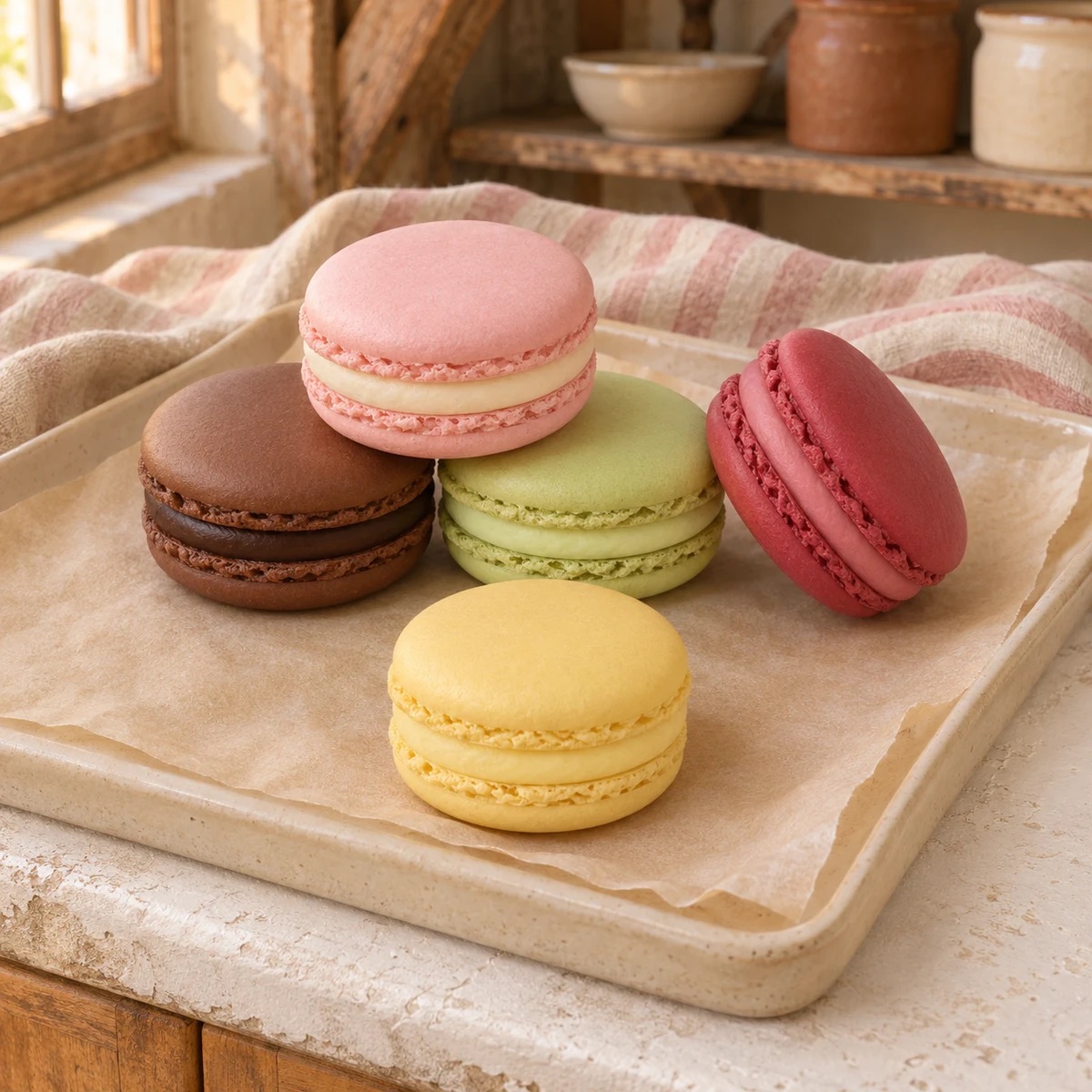
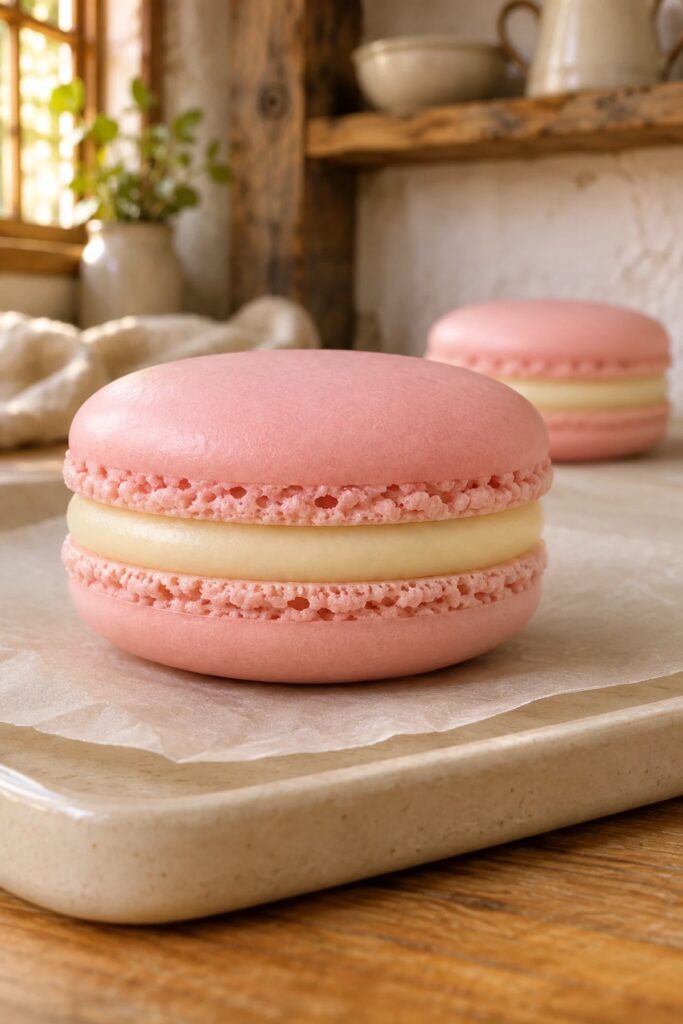
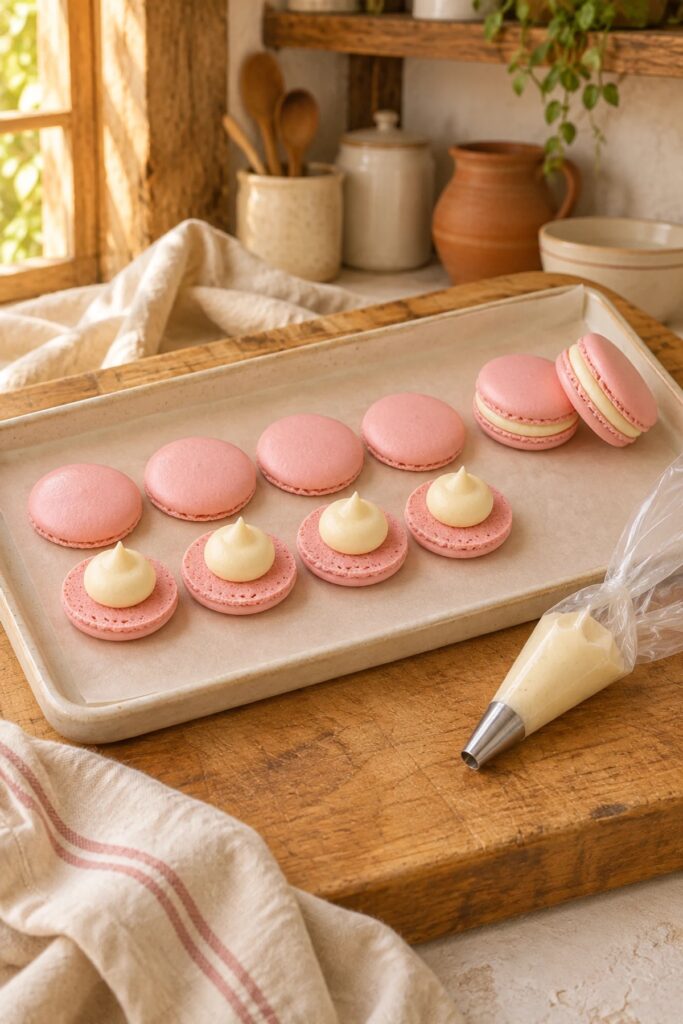
Lift one shell off the tray and turn it over: when the bottom is smooth and dry, the top is a satin dome and a frilly ruffle runs around the base, your macarons have done exactly what they should.
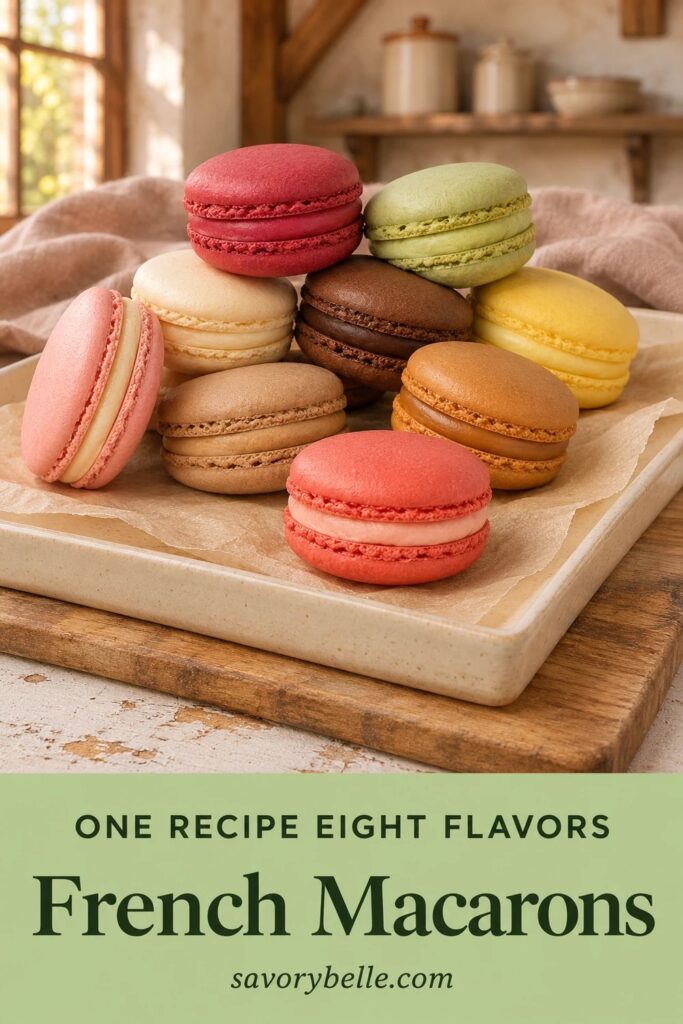
These are classic French macarons, made with a meringue of egg whites and sugar folded into finely ground almond flour and powdered sugar. The shells bake pale pink, crisp on the outside and chewy inside, and a soft vanilla buttercream holds each pair together.
The ingredients come from a regular supermarket, but this macaron recipe depends on precision more than most. A kitchen scale, an oven thermometer and a little patience do most of the work.
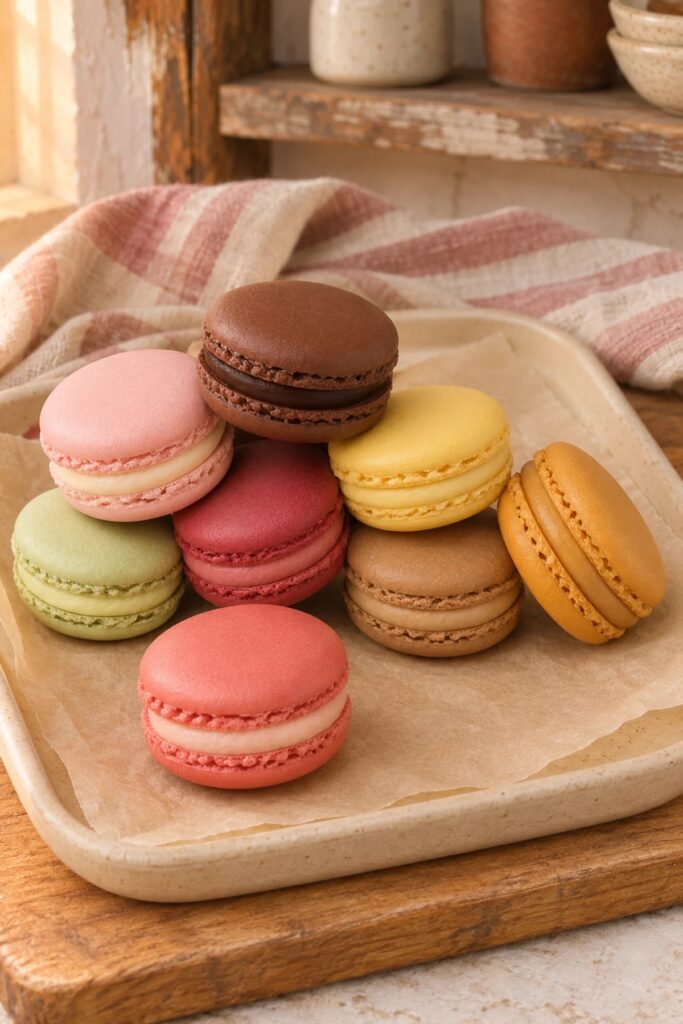
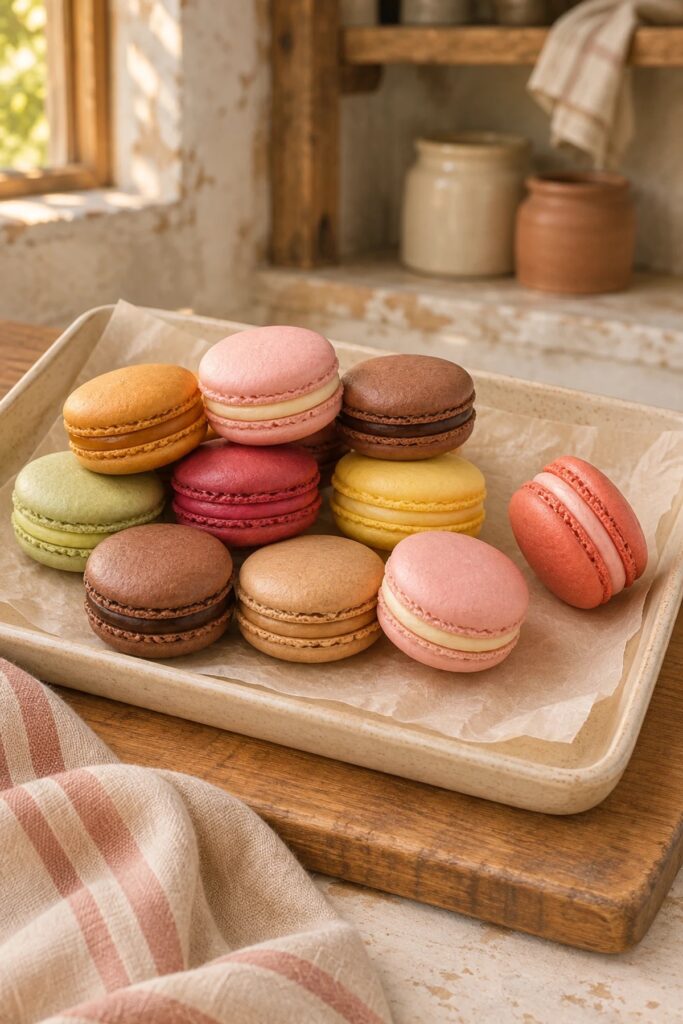
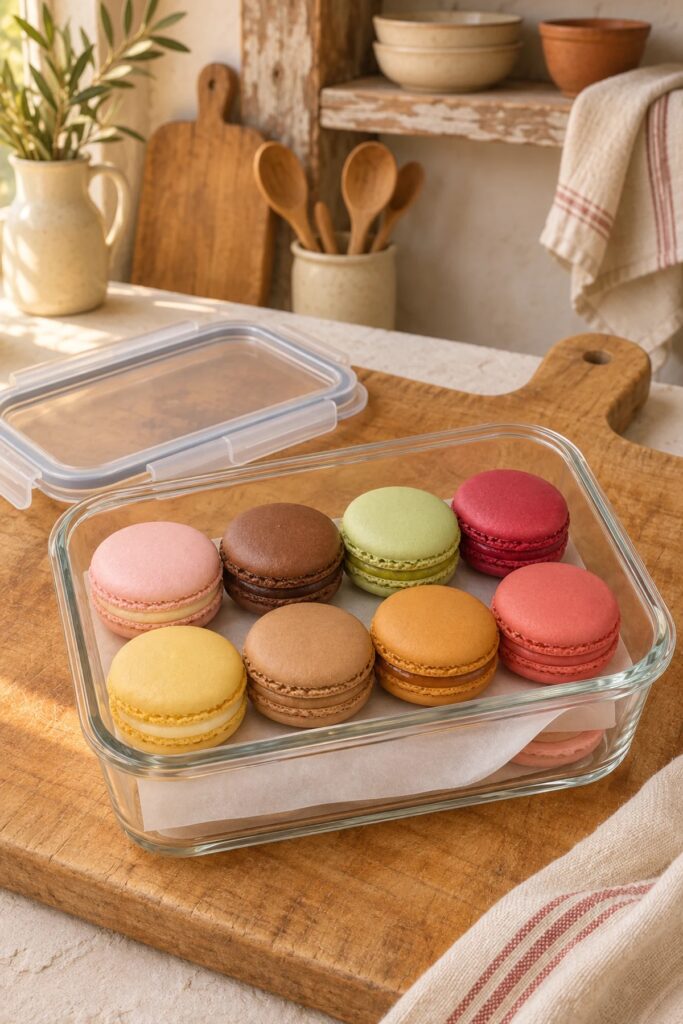
The batch makes 24 macarons about 1¾ inches (4.5 cm) across, baked one tray at a time. The photos show a mix of eight flavors, all made from this one shell recipe, and you’ll find each one in the flavors section below. Every step below ends with what you should see, so you can check the meringue, the batter and the shells before you move on.
Why You’ll Love These Macarons
Smooth tops and ruffled feet. From a stiff meringue to a proper rest, every step is there to give even domes and straight, frilly feet.
A chewy-crisp bite. A thin, crisp outer layer gives way to a soft, slightly chewy almond center, and a day in the refrigerator makes the texture even better.
A simple vanilla filling. The buttercream needs only butter, powdered sugar, a spoonful of cream and vanilla, with no cooked syrup or thermometer.
Every number in grams. All the ingredients are weighed, so your batch of macarons matches the one written here, whatever your measuring cups say.
Perfect For
A box of homemade macarons makes a lovely gift, and once chilled and packed in a single layer, they travel well.
They also fit holiday and party dessert tables, afternoon tea, baby and bridal showers, or any weekend when you want a baking project with a clear finish line. Set them beside other French recipes for a small pastry spread, and find more ideas for the season in the holiday recipes collection.
Macarons at a Glance
| Flavor | Sweet almond and creamy vanilla, with seven more flavors below |
| Texture | Thin, crisp shell, soft and slightly chewy center, smooth buttercream |
| Difficulty | Challenging, but very doable with a scale and an oven thermometer |
| Prep Time | 45 minutes |
| Cook Time | 36 minutes (2 trays, one at a time, up to 18 minutes each) |
| Rest and Cool Time | 1 hour 30 minutes (skin, cooling and filling) |
| Total Time | 2 hours 51 minutes, plus an optional 24 hours in the refrigerator |
| Yield | 24 filled macarons (48 shells), about 1¾ inches (4.5 cm) across |
| Oven | 300°F (150°C), conventional setting, middle rack |
| Method | French meringue, baked |
| Cuisine | French-inspired |
| Best For | Gift boxes, dessert tables, afternoon tea and showers |
Before You Start
Most problems with French macarons start before the mixer turns on, so set up these details first.
Weigh everything. A digital scale is not optional here, since a cup of almond flour can weigh very different amounts and a few grams change how the batter flows.
Use fine, blanched almond flour, sifted twice. Look for bags labeled blanched, finely ground almond flour, and sift it twice with the powdered sugar to catch lumps and coarse bits.
Bring the whites to room temperature. Let the separated whites sit, covered, for about 30 minutes, since room-temperature whites whip up more easily than cold ones.
Start with a clean, dry bowl. Any trace of yolk or grease keeps whites from whipping, so wipe the bowl and whisk with a paper towel dampened with a little lemon juice or vinegar.
Use gel color, not liquid. One to three drops of gel gives a soft pink without adding water to the batter.
Check your oven with a thermometer. Ovens often run 10 to 25 degrees off, which is enough to brown or crack the shells. Adjust the dial until a thermometer on the middle rack reads 300°F (150°C).
Plan for the rest and the wait. Piped macarons need about 45 minutes to form a dry skin before baking. The optional 24 hours in the refrigerator after filling improves the texture and is not counted in the total time.
What Makes These Macarons Work
Weighed, Not Scooped
Macarons depend on the balance of almond flour, sugar and egg white. Too much almond flour gives a stiff batter that never smooths out, and too little lets the rounds spread thin.
Sifted Twice
Two passes through a fine sieve remove clumps of almond or sugar, which would otherwise show as bumps on the baked tops.
A Stiff, Glossy Meringue
Beating on medium speed and adding the sugar slowly builds small, even bubbles that hold up to folding. A soft meringue, or one beaten until dry and clumpy, gives weak shells that crack or turn hollow.
Macaronage Sets the Flow
Macaronage is the folding and pressing that knocks some air out of the meringue until the batter flows like slow lava. Stop too early and the shells stay lumpy with points on top; go too far and they spread flat without feet.
The Rest Builds the Skin and the Feet
While the piped rounds rest, the surface dries into a thin skin. In the oven, that skin keeps the top from cracking, so the rising batter pushes out at the base instead and forms the ruffled foot.
A Low, Steady Oven
At 300°F (150°C) on a conventional setting, the shells set and dry through without browning, and the pale color stays clean. A hotter oven cracks or browns them, a cooler one can leave them sticky and without feet, and a convection fan can push them lopsided.
A Day in the Fridge
Filled macarons chilled for about 24 hours absorb a little moisture from the buttercream, so the inside turns softer and chewier while the outside stays lightly crisp.
Ingredient Notes and Substitutions
Almond flour macarons need only four main ingredients for the shells, so each one matters more than usual.
Almond flour. Use blanched, finely ground almond flour, kept dry and free of lumps. Almond meal is coarser and contains the skins, so it gives bumpy, speckled tops.
Powdered sugar. Regular supermarket powdered sugar, which contains a little cornstarch, works well. Don’t reduce it, apart from the gram-for-gram swaps in the flavors section, since the sugar gives the shells their structure and smooth tops.
Egg whites. Separate fresh large eggs and weigh the whites, aiming for 100 g. If you separate them ahead, raw egg whites keep 2 to 4 days in the refrigerator and up to 12 months in the freezer; bring them to room temperature before whipping.
Granulated sugar. Plain granulated sugar whips into the meringue a spoonful at a time. Superfine sugar dissolves a little faster, but it isn’t needed.
Cream of tartar. A quarter teaspoon stabilizes the whipped whites, so the meringue stays firm while you fold. Without it, the meringue still whips but is less forgiving.
Butter and cream. Use soft unsalted butter and heavy cream for a smooth macaron filling. Whole milk works in the same amount with a slightly lighter result, and well-drained homemade butter works too.
Allergens. Macarons contain almonds and eggs, and this filling adds milk. All three appear on the FDA’s list of major food allergens, which names tree nuts such as almonds alongside milk and eggs, so label them when you give them as gifts. Pistachios are tree nuts as well, and lemon curd and caramel add more eggs and milk.
What Not to Substitute
Cups instead of grams, or less sugar. Either one throws off the balance, and the shells crack, spread, hollow out or stay bumpy.
Liquid food coloring. It thins the batter, which spreads and loses its feet.
Other nut flours. These quantities are written for almond flour only, so other flours would need a different recipe, apart from the small pistachio swap in the flavors section.
Ingredients for Macarons
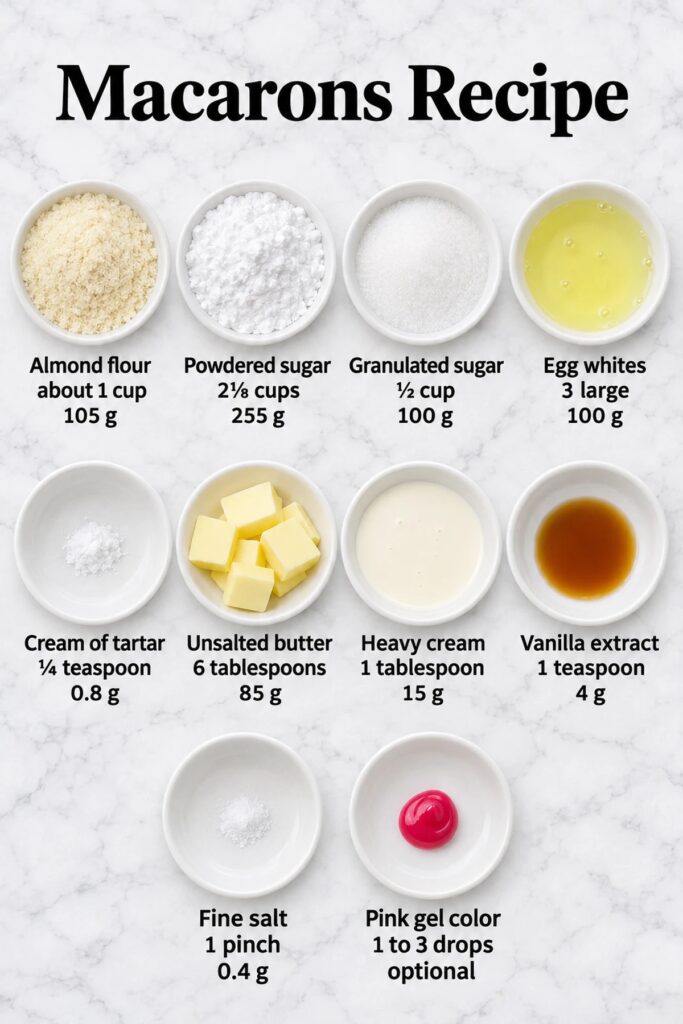
These amounts make 48 shells, or 24 filled macarons. Weighing is the reliable way to make them, and the cup measures are only a rough guide.
For the Shells
- 105 g (about 1 cup, lightly spooned) fine blanched almond flour
- 105 g (about ¾ cup plus 2 tablespoons) powdered sugar
- 3 large egg whites (about 100 g), at room temperature
- ¼ teaspoon (0.8 g) cream of tartar
- 100 g (½ cup) granulated sugar
- 1 to 3 drops pink gel food coloring (optional)
For the Vanilla Buttercream
- 6 tablespoons (85 g) unsalted butter, softened
- 150 g (about 1¼ cups) powdered sugar
- 1 tablespoon (15 g) heavy cream, plus 1 to 2 teaspoons if needed
- 1 teaspoon (4 g) pure vanilla extract
- 1 small pinch (0.4 g) fine salt
Kitchen Equipment Needed
• Digital kitchen scale that weighs in grams – the one tool you can’t skip
• Oven thermometer – to set the oven to a true 300°F (150°C)
• Fine-mesh sieve – sift the almond flour and powdered sugar twice
• Stand mixer with a whisk, or a hand mixer – whip the meringue
• Large mixing bowl and a flexible silicone spatula – for macaronage
• Piping bag with a ½-inch (1 cm) round tip, such as a Wilton 12 or Ateco 804 – pipe the rounds
• 2 rimmed half sheet pans (13 x 18 inches / 33 x 46 cm)
• Parchment paper or silicone macaron mats, plus a pencil and a 1½-inch (4 cm) round cutter or template
• Toothpick – pop air bubbles
• Airtight container – mature and store the filled macarons
How to Make Macarons
Here is the full method for macarons, from lining the pans to filling the shells. Read it through once first, since several steps move quickly.
Step 1: Line and Mark the Pans
Trace 24 circles 1½ inches (4 cm) wide on each of 2 sheets of parchment, in 6 rows of 4 about 1 inch (2.5 cm) apart, and flip the sheets onto the pans. Fit the piping bag with the round tip and stand it in a tall glass.
What you should see: Two lined pans with neat rows of circles showing faintly through the parchment, pencil side down.
Step 2: Weigh and Sift the Dry Ingredients
Whisk 105 g of almond flour with 105 g of powdered sugar. Sift the mixture through a fine-mesh sieve twice, pressing lightly and discarding the few coarse bits left behind.
What you should see: A soft, fine, pale ivory powder with no lumps, and no more than about a teaspoon of coarse almond left in the sieve.
Step 3: Whip the Whites Until Foamy
Put 100 g of room-temperature egg whites in the clean bowl of the mixer with the cream of tartar. Beat on medium-low speed for about 1 minute, until foamy.
What you should see: A loose white foam of small bubbles that has lost its yellow, liquid look, with no sign of peaks yet.
Step 4: Add the Sugar and Whip to Stiff Peaks
With the mixer on medium, add the granulated sugar about 1 tablespoon at a time. Keep beating on medium for 6 to 8 minutes after the last spoonful, adding the gel color in the final minute.
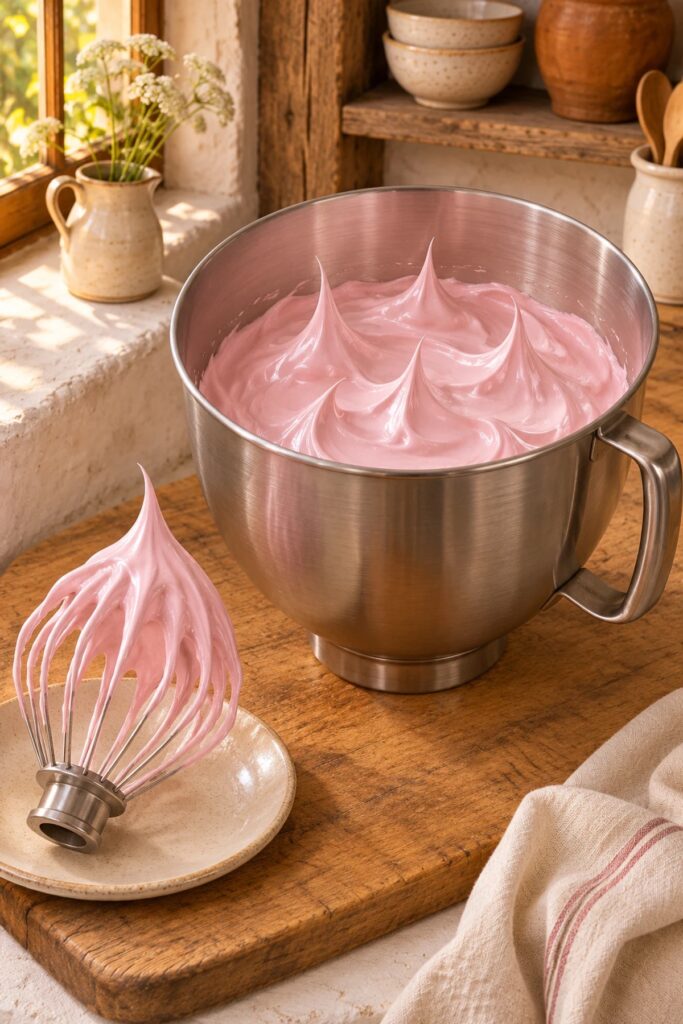
What you should see: A thick, glossy, evenly blush-pink meringue that clumps inside the whisk, holds a peak that stands straight up when you lift the whisk, and doesn’t slide when you tip the bowl.
Step 5: Fold in the Dry Ingredients
Add about a third of the sifted almond mixture to the meringue and fold it in with the spatula. Add the rest in two more additions, folding just until no dry powder remains.
What you should see: A thick, matte, pink paste that still holds soft peaks and drops from the spatula in heavy clumps.
Step 6: Work the Batter (Macaronage)
Press the batter against the side of the bowl with the flat of the spatula, scrape it back to the center and turn the bowl. Repeat, testing every few strokes by drawing a figure eight with the batter that falls from the spatula.
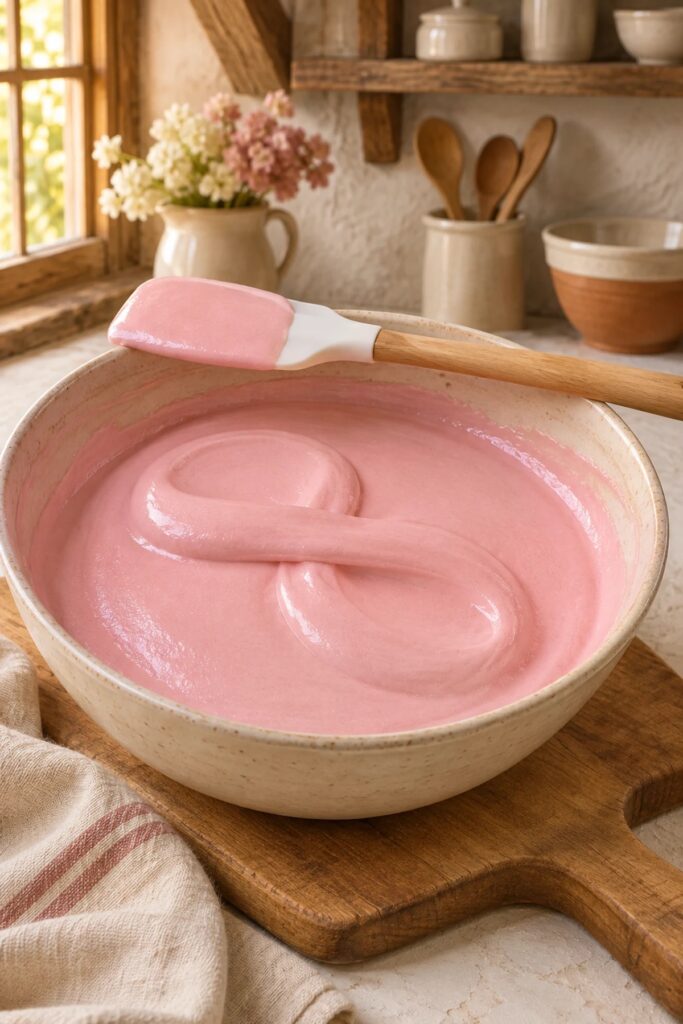
What you should see: A smooth, glossy batter that falls in a thick, unbroken ribbon, and a ribbon laid on the surface that slowly sinks and disappears in about 10 to 15 seconds.
Step 7: Pipe the Rounds
Dab a little batter under each corner of the parchment to hold it down. Hold the filled bag straight up about ½ inch (1 cm) above the pan, squeeze until the batter just fills a circle, then stop and flick the tip sideways.
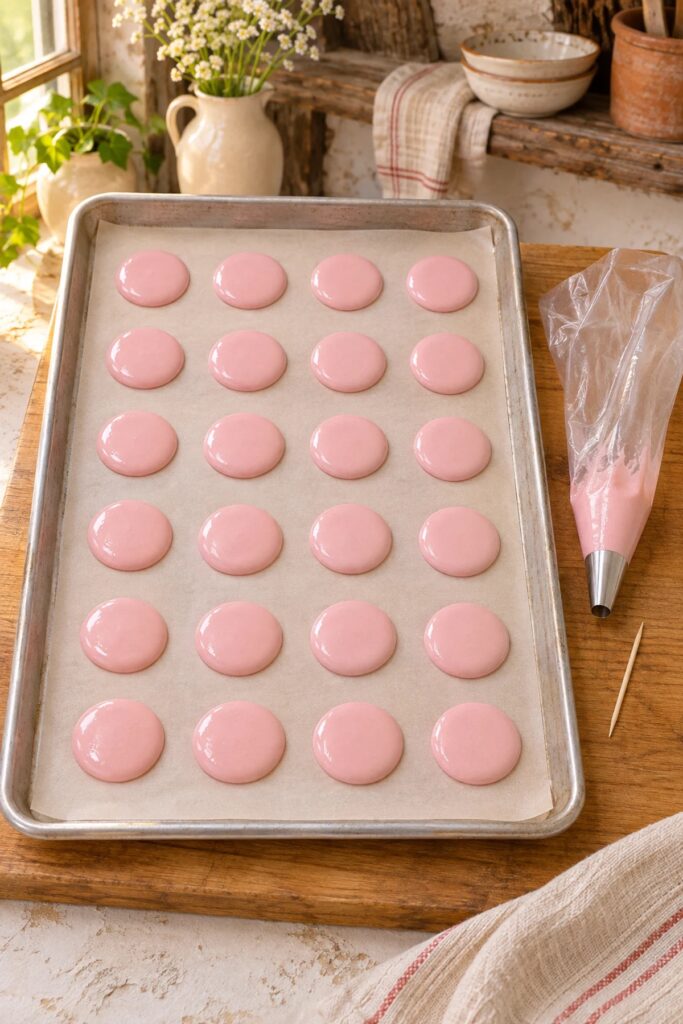
What you should see: 24 rounds per pan, each about 1½ inches (4 cm) wide and about 8 g, sitting inside the circles with only a small tail on top.
Step 8: Tap the Pans and Pop the Bubbles
Lift each pan about 6 inches (15 cm) and drop it flat onto the counter 3 or 4 times. Pop any bubbles left on the surface with a toothpick.
What you should see: Flat, glossy rounds with smooth, level tops, slightly wider than when piped, with no tails and no visible bubbles.
Step 9: Rest Until a Skin Forms
Leave the pans uncovered at room temperature for about 45 minutes, or up to 1½ hours on a humid day. Meanwhile, heat the oven to 300°F (150°C), conventional setting, with the thermometer on the middle rack.
What you should see: Rounds with a matte, dull surface that feel dry when you touch one lightly with a dry fingertip, with no batter sticking to your finger.
Step 10: Bake One Tray at a Time
Bake one pan on the middle rack for 15 to 18 minutes, without opening the door for the first 12 minutes. The macarons are done when a nudged shell doesn’t wobble on its feet. Bake the second pan the same way; it can wait at room temperature meanwhile.
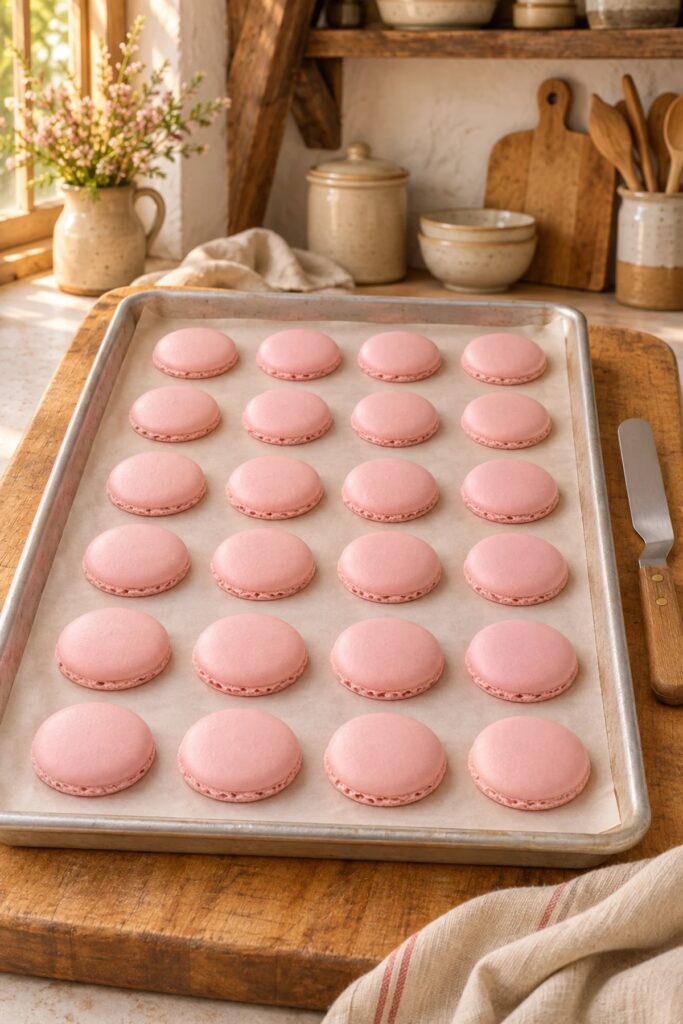
What you should see: Smooth, domed shells with a soft satin sheen, ruffled feet about ⅛ inch (3 mm) tall and the same blush pink as the batter, with no browning at the edges.
Step 11: Cool Completely and Release
Let the shells cool completely on the pan, about 30 minutes. Lift them off with your fingers or a thin offset spatula and match them into pairs of the same size.
What you should see: Shells that release cleanly with smooth, dry, flat bottoms, set out in matched pairs with one shell of each pair turned flat side up.
Step 12: Make the Vanilla Buttercream
While the shells rest or cool, beat the soft butter on medium for 1 minute. Mix in the powdered sugar and salt on low, then beat in the cream and vanilla on medium for 2 to 3 minutes, adding 1 to 2 teaspoons more cream if it feels stiff.
What you should see: A smooth, fluffy, ivory buttercream that holds a soft peak on the beater and pipes without breaking.
Step 13: Fill and Mature
Spoon the buttercream into a piping bag with a round tip or a snipped corner. Pipe about 9 g, a mound a little smaller than a cherry, onto each flat-side-up shell, top with its partner and press gently with a slight twist.
What you should see: 24 filled macarons, each with a neat layer of buttercream about ¼ inch (6 mm) thick reaching just to the edges of the shells, without spilling out. Chill them in an airtight container for 24 hours if you can.
How to Know It’s Done
Macarons give you a clear checkpoint at every stage, so use these signs together with the times in the recipe.
| What to Check | Ready When |
|---|---|
| The meringue | Thick and glossy, with a stiff peak that stands straight up and a meringue that doesn’t slide when the bowl tips |
| The batter | Smooth and glossy, falls in an unbroken ribbon, and a ribbon on the surface melts back in about 10 to 15 seconds |
| The skin | Matte and dull on top, dry to a light touch, with no batter on your fingertip |
| The baked shells | Domed and smooth with ruffled feet, no browning, and tops that don’t wobble when nudged |
| The cooled shells | Release cleanly from the parchment with dry, flat bottoms |
If a test shell still wobbles after 18 minutes, bake 1 to 2 minutes more and check again. If the shells start to color before they set, lower the oven by 10°F (5°C) for the next tray.
Tips for the Best Macarons
Weigh the egg whites. Large eggs vary, so weigh out exactly 100 g rather than counting eggs, separating one extra if needed.
Stop folding early and test often. You can always fold a few more strokes, but you can’t undo an overmixed batter, so test every 3 or 4 strokes near the end.
Hold the bag straight up. Piping at an angle gives oval or lopsided macarons. A point that stays on top after tapping usually means the batter needed a few more folds; smooth it with a damp toothpick.
Turn off the fan. A convection fan can make macarons rise crooked. If one side of your oven runs hot, turn the pan quickly after 12 minutes.
Don’t rest them too long. Past about 1½ hours, the meringue can weaken and the shells may turn lopsided or hollow, so bake as soon as the tops feel dry.
Match the macaron shells before filling. Pair them by size and shape, so every sandwich looks even from the side.
Common Mistakes and How to Fix Them
These are the problems that come up most often with homemade macarons, with the usual cause and the fix for each.
| Mistake | How to Fix It |
|---|---|
| Hollow shells A gap forms between the crisp top and the chewy base. | Whip on medium speed to stiff, glossy peaks, fold until the batter melts back in 10 to 15 seconds, don’t over-rest, and bake until the tops don’t wobble in an oven checked with a thermometer. |
| Cracked tops The domes split open in the oven. | Tap the pans firmly and pop every bubble, rest until the tops are fully dry, bake on the middle rack at a true 300°F (150°C) and use gel color only. |
| No feet The macarons bake flat at the base, with no ruffle. | Rest until a real skin forms, avoid overmixing and make sure the oven isn’t running low, since feet need both the skin and steady heat. |
| Lumpy or wrinkled tops The surface looks bumpy, grainy or creased. | Use fine, dry blanched almond flour, sift the dry mix twice and fold until the batter flows smoothly, but no further. |
| Browned shells The pale pink turns tan at the edges or on top. | Lower the oven by 10°F (5°C), lay foil loosely over the pan for the last minutes, and slide a second pan under the first if the bottoms brown. |
Macaron Flavors
Every flavor below starts from the same shell recipe, so nothing about whipping, folding, resting or baking changes unless a flavor says so. Only the gel color, one small dry swap and the filling change, and each filling is sized for the same batch of 24 sandwiches.
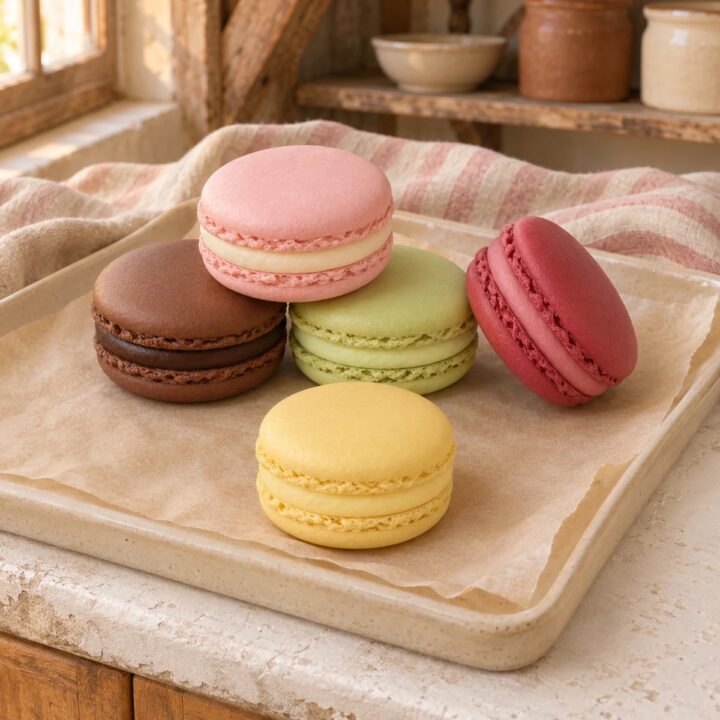
Each kind is an adaptation of the base recipe, and the photos on this page show these flavors. Any dry swap is weighed gram for gram, so the dry mix still adds up to 210 g and the batter stays balanced.
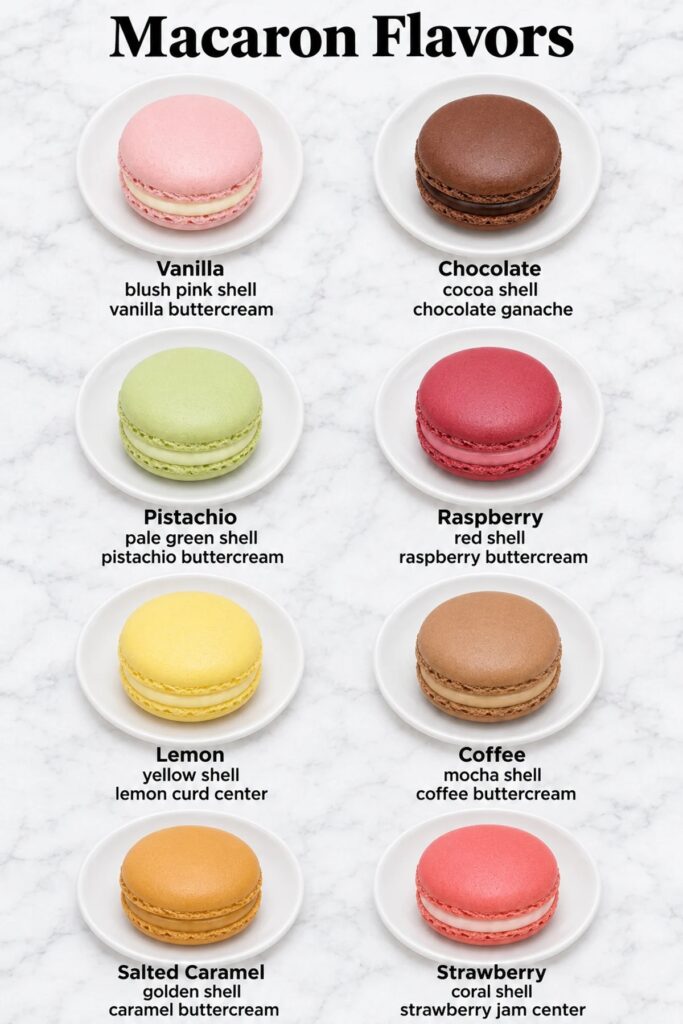
Vanilla Macarons
This is the recipe as written: blush pink shells from 1 to 3 drops of pink gel, filled with about 9 g of the ivory vanilla buttercream. The batch of buttercream is about 255 g, which fills all 24 with roughly 2 tablespoons to spare.
Chocolate Macarons
Shells. Replace 10 g of the powdered sugar with 10 g of unsweetened cocoa powder, so the dry mix is 105 g almond flour, 95 g powdered sugar and 10 g cocoa, and sift them together twice. Skip the gel; the cocoa bakes to a deep cocoa brown.
Filling. Pour 6 tablespoons (90 g) of hot heavy cream over 4 ounces (113 g) of finely chopped semisweet chocolate, let it stand 2 minutes and stir until smooth. Cool it, stirring now and then, until thick enough to pipe. The 203 g of dark ganache fills 24 at about 8 g each, with only a spoonful left, so scrape the bowl well.
Pistachio Macarons
Shells. Pulse about 50 g of raw or dry-roasted unsalted shelled pistachios in short bursts until they look like almond flour, stopping before they turn oily or pasty. Swap 25 g of the almond flour for 25 g of the ground pistachios (80 g almond flour, 25 g pistachio, 105 g powdered sugar) and tint the meringue pale green with 1 drop of green gel.
Filling. Make the vanilla buttercream with 140 g of powdered sugar instead of 150 g and beat in 20 g of the remaining ground pistachios, for about 265 g of pale green-cream filling. Pipe 9 g per sandwich; that covers all 24 with a little left over.
Raspberry Macarons
Shells. Keep the dry mix exactly as written and color the meringue a deep raspberry red with 2 to 3 drops of red gel. The raspberry flavor goes in the filling, because freeze-dried fruit powder pulls moisture into the batter and can make the shells soft.
Filling. Grind freeze-dried raspberries from a freshly opened bag just before you start, sift out the seeds and beat 8 g of the powder into the vanilla buttercream along with the cream, for about 263 g of pink-red filling. If it feels stiff, add the extra 1 to 2 teaspoons of cream, then pipe 9 g per sandwich.
Lemon Macarons
Shells. Keep the dry mix exactly as written and color the meringue a soft yellow with 1 to 2 drops of lemon-yellow gel. The zest goes in the filling, not in the batter.
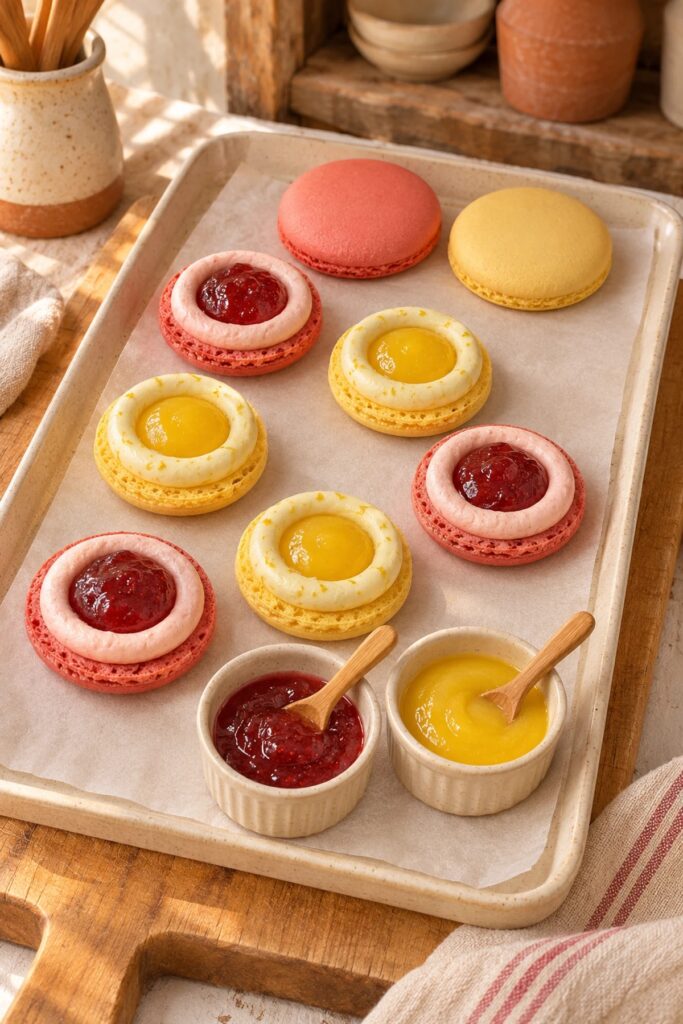
Filling. Make the vanilla buttercream as written and beat in 3 g (about 1 teaspoon) of finely grated lemon zest. Pipe a ring of about 7 g around the edge of each bottom shell and spoon about ½ teaspoon (3 g) of thick lemon curd, homemade or store-bought, into the middle. You’ll use about 170 g of buttercream and 70 g of curd. Curd is moist, and a wetter filling softens the shells faster, so keep the center small.
Coffee Macarons
Shells. Keep the dry mix as written, then fold 1 teaspoon (about 2 g) of instant espresso powder into the batter at the very end of macaronage, with just 2 or 3 strokes. Tint the meringue with 1 to 2 drops of brown gel for a mocha-tan shell with fine coffee specks.
Filling. Stir 1 teaspoon (about 2 g) of instant espresso powder into the 15 g of cream until it dissolves, then make the buttercream as usual. You get about 257 g of tan filling, 9 g per sandwich.
Salted Caramel Macarons
Shells. Leave the dry mix as written and tint the meringue golden amber with 2 drops of golden-yellow gel and 1 drop of brown gel.
Filling. Make the buttercream with 130 g of powdered sugar and use 40 g (about 2 tablespoons) of thick caramel sauce, cooled to room temperature, in place of the cream, for about 260 g of caramel filling. Pipe 9 g onto each shell, add a tiny pinch of flaky salt on top of the filling and close the sandwich. A thin, runny caramel can soak the shells, so choose a sauce thick enough to hold a ribbon.
Strawberry Macarons
Shells. Swap 2 g of the powdered sugar for 2 g of freshly ground, sifted freeze-dried strawberry powder (105 g almond flour, 103 g powdered sugar), going no higher than 4 g. Strawberry powder dulls the color as it bakes, so tint the meringue a bright coral red with 2 drops of red gel and 1 drop of orange gel.
Filling. Pipe a ring of about 7 g of the vanilla buttercream around the edge of each bottom shell and spoon about ¼ teaspoon (2 g) of strawberry jam into the middle. The buttercream works as a dam, so the softer jam stays inside instead of running out and soaking the edges. You’ll use about 170 g of buttercream and 40 g of jam, and the leftover buttercream keeps in the refrigerator for up to 3 days.
Mix and Match
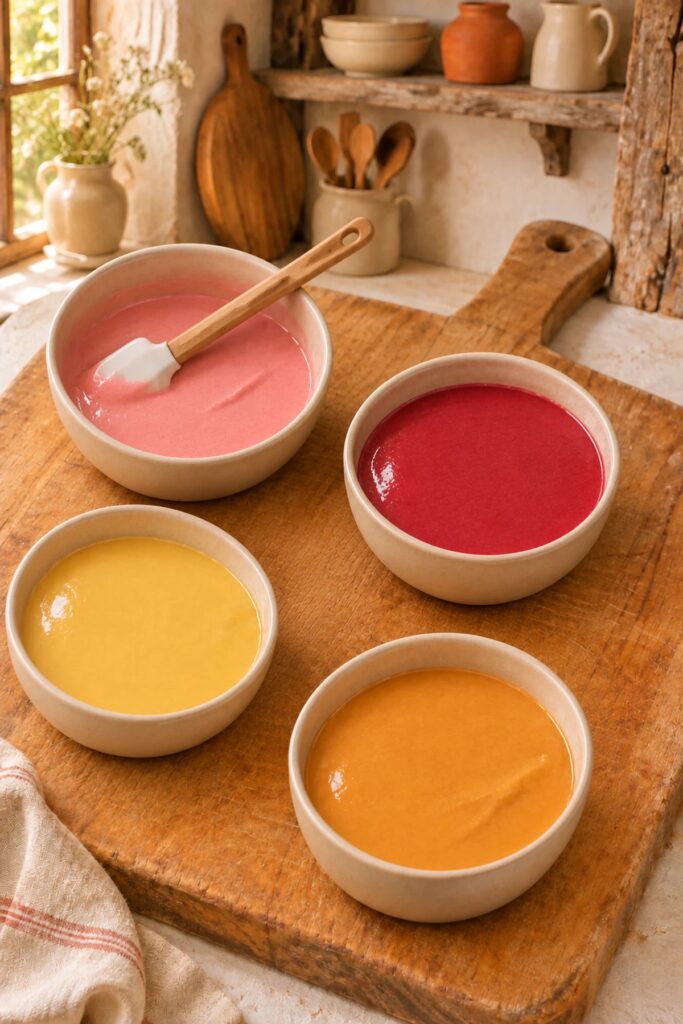
Flavors with a dry swap need their own batch, but the color-only shells (vanilla, raspberry, lemon and salted caramel) can share one: divide the batter into bowls once no dry powder remains, add a different gel to each and finish folding each bowl on its own. Any shell can take any filling, so feel free to pair them differently from the photos. Keep each flavor in its own labeled box, so you can tell them apart in the refrigerator.
Serving Suggestions
Take the macarons out of the refrigerator about 30 minutes to 1 hour before serving, so the filling softens and the almond flavor comes through. Plan on 2 or 3 per person, in a single layer on a parchment-lined tray.
For a French pastry spread, set them beside buttery madeleines, crisp palmiers and sugar-rimmed French sablés. They also sit nicely next to choux au craquelin on a party table.
If you like baking with whites, crisp meringue cookies and a tall pavlova use the same kind of meringue in very different ways. For another almond sandwich cookie with jam, try Linzer cookies, and browse the recipe index for more.
Make Ahead
Shells: Bake the shells up to 1 week ahead and keep them unfilled in an airtight container in the refrigerator, or freeze them for longer.
Buttercream: Make it up to 3 days ahead and refrigerate it covered. Let it soften at room temperature and beat it smooth before piping.
Filled macarons: Fill them a day before serving and chill them overnight. The 24-hour maturing doubles as your make-ahead step.
Storage
Because every filling here contains butter or cream, keep filled macarons in the refrigerator.
Refrigerator: Store filled macarons in a single layer, or in layers separated by parchment, in an airtight container for up to 5 days. Bring them out 30 minutes to 1 hour before serving.
Unfilled shells: Keep them in an airtight container in the refrigerator for up to 1 week, with parchment between the layers so the tops don’t chip.
Freezing
Freeze filled macarons or unfilled shells in a single layer on a tray until firm, then pack them in an airtight container for up to 1 month.
Thaw them in the closed container in the refrigerator overnight, so condensation forms on the box and not on the shells. Let them stand at room temperature for 30 minutes before serving.
Frequently Asked Questions
What is the difference between macarons and macaroons?
They are different cookies. Macarons are smooth almond-meringue sandwich cookies with a filling, while coconut macaroons are mounded, chewy cookies made mostly from shredded coconut.
Can I make macarons without a kitchen scale?
Not reliably. Almond flour and powdered sugar pack differently into cups, so measured batches vary by many grams and the batter turns stiff or runny. A basic digital scale is the best investment for this recipe.
Can I use almond meal instead of almond flour?
Almond meal is ground with the skins and is coarser, so the shells come out bumpy and speckled. Use fine blanched almond flour for smooth tops.
Why did my shells spread flat?
The batter was most likely overmixed, so it lost too much air and ran before it could set. Stop folding as soon as the ribbon melts back in 10 to 15 seconds, and whip the meringue to stiff peaks.
Why are the bottoms sticky or stuck to the parchment?
The macarons were underbaked, or they were lifted before they cooled. Bake until the tops don’t wobble and cool them completely; if they still stick, put the pan in the freezer for 15 minutes, then peel them off.
Can I use liquid food coloring?
No. Liquid color adds water, which thins the batter and can cost you the smooth tops and feet. Use gel or powdered color, a few drops only.
Do I need parchment, a silicone mat or a template?
Either parchment or a mat works. You can trace circles on the back of parchment, while a mat is reusable and often has circles printed on it; either way, matching circles help every shell come out the same size.
Final Thoughts
A scale, a twice-sifted almond mix, a stiff meringue, a batter that melts back in 10 to 15 seconds and a true 300°F oven are what turn four simple ingredients into smooth, ruffle-footed shells.
Make your first batch of macarons as written and keep a note of your oven’s timing. Once you know how the batter should flow, the other flavors follow easily.
Which of your two trays came out with taller feet, and how many minutes did your oven need at 300°F? Post your oven notes and the flavor and color you settled on in the comments, so the next baker can learn from your batch.
If you try this recipe, please leave a star rating along with your comment below. It takes a few seconds and helps other readers find the recipe.
Macarons
These macarons have smooth, pale pink almond shells with ruffled feet and a chewy-crisp bite, filled with soft vanilla buttercream. The shells start with weighed almond flour, powdered sugar and a stiff French meringue, rest 45 minutes to form a skin and bake low at 300°F, one tray at a time. The recipe makes 24 macarons for gift boxes, dessert tables, showers and afternoon tea.
Ingredients
For the Shells
- 105 g (about 1 cup, lightly spooned) fine blanched almond flour
- 105 g (about ¾ cup plus 2 tablespoons) powdered sugar
- 3 large egg whites (about 100 g), at room temperature
- ¼ teaspoon (0.8 g) cream of tartar
- 100 g (½ cup) granulated sugar
- 1 to 3 drops pink gel food coloring (optional)
For the Vanilla Buttercream
- 6 tablespoons (85 g) unsalted butter, softened
- 150 g (about 1¼ cups) powdered sugar
- 1 tablespoon (15 g) heavy cream, plus 1 to 2 teaspoons if needed
- 1 teaspoon (4 g) pure vanilla extract
- 1 small pinch (0.4 g) fine salt
Instructions
- Trace 24 circles, 1½ inches (4 cm) wide and 1 inch (2.5 cm) apart, on each of 2 sheets of parchment; flip them onto 2 half sheet pans. Fit a piping bag with a ½-inch (1 cm) round tip.
- Whisk 105 g almond flour with 105 g powdered sugar and sift twice through a fine-mesh sieve, discarding the coarse bits.
- Beat 100 g room-temperature egg whites with ¼ teaspoon cream of tartar on medium-low until foamy, about 1 minute.
- On medium speed, add 100 g granulated sugar 1 tablespoon at a time, then beat 6 to 8 minutes more to stiff, glossy peaks, adding 1 to 3 drops gel color in the last minute.
- Fold in the almond mixture in 3 additions until no dry powder remains.
- Press and fold the batter against the bowl until it falls in a thick ribbon that melts back into the surface in about 10 to 15 seconds.
- Pipe 24 rounds per pan, about 1½ inches (4 cm) and 8 g each, holding the bag straight up.
- Drop each pan on the counter 3 or 4 times and pop any bubbles with a toothpick.
- Rest uncovered about 45 minutes (up to 1½ hours if humid), until the tops are dry to the touch. Heat the oven to 300°F (150°C), conventional setting, rack in the middle, checked with an oven thermometer.
- Bake one pan at a time for 15 to 18 minutes, until the tops don’t wobble on their feet; don’t open the door for the first 12 minutes.
- Cool completely on the pan, about 30 minutes, then lift off and match the shells into pairs.
- Beat 6 tablespoons (85 g) soft butter until creamy, add 150 g powdered sugar and a pinch of salt, then beat in 1 tablespoon (15 g) heavy cream and 1 teaspoon vanilla for 2 to 3 minutes.
- Pipe about 9 g buttercream onto half the shells and top with the rest. Chill in an airtight container for 24 hours if possible and serve at room temperature.
Notes
- Weigh everything: Use a digital scale for the almond flour, powdered sugar, egg whites and granulated sugar; cup measures are not reliable enough for macarons.
- Oven: Bake at a true 300°F (150°C) on the conventional setting, checked with an oven thermometer, one pan at a time on the middle rack. If the shells brown, lower the oven by 10°F (5°C).
- Macaronage: Test often near the end: the batter is ready when a ribbon melts back into the surface in about 10 to 15 seconds. Overmixed batter spreads flat; undermixed batter stays lumpy.
- Resting: Rest the piped shells until the tops feel dry, about 45 minutes, or up to 1½ hours in humid weather; don’t rest them much longer.
- Color: Use gel or powdered food coloring only, 1 to 3 drops; liquid coloring thins the batter.
- Maturing: For the best texture, chill the filled macarons in an airtight container for 24 hours before serving. This optional time is not included in the total time.
- Storage: Refrigerate filled macarons airtight for up to 5 days and serve after 30 minutes to 1 hour at room temperature. Unfilled shells keep 1 week in the refrigerator; filled or unfilled, they freeze up to 1 month. Thaw overnight in the refrigerator in the closed container.
- Flavors: The post adds seven flavor adaptations (chocolate, pistachio, raspberry, lemon, coffee, salted caramel and strawberry) made from the same shells; the nutrition below is for the pink vanilla macaron only.
- Nutrition: Values are per serving (1 filled macaron, 1 of 24). They count the shell batter that reaches the pans (about 396 of the 411 g; the rest stays in the bowl and bag) and 9 g of buttercream per macaron (216 of the 255 g batch; the small leftover is not counted). The optional gel color is not included.
Nutrition Information:
Yield: 24 Serving Size: 1 macaronAmount Per Serving: Calories: 103Total Fat: 5gSaturated Fat: 2gCholesterol: 7mgSodium: 14mgCarbohydrates: 14gFiber: 0gSugar: 14gProtein: 1g