Pavlova
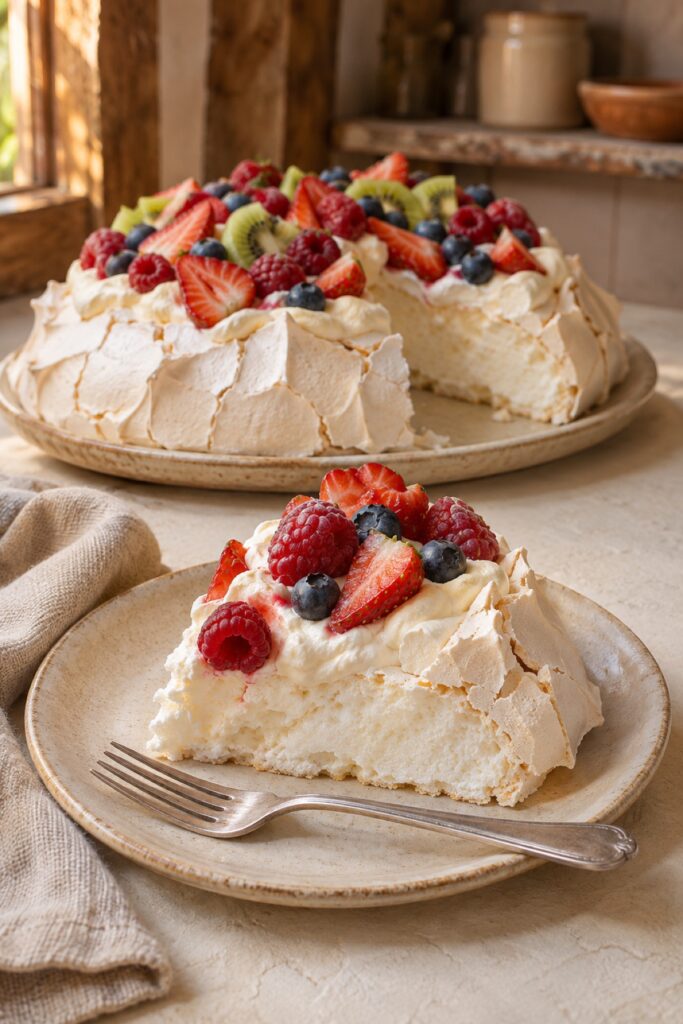
This pavlova recipe makes a crisp, snow-white meringue shell with a soft, marshmallow-like center, piled high with lightly sweetened whipped cream and fresh fruit. It looks like a dessert that took all day, yet it needs only a handful of pantry ingredients and a little patience at the oven.
Pavlova is named after the Russian ballerina Anna Pavlova, and both Australia and New Zealand claim it as their own. Whoever invented it, the idea is the same everywhere: a delicate shell that shatters under the fork, a chewy center that tastes like toasted marshmallow, and cold cream and juicy fruit to balance all that sugar.
The secret is not a long ingredient list but a few small habits: a spotlessly clean bowl, sugar added slowly, a little cornstarch and vinegar for the soft center, and a long, gentle bake at 250°F (120°C). Follow those and the meringue holds its shape without weeping or breaking into pieces.
One pavlova serves 8 people and takes about 3 hours 45 minutes from start to finish, most of it hands-off baking and cooling. That makes it a good make-ahead dessert for Christmas, birthdays, spring brunches and summer parties, or any day you want something light after a big meal.

Why You’ll Love This Pavlova Recipe
Crisp outside, soft inside. A little cornstarch and vinegar keep the center marshmallowy while the outside bakes into a dry, delicate shell. You get both textures in every bite.
Simple ingredients. The meringue needs only egg whites, sugar, cornstarch, vinegar and vanilla. There is no flour, butter or oil in the base, and everything is easy to find at any grocery store.
Light after a big meal. Meringue is mostly air, and the cold cream and tart fruit keep each slice fresh instead of heavy. It is the dessert people still have room for.
Make-ahead friendly. You can bake the shell up to 2 days ahead and keep it airtight, so on the day you only whip the cream and arrange the fruit.

Perfect For
A pavlova belongs on the table whenever you want a dessert that looks like an occasion: Christmas dinner, birthdays, Easter lunch, Mother’s Day, baby showers and summer barbecues. Red berries and a few mint leaves turn it into a holiday centerpiece, while sliced mango and kiwi make it feel like a warm-weather party. If you are building a full holiday dessert table, add my yule log cake or a few cookies from my 10 best Christmas cookies.
It is also a stress-free choice for hosts. Because the shell keeps for 2 days, you can bake it earlier in the week and spend the last half hour before dinner whipping the cream and arranging the fruit, with no oven needed on the day.
Pavlova at a Glance
| Flavor | Sweet vanilla meringue with lightly sweetened cream and tart fresh fruit |
| Texture | Crisp shell, soft marshmallow center and airy whipped cream |
| Difficulty | Easy to medium |
| Prep Time | 30 minutes |
| Bake Time | 1 hour 15 minutes |
| Cooling Time | 2 hours (in the oven) |
| Total Time | 3 hours 45 minutes |
| Servings | 8 slices |
| Method | Baking |
| Cuisine | International |
| Best For | Christmas, birthdays, spring brunches and summer parties |
Before You Start
Separate the eggs while they are cold. Cold yolks stay intact, so you get clean whites. Then let the whites sit at room temperature for about 30 minutes, because they whip to a higher, more stable volume when they are not cold.
Use a spotless bowl. Even a speck of egg yolk or a film of grease keeps whites from whipping to stiff peaks. Use a glass or stainless steel bowl, not plastic, and wipe the bowl and beaters with a paper towel dampened with vinegar or lemon juice.
Pick a dry day if you can. Meringue absorbs moisture from the air. On a humid or rainy day the shell can turn sticky, so bake it on a dry day when possible.
Measure by weight. Grams are more accurate than cups for egg whites and sugar, and the proportions matter in meringue. A kitchen scale makes this pavlova recipe far more reliable.
What Makes This Pavlova Work
Superfine Sugar and Slow Additions
Sugar is what makes meringue stable, but only if it dissolves completely. Superfine sugar has tiny crystals that melt into the whites quickly, and adding it a tablespoon at a time lets the mixer dissolve each addition before the next. Undissolved sugar is what causes grainy, weeping meringue.
Cornstarch and Vinegar for the Marshmallow Center
Cornstarch and a little acid help the inside stay soft and chewy instead of drying out into a hard, brittle meringue. This is the difference between a pavlova and a plain meringue, and it takes only 1½ teaspoons of cornstarch and 1 teaspoon of white vinegar.
A Low Bake and a Slow Cool-Down
At 250°F (120°C) the meringue dries rather than browns, which keeps the shell white. Leaving it in the turned-off oven with the door slightly open lets it cool gradually, because a sudden drop in temperature makes the shell crack and sink.

Ingredient Notes and Substitutions
Egg whites. You need 4 large egg whites, about 120 g. Fresh whites from refrigerated eggs give the glossiest, stiffest peaks. Carton egg whites can work if they are 100% egg whites with no additives, though they may take longer to whip and reach a little less volume. Keep the extra yolks covered in the refrigerator and use them within a couple of days.
Superfine sugar. Also sold as caster sugar, it dissolves faster than regular granulated sugar. If you cannot find it, pulse 1 cup (200 g) of granulated sugar in a food processor for about 30 seconds, then measure again by weight. Do not swap in powdered sugar, since it contains cornstarch and changes the texture.
Cream of tartar. A pinch, ¼ teaspoon (1 g), stabilizes the whites and makes them less likely to over-whip. It is optional. If you do not have it, leave it out, since the vinegar already adds acid, or use ½ teaspoon of lemon juice instead.
Cornstarch and vinegar. Do not skip these two if you want a soft center. Stir them together with the vanilla before folding them in, so the cornstarch does not form dry clumps in the meringue.
Heavy cream. Use cold heavy whipping cream with at least 36% fat, since lower-fat cream will not hold its shape. For a dairy-free version, whip the thick, chilled solid part of a can of full-fat coconut cream, which adds a light coconut flavor.
Fresh fruit. Pick a mix of sweet and tart, such as strawberries, raspberries, blueberries and kiwi. Rinse the fruit under running water and pat it dry with a clean towel, so no extra water drips into the cream and softens the meringue.
Ingredients for This Pavlova Recipe
For the Meringue
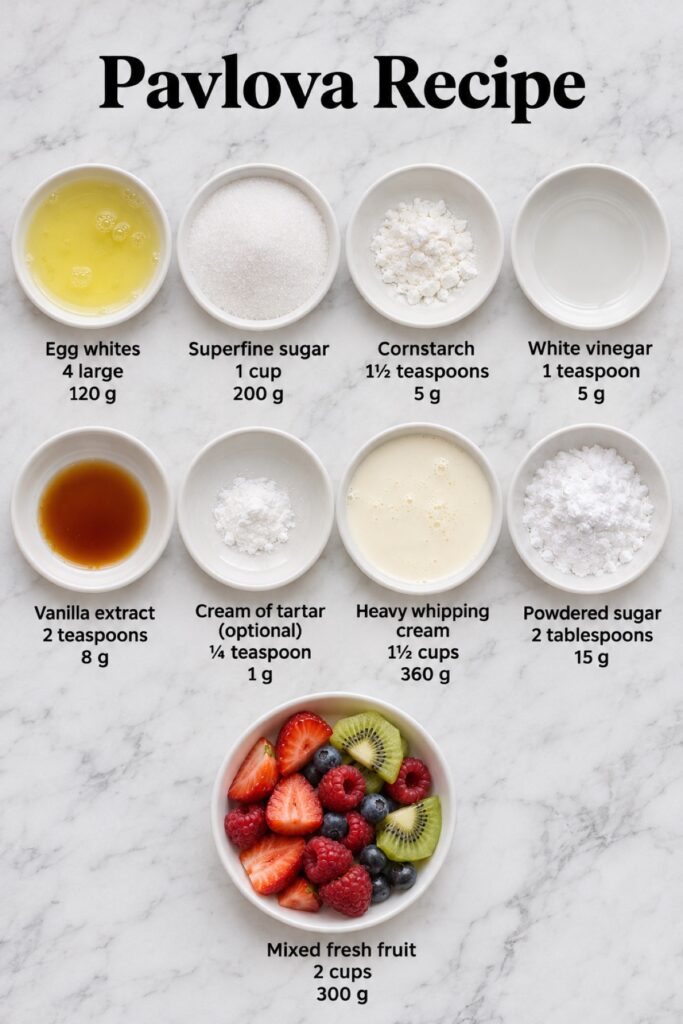
- 4 large egg whites (120 g), at room temperature
- 1 cup (200 g) superfine sugar
- 1½ teaspoons (5 g) cornstarch
- 1 teaspoon (5 g) white vinegar
- 1 teaspoon (4 g) pure vanilla extract
- ¼ teaspoon (1 g) cream of tartar (optional)
For the Topping
- 1½ cups (360 g) cold heavy whipping cream
- 2 tablespoons (15 g) powdered sugar
- 1 teaspoon (4 g) pure vanilla extract
- 2 cups (300 g) mixed fresh fruit, such as strawberries, raspberries, blueberries and kiwi, rinsed and dried
Kitchen Equipment Needed
• Stand mixer with whisk attachment or hand mixer – for whipping the whites and the cream
• Large glass or stainless steel bowl – for the egg whites
• Baking sheet and parchment paper – for shaping and baking
• 8-inch (20 cm) plate or cake pan and a pencil – for tracing the circle
• Rubber spatula – for folding and shaping
• Oven thermometer – to confirm the oven really is at 250°F (120°C)
• Serrated knife – for slicing
How to Make Pavlova
Step 1: Prepare the Oven and the Baking Sheet
Place a rack in the middle of the oven and heat it to 250°F (120°C). Trace an 8-inch (20 cm) circle on a sheet of parchment paper with a pencil, then flip the paper over so the pencil side faces down and set it on a baking sheet. Wipe the mixing bowl and whisk with a paper towel dampened with vinegar or lemon juice.
What you should see: a clear circle outline showing through the paper, and a bowl and whisk that look dry and shiny with no oily film.
Step 2: Whip the Egg Whites to Soft Peaks
Add the room-temperature egg whites and the cream of tartar, if using, to the bowl. Beat on medium speed for 1½ to 2 minutes, until the whites turn foamy and then form soft peaks.
What you should see: a thick white foam, and when you lift the whisk the peak curls over at the tip instead of standing straight.
Step 3: Add the Sugar One Tablespoon at a Time
Increase the speed to medium-high. Add the superfine sugar about 1 tablespoon (12 g) at a time, beating for 15 to 20 seconds after each addition. This takes about 5 minutes in total, and adding the sugar slowly is the most important step in the whole recipe.
What you should see: a thick, shiny mixture that looks like marshmallow cream. Rub a little between your fingers, and it should feel smooth with no gritty sugar crystals.
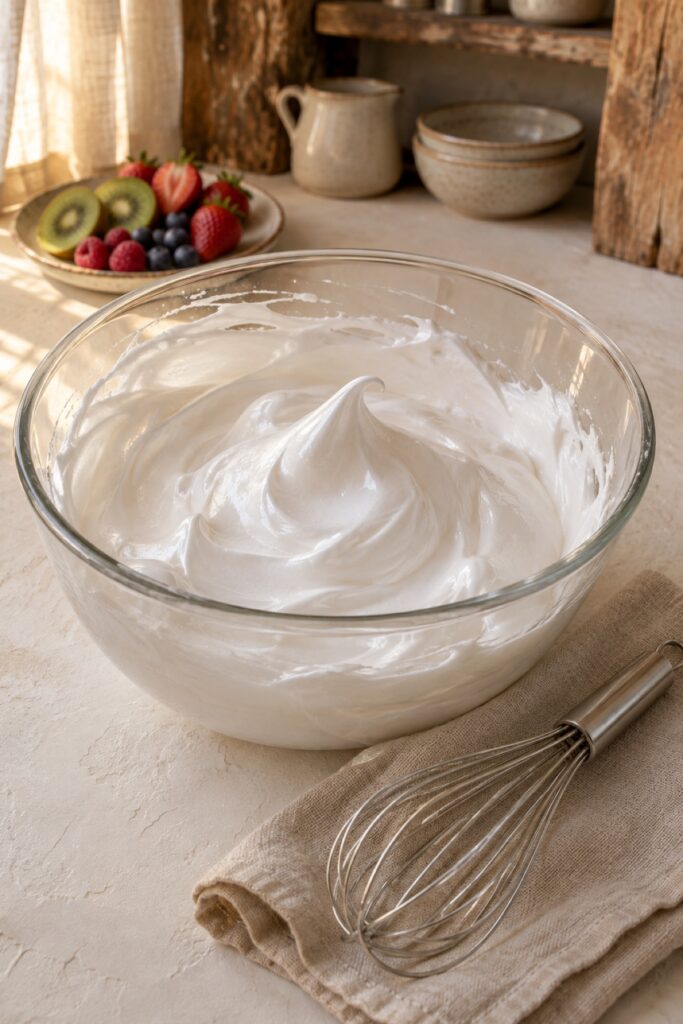
Step 4: Beat to Stiff, Glossy Peaks
Once all the sugar is in, beat on high speed for 2 to 3 more minutes. Stop when the meringue is stiff and very glossy, and do not keep going far beyond that point, because over-beaten meringue turns dull and starts to look dry.
What you should see: peaks that stand straight up with a sharp tip, and a smooth, shiny surface with no grains.
Step 5: Fold in the Cornstarch, Vinegar and Vanilla
In a small bowl, stir together the cornstarch, vinegar and vanilla until smooth. Pour it over the meringue and fold it in with a rubber spatula in a few gentle strokes, scraping the bottom of the bowl. Stop as soon as no streaks remain.
What you should see: a thick, glossy meringue with no wet streaks and no deflated, runny patches.
Step 6: Shape the Pavlova
Spoon the meringue into the middle of the circle and spread it out to the edge of the outline. Build up the sides with the back of a spoon or a spatula so they are slightly higher than the center, then make a shallow well in the middle to hold the cream later.
What you should see: a tall, round nest with softly swooped sides and a gentle dip in the center.

Step 7: Bake Low and Slow
Place the baking sheet in the oven and bake at 250°F (120°C) for 1 hour 15 minutes. Do not open the oven door during baking, because the drop in temperature can make the pavlova crack or sink.
What you should see: a pale ivory to white shell that looks dry on the outside, with maybe a few fine hairline cracks. If it starts to turn golden, your oven runs hot, so lower the temperature next time.
Step 8: Cool the Pavlova in the Oven
Turn the oven off, prop the door slightly open with a wooden spoon and leave the pavlova inside for about 2 hours, until it is completely cool. Slide the parchment onto a serving plate or cake stand.
What you should see: a firm, dry shell that lifts off the paper cleanly and feels cool all the way through.

Step 9: Whip the Cream
Chill the bowl and whisk for 10 minutes. Beat the cold heavy cream with the powdered sugar and vanilla on medium-high speed for about 2 to 3 minutes, until it forms soft to medium peaks that hold their shape.
What you should see: a thick, billowy cream that holds a soft swirl and only curls slightly at the tip. If it looks grainy, you have gone too far.
Step 10: Top and Serve
Within an hour of serving, spoon the whipped cream into the well of the pavlova and arrange the fruit over the top. Slice with a serrated knife using a gentle sawing motion, and serve right away.
What you should see: a snow-white shell crowned with soft cream and bright fruit, and a slice with a crisp edge and a marshmallow center.
How to Know It’s Done
| What to Check | Ready When |
|---|---|
| Color | Pale ivory to white, with no brown patches |
| Surface | Dry and smooth to the touch, with at most a few fine hairline cracks |
| Sound | A light tap on the shell sounds crisp and hollow |
| Base | Lifts off the parchment cleanly with no sticky spot underneath |
| Center (after cooling) | Soft and marshmallowy when sliced, never wet or syrupy |
If the shell is still sticky or soft after cooling, it needs a little more time. Return it to the 250°F (120°C) oven for 10 to 15 minutes and let it cool in the oven again.
Tips for the Best Pavlova
Use the rub test. Before you add the cornstarch mixture, rub a little meringue between your fingers. If it feels gritty, the sugar has not dissolved yet, so keep beating for another minute.
Check the oven with a thermometer. Many ovens run hotter than the dial says, and even 25°F makes a difference to a shell that should stay white.
Resist peeking. Use the oven light instead of opening the door while the pavlova bakes or cools. Sudden temperature changes are the number one cause of cracking and collapse.
Top it at the last minute. The cream and fruit slowly soften the shell, so wait until within an hour of serving. The base can be made days ahead, and the cream can be whipped a little earlier and kept cold.
Do not worry about a few cracks. A pavlova is meant to crack a little as it cools. The cream and fruit cover every imperfection.
Common Mistakes and How to Fix Them
| Mistake | How to Fix It |
|---|---|
| Grease or yolk in the whites The whites will not reach stiff peaks. | Use a clean glass or metal bowl and wipe it with vinegar. Separate each egg over a small bowl first, so one broken yolk does not ruin the batch. |
| Adding the sugar too fast The meringue turns grainy and weeps syrup. | Add 1 tablespoon at a time and use the rub test to check that the sugar has dissolved. |
| Baking at too high a temperature The shell browns, cracks deeply or collapses. | Bake at 250°F (120°C) and confirm the temperature with an oven thermometer. |
| Opening the door or cooling too fast The pavlova sinks and splits. | Leave it in the turned-off oven for 2 hours with the door slightly open. |
| Topping it too early The shell softens and turns soggy. | Add the cream and fruit within an hour of serving. |
| Baking on a humid day The outside turns sticky and chewy. | Bake on a dry day when possible, and keep the finished shell in an airtight container. |
Pavlova Variations
Mini Pavlovas
Spoon the meringue into 8 nests about 3 inches (7.5 cm) wide and bake at 250°F (120°C) for 45 to 60 minutes, then cool in the turned-off oven for 1 hour. Fill each nest with cream and fruit. If you prefer crisp, bite-size meringues, try my meringue cookies instead.
Chocolate Pavlova
Sift 1 tablespoon (6 g) of unsweetened cocoa powder over the finished meringue and fold it in with the cornstarch mixture. Bake as directed, then top with whipped cream, raspberries and a little shaved dark chocolate.
Tropical Pavlova
Top the cream with sliced mango, kiwi and the pulp of 2 passion fruit, then add a spoonful of toasted coconut. If you love mango desserts, you will also like my mango cake.
Christmas Wreath Pavlova
Spoon the meringue into a ring about 9 inches (23 cm) wide with an open center, and bake as directed. Fill it with cream and decorate with cranberries, pomegranate seeds and a few mint leaves for a festive wreath.
Serving Suggestions
Bring the pavlova to the table whole, so everyone can see it before you slice. Serve each piece with extra fruit on the side, and finish with a dusting of powdered sugar, a few mint leaves or a drizzle of passion fruit pulp. A cup of coffee or a glass of sparkling wine goes well with it.
If you love cream and fruit desserts, you might also like my strawberry shortcake, strawberry mousse, lemon posset and panna cotta. They all keep well in the refrigerator and make easy desserts for company.
Storage
Store the unfilled pavlova shell in an airtight container at room temperature for up to 2 days. Do not refrigerate it, because the moisture in the refrigerator softens the shell and makes it sticky. Keep the cream and fruit separate, in the refrigerator, until serving.
Leftover topped pavlova can be covered and refrigerated within 2 hours of serving and eaten the next day. The shell will soften and turn chewy, but it still tastes good.
Freezing
I do not recommend freezing pavlova. The shell absorbs moisture as it thaws and turns sticky, and whipped cream and fresh fruit do not freeze well either. It is better to bake the shell ahead and keep it airtight at room temperature.
Frequently Asked Questions
Why did my pavlova crack?
A few fine cracks are normal, because the shell expands in the oven and then shrinks as it cools. Large cracks or a collapsed center usually mean the oven was too hot or the pavlova cooled too quickly. Use an oven thermometer and let it cool in the turned-off oven.
Why is my pavlova weeping beads of syrup?
Syrup droplets usually mean the sugar did not fully dissolve in the whites, or the oven ran too hot. Add the sugar one tablespoon at a time, use the rub test, and bake at 250°F (120°C).
Why is my pavlova sticky or chewy all the way through?
It was either underbaked or exposed to humidity. Bake for the full time, let it cool in the oven and store the finished shell in an airtight container.
Can I make this pavlova recipe ahead of time?
Yes. Bake the shell up to 2 days ahead and keep it airtight at room temperature. Whip the cream and add the fruit within an hour of serving.
What is the difference between pavlova and meringue?
Both are made from whipped egg whites and sugar. Pavlova adds cornstarch and vinegar, is baked as one large nest and has a crisp shell with a soft marshmallow center. Meringue cookies are small and dry through.
Can I use something other than heavy cream?
Yes. Whipped, chilled full-fat coconut cream works for a dairy-free version, and a mix of whipped cream and mascarpone gives a thicker, richer topping.
What can I do with the leftover egg yolks?
Cover them and keep them in the refrigerator for a couple of days. Use them in custard, curd or scrambled eggs.
Final Thoughts
A good pavlova comes down to patience: slow sugar, a gentle bake and a long cool-down in the oven. The reward is a shell that crackles under the fork, a soft marshmallow center and a pile of cold cream and fruit that makes every slice feel like a celebration.
Once you have made it, this pavlova recipe is easy to repeat and easy to change. Swap the fruit with the seasons, make mini nests for a party or add cocoa for a chocolate version, and the base stays the same every time.
Which fruit crowned your pavlova, and did the center come out soft and marshmallowy? Leave a comment and tell me how yours turned out.
If you try this recipe, please leave a star rating along with your comment below. It takes a few seconds and helps other readers find the recipe.

Pavlova
This pavlova recipe makes a crisp, snow-white meringue shell with a soft, marshmallow-like center, topped with whipped cream and fresh fruit. With just egg whites, sugar, cornstarch, vinegar and vanilla, it’s the perfect balance of crunchy and creamy, sweet and fresh. Baked low and slow, this pavlova recipe is a must-have for Christmas, birthdays, spring brunches, or anytime you crave a light dessert.
Ingredients
For the Meringue
- 4 large egg whites (120 g), at room temperature
- 1 cup (200 g) superfine sugar
- 1½ teaspoons (5 g) cornstarch
- 1 teaspoon (5 g) white vinegar
- 1 teaspoon (4 g) pure vanilla extract
- ¼ teaspoon (1 g) cream of tartar (optional)
For the Topping
- 1½ cups (360 g) cold heavy whipping cream
- 2 tablespoons (15 g) powdered sugar
- 1 teaspoon (4 g) pure vanilla extract
- 2 cups (300 g) mixed fresh fruit, such as strawberries, raspberries, blueberries and kiwi, rinsed and dried
Instructions
- Heat the oven to 250°F (120°C). Trace an 8-inch (20 cm) circle on parchment, flip it over onto a baking sheet and wipe the bowl and whisk with vinegar.
- Beat the egg whites and cream of tartar on medium speed for 1½ to 2 minutes, until foamy with soft peaks.
- On medium-high speed, add the superfine sugar 1 tablespoon at a time, beating 15 to 20 seconds after each addition, until thick and glossy and no grit remains when rubbed between your fingers.
- Beat on high for 2 to 3 more minutes, until stiff, glossy peaks form.
- Stir the cornstarch, vinegar and vanilla together, then fold them into the meringue with a few gentle strokes.
- Spoon the meringue onto the circle, build up the sides and make a shallow well in the center.
- Bake at 250°F (120°C) for 1 hour 15 minutes without opening the door, until pale ivory and dry.
- Turn the oven off, prop the door slightly open and cool the pavlova inside for about 2 hours.
- Beat the cold cream with the powdered sugar and vanilla to soft to medium peaks.
- Within an hour of serving, spoon the cream into the well, top with the fruit and slice with a serrated knife.
Notes
- Egg whites: Use a spotless glass or stainless steel bowl, and let the whites sit at room temperature for about 30 minutes before whipping.
- Rub test: Rub a little meringue between your fingers before folding in the cornstarch mixture. It should feel smooth, not gritty.
- Oven door: Do not open the oven door while baking or cooling. Sudden temperature changes make the pavlova crack and sink.
- Make ahead: Bake the shell up to 2 days ahead. Whip the cream and add the fruit within an hour of serving.
- Storage: Keep the unfilled shell in an airtight container at room temperature for up to 2 days. Do not refrigerate it.
- Freezing: Pavlova does not freeze well, because the shell turns sticky as it thaws.
- Nutrition: Values are per serving (1 of 8 slices with whipped cream and mixed fruit), made with heavy cream and without optional ingredients.
Nutrition Information:
Yield: 8 Serving Size: 1 sliceAmount Per Serving: Calories: 287Total Fat: 16gSaturated Fat: 10gCholesterol: 62mgSodium: 42mgCarbohydrates: 33gFiber: 1gSugar: 31gProtein: 3g