Cream Cheese Stuffed French Toast
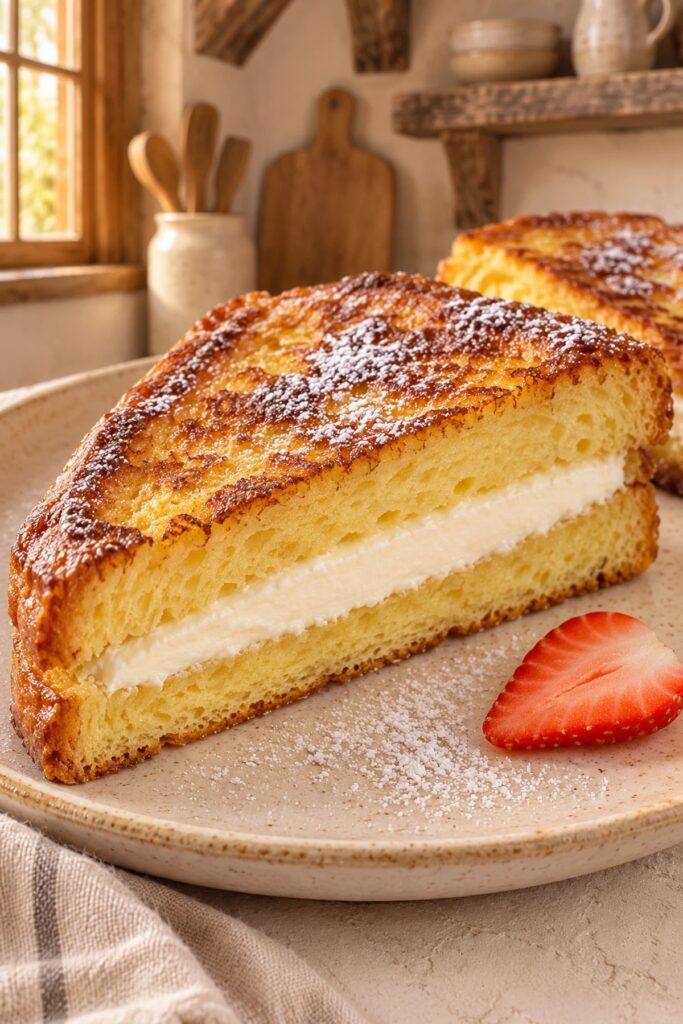
Cream cheese stuffed French toast hides a sweet, vanilla-scented layer of soft cream cheese between two thick slices of custard-soaked bread, so every diagonal cut shows a creamy white stripe under a golden, buttery crust.
Making cream cheese stuffed French toast is simple: sandwich the filling between slices of brioche or challah, give each sandwich a quick dip in a cinnamon egg custard and cook it in butter until both sides are deep golden. A short stay in a 350°F (175°C) oven finishes the job, so the center is hot and fully cooked by the time the outside is crisp.
That oven step matters more than it seems. A stuffed sandwich is about twice as thick as a regular slice of French toast, and a skillet alone tends to brown the outside before the custard in the middle has set.
This cream cheese stuffed French toast recipe makes 4 sandwiches, one per person, with the filling measured so it stays inside instead of oozing into the pan. It’s a cozy fit for Christmas morning, and just as welcome on any slow Saturday.

Why You’ll Love This Cream Cheese Stuffed French Toast
It tastes like cheesecake for breakfast. Cream cheese sweetened with a little powdered sugar and vanilla turns warm and silky inside the bread, with a gentle tang that keeps the sweetness in check.
Crisp outside, custardy inside. Thick slices and a short dip give cream cheese stuffed French toast a golden, buttery crust and a soft, set center, not a soggy one.
The filling stays put. A measured 3 tablespoons per sandwich, a clean border around the edges and a firm press seal the cream cheese in, so you don’t lose half of it to the skillet.
Brunch without a long bake. Unlike an overnight casserole, cream cheese stuffed French toast goes from cutting board to plate in about 40 minutes, with ingredients you probably already have.

Perfect For
Cream cheese stuffed French toast belongs on slow mornings: Christmas morning, a birthday breakfast in bed, Mother’s Day or a weekend brunch with friends. It looks special on the plate, but it doesn’t need any make-ahead work.
For a holiday brunch spread, set the sandwiches beside something savory, like a vegetable frittata or slices of glazed ham, so the table isn’t all sweet. If you’d rather bake one dish for a crowd, my pumpkin French toast casserole soaks overnight, and you’ll find more ideas for the season in my holiday recipes.

Cream Cheese Stuffed French Toast at a Glance
| Flavor | Buttery, vanilla and cinnamon custard with a sweet, lightly tangy cream cheese center |
| Texture | Crisp, golden outside, soft and custardy inside, with a warm, creamy filling |
| Difficulty | Easy |
| Prep Time | 15 minutes |
| Cook Time | 22 minutes (two skillet batches of about 6 minutes, then 8 to 10 minutes in the oven) |
| Rest Time | 2 minutes |
| Total Time | 39 minutes |
| Servings | 4 stuffed sandwiches (8 slices of bread) |
| Method | Pan-frying, finished in a 350°F (175°C) oven |
| Cuisine | American |
| Best For | Christmas morning, holiday brunch and slow weekend breakfasts |
Before You Start
Soften the cream cheese safely. Take it out of the refrigerator 30 to 60 minutes ahead, or unwrap it and microwave it on a plate in 10-second bursts until it spreads easily. Don’t leave it out all morning: perishable foods shouldn’t be left out of refrigeration for more than 2 hours, or for more than 1 hour above 90°F (32°C).
Use bread that’s a day old. Slightly dry slices soak up the custard without collapsing. If your loaf is very fresh, lay the slices on a rack for a few hours, or dry them in a 300°F (150°C) oven for about 8 minutes, turning once.
Set up the oven first. Heat the oven to 350°F (175°C) and set a wire rack on a rimmed baking sheet. The sandwiches go straight from the skillet to the rack, so the bottoms stay crisp while the centers finish.
Keep a thermometer nearby. An instant-read thermometer is the surest way to know the egg-soaked center of cream cheese stuffed French toast is fully cooked, since you can’t see inside a stuffed sandwich.
What Makes This French Toast Work
Sturdy, Slightly Dry Bread
Enriched breads like brioche and challah have a tight, tender crumb that drinks up custard and still holds its shape. A day on the counter dries them just enough that a short dip makes them custardy, not wet.
A Short Dip, Not a Long Soak
A stuffed sandwich has a layer of cream cheese in the middle that the custard can’t pass through, so each slice only absorbs from one side. A 10 to 15 second dip per side wets the bread without leaving a raw, eggy layer next to the filling.
A Balanced Custard
Four eggs to ¾ cup of milk makes a custard rich enough to set firmly, with only 1 tablespoon of sugar so the outside browns evenly instead of scorching. Most of the sweetness in cream cheese stuffed French toast comes from the filling and the toppings.
Sweetened Filling with a Border
Plain cream cheese tastes tangy and a little flat against sweet bread. Powdered sugar and vanilla round it out, and leaving a ½-inch (1.3 cm) bare border lets the two slices press together and seal.
Moderate Heat and an Oven Finish
Medium-low heat gives a deep golden crust in about 3 minutes per side without burning the butter. The oven then brings the thick center up to a safe temperature while the crust stays crisp.
Ingredient Notes and Substitutions
Every ingredient for cream cheese stuffed French toast is easy to find, and most of them have a simple swap.
Bread. Brioche gives the softest, richest cream cheese stuffed French toast, and challah is a little sturdier and easier to slice. Thick-cut white sandwich bread or Texas toast also works; avoid sourdough and crusty country loaves, which stay chewy and don’t seal well around the filling.
Cream cheese. Use full-fat brick cream cheese, the same kind that goes into a New York cheesecake, since it stays thick when warm. Whipped cream cheese and light or reduced-fat versions are softer and more likely to run out of the sides, so if you use them, cut the amount to about 2 tablespoons per sandwich.
Milk or cream. Whole milk gives a custard that browns well and sets firmly. For a richer, more pudding-like inside, use half milk and half heavy cream, and for a lighter one, 2% milk works fine; skim milk makes the slices thin and pale.
Filling flavor. Vanilla and powdered sugar keep the filling classic. You can add ½ teaspoon of finely grated lemon or orange zest, a pinch of cinnamon or a spoonful of jam, as in the variations below.
Butter. Unsalted butter gives the best flavor and color. If the butter browns too fast, cook with 1 teaspoon of neutral oil mixed into each tablespoon of butter, which raises the smoke point a little.
Ingredients for Cream Cheese Stuffed French Toast
These amounts make 4 sandwiches of cream cheese stuffed French toast from 8 slices of bread. A 1-pound (454 g) brioche or challah loaf gives you enough, with a few slices left over.
For the Sandwiches
- 8 slices brioche or challah, ¾ inch (2 cm) thick, about 40 g each (320 g total), preferably a day old
- 6 ounces (170 g) full-fat brick cream cheese, softened
- 2 tablespoons (16 g) powdered sugar
- ½ teaspoon (2 g) pure vanilla extract
For the Egg Mixture
- 4 large eggs (200 g)
- ¾ cup (183 g) whole milk
- 1 tablespoon (13 g) granulated sugar
- 1 teaspoon (4 g) pure vanilla extract
- ½ teaspoon (1 g) ground cinnamon
- ⅛ teaspoon (0.7 g) fine sea salt
For Cooking
- 2 tablespoons (28 g) unsalted butter, divided
For Serving (Optional)
- Maple syrup, a light dusting of powdered sugar and sliced fresh strawberries

Kitchen Equipment Needed
• Bread knife and cutting board – slice the loaf into even ¾-inch slices
• Small bowl and rubber spatula – mix the cream cheese filling
• Butter knife or small offset spatula – spread the filling with a clean border
• 9 x 13-inch (23 x 33 cm) baking dish or wide pie plate, and a whisk – hold the custard for dipping
• 12-inch (30 cm) nonstick or well-seasoned skillet, or an electric griddle – cooks two sandwiches at a time
• Wide, thin spatula – turns the sandwiches without squeezing out the filling
• Rimmed baking sheet with a wire rack – holds the sandwiches in the oven
• Instant-read thermometer – checks that the center reaches 160°F (71°C)
How to Make Cream Cheese Stuffed French Toast
Here’s the full method for cream cheese stuffed French toast, from mixing the filling to cutting the first sandwich. Each step ends with what you should see, so you can check your progress as you go.
Step 1: Heat the Oven and Prepare the Pan
Heat the oven to 350°F (175°C) with a rack in the center. Set a wire rack on a rimmed baking sheet and keep it near the stove.
What you should see: A clean wire rack sitting flat inside the baking sheet, ready to go into a fully heated oven.
Step 2: Mix the Filling
In a small bowl, stir the softened cream cheese, powdered sugar and ½ teaspoon of vanilla with a rubber spatula until completely smooth, about 1 minute.
What you should see: A thick, smooth, bright white filling with no lumps or streaks of powdered sugar, soft enough to spread like frosting.
Step 3: Assemble the Sandwiches
Lay out 4 slices of bread and spread each one with a quarter of the filling, about 3 tablespoons (47 g), leaving a ½-inch (1.3 cm) border on all sides. Top with the remaining slices and press firmly around the edges with your fingertips.
What you should see: Four neat, level sandwiches with an even white layer in the middle and no filling showing at the edges when you look at them from the side.

Step 4: Whisk the Egg Mixture
In the baking dish, whisk the eggs, milk, granulated sugar, 1 teaspoon of vanilla, cinnamon and salt for about 30 seconds.
What you should see: An even, pale golden custard with no streaks of egg white and only a few flecks of cinnamon on the surface.
Step 5: Dip the Sandwiches
Lay one sandwich in the custard for 10 to 15 seconds, then turn it with your hands or a spatula and soak the other side for 10 to 15 seconds. Lift it out, let the extra drip back into the dish, and set it on a plate; repeat with a second sandwich.
What you should see: Bread that looks evenly wet and darker on both sides and feels heavier, but still holds its shape when lifted, with no dry white patches.

Step 6: Cook the First Batch
Melt 1 tablespoon of butter in the skillet over medium-low heat until it foams. Add the two dipped sandwiches and cook for about 3 minutes, until the bottom is deep golden, then turn them gently with a wide spatula and cook the second side for about 3 minutes.
What you should see: Both sides an even, deep golden brown with a few darker spots, the butter still golden rather than dark brown, and the sandwiches slightly puffed.

Step 7: Move Them to the Oven
Transfer the first two sandwiches to the wire rack and slide the baking sheet into the oven. Wipe the skillet with a paper towel if any bits have darkened.
What you should see: Two golden sandwiches standing on the rack with space around them, and a clean skillet ready for the next batch.
Step 8: Cook the Second Batch and Finish in the Oven
Dip and cook the remaining two sandwiches the same way with the second tablespoon of butter, then add them to the rack. Bake all four for 8 to 10 minutes more, until an instant-read thermometer pushed through the side into the center of the thickest sandwich reads 160°F (71°C).
What you should see: Sandwiches that have puffed a little more, with crisp, dry-looking crusts and edges that feel firm, not soft, when you press them.
Step 9: Rest and Cut
Let the sandwiches rest on the rack for 2 minutes so the filling can settle. Cut each one in half on the diagonal with a sharp bread knife, using a gentle sawing motion.
What you should see: A clean cut through a golden crust, a soft, set, custardy crumb with no wet egg, and a creamy white layer of filling in the middle that holds its place.

Step 10: Serve Warm
Set the halves on warm plates and add your toppings: a drizzle of maple syrup, a light dusting of powdered sugar and a few sliced strawberries. Serve the cream cheese stuffed French toast right away, while the crust is still crisp.
What you should see: Two golden triangles per plate, each showing its white cream cheese center, with syrup pooling at the edges and the sugar still white on the crust.
How to Know It’s Done
You can’t see the inside of cream cheese stuffed French toast, so use the color, the feel and a thermometer. For egg dishes, the safe internal temperature for cooked eggs is 160°F (71°C), and leftover prepared eggs keep 3 to 4 days in the refrigerator.
| What to Check | Ready When |
|---|---|
| Filling | Smooth, white and spreadable, with no lumps |
| Dipped sandwich | Evenly wet and darker on both sides, still holding its shape |
| Butter in the skillet | Foaming and pale golden, not smoking or dark brown |
| First side | Deep golden brown after about 3 minutes |
| Second side | Evenly golden, with the sandwich slightly puffed |
| After the oven | Crust crisp and dry, edges firm when pressed |
| Center temperature | 160°F (71°C) on an instant-read thermometer |
| Cut sandwich | Soft, set crumb with no wet egg next to the filling |
If the center reads below 160°F (71°C) after 10 minutes, return the sheet to the oven and check again every 2 to 3 minutes. If the crust is browning faster than the center cooks, lower the heat under the skillet for the next batch.
Tips for the Best Cream Cheese Stuffed French Toast
Measure the filling. About 3 tablespoons per sandwich is enough to taste in every bite without bursting through the sides.
Press the edges well. Firm pressure around the border seals the two slices, and the custard and heat set that seal in the pan.
Dip right before cooking. Dip only the sandwiches that are going into the skillet next. A sandwich that sits in or after the custard keeps soaking and turns heavy.
Don’t rush the heat. Medium-low heat gives the custard in cream cheese stuffed French toast time to set; high heat browns the outside while the inside stays wet.
Turn once, gently. Slide a wide spatula fully under the sandwich and turn it in one motion, so you don’t squeeze the filling out of the sides.
Common Mistakes and How to Fix Them
These are the problems that most often get in the way of crisp, golden cream cheese stuffed French toast, with a fix for each one.
| Mistake | How to Fix It |
|---|---|
| Soaking the bread too long The slices turn heavy and soggy, and the center stays wet next to the filling. | Dip for 10 to 15 seconds per side, use day-old bread, and dip each sandwich just before it goes into the pan. |
| Cooking over high heat The outside burns before the custard inside has set. | Cook over medium-low heat for about 3 minutes per side, then finish in the 350°F (175°C) oven. |
| Overfilling the sandwiches The cream cheese melts out of the sides and scorches in the skillet. | Use about 3 tablespoons per sandwich, leave a ½-inch border and press the edges firmly. |
| Using cold cream cheese The filling tears the bread and spreads in thick, uneven lumps. | Soften it for 30 to 60 minutes, or microwave it in 10-second bursts until spreadable. |
| Skipping the temperature check The sandwich looks done outside but the egg in the middle is undercooked. | Bake until an instant-read thermometer reads 160°F (71°C) in the center of the thickest sandwich. |
Variations
Cream cheese stuffed French toast takes well to small changes. Keep the measured filling and the border, and try one of these.
Strawberries and Cream
Slice 4 to 6 strawberries very thin, pat them dry with a paper towel and lay a single layer over the cream cheese, keeping them inside the border. Wet or thick slices push the filling out, so dry, thin slices are the key.
Blueberry
Press 1 tablespoon of fresh blueberries into the filling on each sandwich. Frozen berries work too if you add them straight from the freezer, without thawing, since thawed berries bleed purple juice into the bread.
Lemon
Stir 1 teaspoon of finely grated lemon zest into the filling. It tastes bright and fresh with a spoonful of homemade strawberry jam on the side instead of syrup.
Cinnamon Sugar
Mix 1 tablespoon (13 g) of brown sugar and ¼ teaspoon of cinnamon into the filling. Brush the cooked sandwiches with a little melted butter and roll the tops in cinnamon sugar for a cinnamon-roll feel.
Chocolate Chip
Sprinkle 2 teaspoons of mini chocolate chips over the filling on each sandwich. Mini chips melt evenly and don’t poke through the bread the way regular chips can.
Savory Chive
Leave out the powdered sugar, vanilla, sugar and cinnamon, and stir 2 tablespoons of chopped chives and a pinch of black pepper into the cream cheese. Serve it with fried eggs or crisp bacon instead of syrup.
Ham and Cream Cheese
Make the savory chive version and add one thin slice of cooked ham to each sandwich. It’s a good use for leftover holiday ham.
Serving Suggestions
Warm maple syrup and a light dusting of powdered sugar are the classic finish for cream cheese stuffed French toast, and sliced strawberries add color and a little freshness. A spoonful of jam or lightly sweetened whipped cream works as well.
For a fuller brunch, add a savory dish like a bacon, egg and cheese sandwich for anyone who prefers salt to sweet, and a bowl of fruit or a yogurt parfait for something fresh.
A warm drink completes the table, from plain coffee to a pumpkin spice latte. If you’re building a whole breakfast menu, blueberry pancakes and thin, tender crepes cook on the same griddle, and the recipe index has plenty more breakfast ideas.
Storage
Cream cheese stuffed French toast is at its best fresh from the oven, when the crust is crisp. Refrigerate leftovers within 2 hours of cooking, in an airtight container with parchment between the sandwiches, for up to 3 days.
To reheat, set the sandwiches on a rack over a baking sheet and warm them at 350°F (175°C) for 10 to 12 minutes, until hot in the center, or use a toaster oven. The microwave works in a pinch, but the crust turns soft.
To prepare ahead, assemble the plain sandwiches, wrap them tightly and refrigerate for up to 1 day; whisk the custard and keep it covered in the refrigerator separately. In the morning, dip and cook them straight from the refrigerator, allowing 1 or 2 extra minutes in the oven.
Freezing
Cooked sandwiches: Cream cheese stuffed French toast can be frozen after cooking, which is the most practical way to keep it. Cool the sandwiches completely, freeze them in a single layer on a lined baking sheet until firm, about 1 hour, then wrap them and store them in a freezer bag for up to 1 month.
Reheat them straight from the freezer on a rack at 350°F (175°C) for 15 to 20 minutes, until hot all the way through. The filling may be slightly less smooth than fresh, since freezing makes cream cheese a little grainy.
Uncooked sandwiches: Freezing the plain, undipped sandwiches also works for up to 1 month. Thaw them overnight in the refrigerator, then dip and cook as usual; don’t freeze the custard or sandwiches that have already been dipped.
Frequently Asked Questions
Can I make cream cheese stuffed French toast ahead of time?
Yes. Assemble the sandwiches and whisk the custard the night before, and keep both covered in the refrigerator, separately. Dip and cook them in the morning, adding 1 or 2 minutes in the oven since they start cold.
What is the best bread for stuffed French toast?
Brioche and challah are the best choices, sliced ¾ inch (2 cm) thick and left out for a day. Thick-cut white bread works too, but very soft, thin sandwich bread tears when you spread the filling.
Why is my cream cheese stuffed French toast soggy in the middle?
Usually the bread was too fresh, it soaked too long, or the heat was too high, so the outside browned before the custard set. Use day-old bread, dip for 10 to 15 seconds per side and finish in the oven until the center reaches 160°F (71°C).
Can I use whipped or flavored cream cheese?
You can. Whipped cream cheese is softer and runs more easily, so use about 2 tablespoons per sandwich. Mild flavored spreads like strawberry or honey work; skip the powdered sugar if the spread is already sweet.
Do I really need the oven?
For stuffed sandwiches, yes. They’re about twice as thick as plain French toast, and the oven cooks the center through without burning the crust. Thin, single slices can be cooked in the skillet alone.
How do I keep the filling from leaking out?
Use softened brick cream cheese, about 3 tablespoons per sandwich, leave a ½-inch border and press the edges firmly. Cook over medium-low heat and turn the sandwiches once with a wide spatula.
Can I bake the whole batch instead of frying it?
Yes. Dip the sandwiches, set them in a well-buttered 9 x 13-inch pan and bake at 350°F (175°C) for about 20 minutes per side, until golden and 160°F (71°C) in the center. The crust will be softer and less crisp than pan-fried cream cheese stuffed French toast.
Final Thoughts
Day-old bread, a short dip, a sweetened filling with a clean border and a few minutes in the oven are what make this recipe reliable. You get a crisp, golden crust, a custardy inside and a creamy center that stays where it belongs.
Keep the classic vanilla version for Christmas morning, or try the strawberry or lemon filling the next time you make cream cheese stuffed French toast for a weekend brunch.
When you cut your first sandwich, did the white layer stay neatly inside, and which topping made it onto the plate? Share your answer in the comments, along with the filling you’d tuck between the slices next time.
If you try this recipe, please leave a star rating along with your comment below. It takes a few seconds and helps other readers find the recipe.

Cream Cheese Stuffed French Toast
This cream cheese stuffed French toast seals a sweet vanilla cream cheese filling between thick slices of brioche or challah, dipped in cinnamon custard and fried in butter until deep golden. A quick dip, 3 minutes per side and a short 350°F oven finish give a crisp crust and a fully cooked center. Ready in about 40 minutes, this cream cheese stuffed French toast makes 4 sandwiches for holiday brunch.
Ingredients
For the Sandwiches
- 8 slices brioche or challah, ¾ inch (2 cm) thick, about 40 g each (320 g total), preferably a day old
- 6 ounces (170 g) full-fat brick cream cheese, softened
- 2 tablespoons (16 g) powdered sugar
- ½ teaspoon (2 g) pure vanilla extract
For the Egg Mixture
- 4 large eggs (200 g)
- ¾ cup (183 g) whole milk
- 1 tablespoon (13 g) granulated sugar
- 1 teaspoon (4 g) pure vanilla extract
- ½ teaspoon (1 g) ground cinnamon
- ⅛ teaspoon (0.7 g) fine sea salt
For Cooking
- 2 tablespoons (28 g) unsalted butter, divided
For Serving (Optional)
- Maple syrup, a light dusting of powdered sugar and sliced fresh strawberries
Instructions
- Heat the oven to 350°F (175°C). Set a wire rack on a rimmed baking sheet.
- Stir 6 ounces (170 g) softened cream cheese, 2 tablespoons (16 g) powdered sugar and ½ teaspoon (2 g) vanilla until smooth.
- Spread about 3 tablespoons (47 g) of filling on each of 4 bread slices, leaving a ½-inch (1.3 cm) border. Top with the remaining slices and press the edges firmly.
- In a 9 x 13-inch dish, whisk 4 eggs, ¾ cup (183 g) milk, 1 tablespoon (13 g) sugar, 1 teaspoon (4 g) vanilla, ½ teaspoon cinnamon and ⅛ teaspoon salt.
- Dip two sandwiches, 10 to 15 seconds per side, and let the extra drip off.
- Melt 1 tablespoon (14 g) butter in a 12-inch skillet over medium-low heat. Cook the two sandwiches about 3 minutes per side, until deep golden.
- Move them to the rack in the oven. Dip and cook the remaining two sandwiches with the remaining butter and add them to the rack.
- Bake 8 to 10 minutes more, until the center of the thickest sandwich reads 160°F (71°C) on an instant-read thermometer.
- Rest 2 minutes, then cut each sandwich in half on the diagonal.
- Serve warm with maple syrup, a dusting of powdered sugar and sliced strawberries, if you like.
Notes
- Bread: Use brioche or challah sliced ¾ inch (2 cm) thick, about 40 g per slice, ideally a day old so it soaks without turning soggy.
- Cream cheese: Use full-fat brick cream cheese. Soften it 30 to 60 minutes on the counter (no more than 2 hours) or in 10-second bursts in the microwave.
- Filling: Keep to about 3 tablespoons per sandwich with a ½-inch border, so it stays inside.
- Heat: Cook over medium-low heat; high heat browns the outside before the center sets.
- Doneness: The oven finish brings the thick center to 160°F (71°C). If it is lower, bake 2 to 3 minutes more and check again.
- Make ahead: Refrigerate the assembled, undipped sandwiches and the custard separately for up to 1 day; dip and cook in the morning.
- Storage: Refrigerate leftovers within 2 hours for up to 3 days. Reheat on a rack at 350°F (175°C) for 10 to 12 minutes.
- Freezing: Freeze cooked, cooled sandwiches for up to 1 month and reheat from frozen at 350°F (175°C) for 15 to 20 minutes; the filling may turn slightly grainy.
- Nutrition: Values are per stuffed sandwich (1 of 4), with challah-style egg bread, whole milk, all of the custard and 2 tablespoons of cooking butter counted. Maple syrup, the powdered sugar dusting and strawberries are not included.
Nutrition Information:
Yield: 4 Serving Size: 1 sandwichAmount Per Serving: Calories: 561Total Fat: 31gSaturated Fat: 16gCholesterol: 289mgSodium: 710mgCarbohydrates: 51gFiber: 2gSugar: 13gProtein: 18g