Profiteroles
A cold scoop of vanilla ice cream inside a crisp, hollow shell, with warm chocolate sauce spooned over the top at the table: that play of hot and cold is the whole idea behind profiteroles.
The shells are pâte à choux, a cooked dough of water, milk, butter, flour and eggs that puffs up in the oven with nothing but steam.
The timing is what makes them so practical for guests. The shells, the ice cream scoops and the sauce can all be ready a day or more ahead, so the only job after dinner is assembly.
The batch makes 24 profiteroles, enough for 8 guests at 3 each. Every step ends with what you should see, so you can check the paste, the mounds and the baked shells as you go.
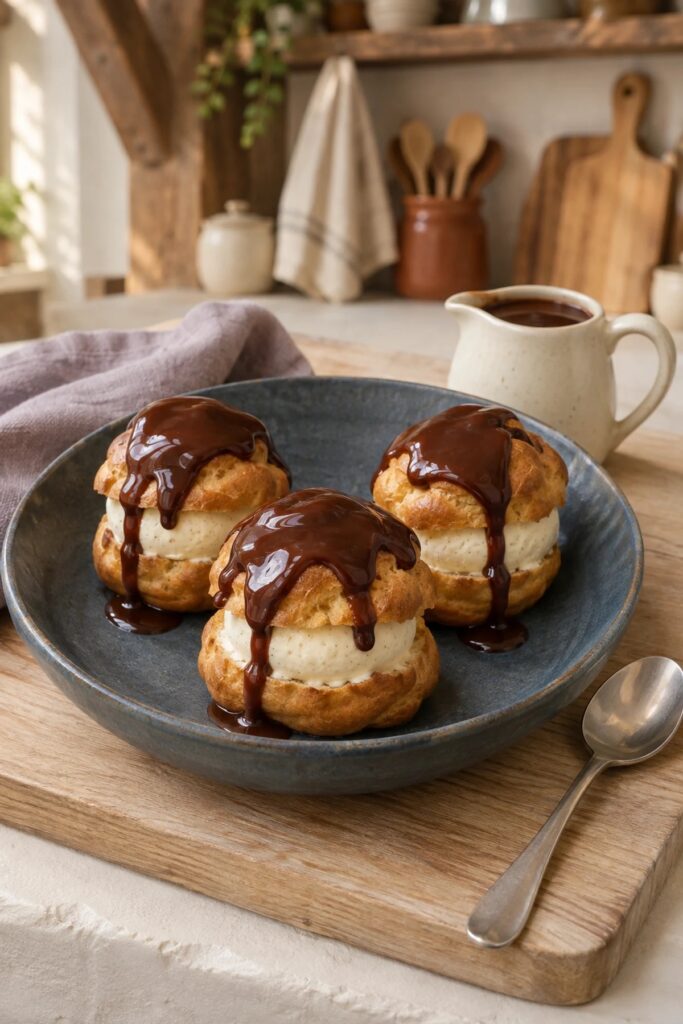
Why You’ll Love These Profiteroles
Crisp shells, cold centers. Each puff bakes deep golden and hollow, so it holds a firm scoop of ice cream without turning soft right away.
A four-ingredient sauce. Chopped chocolate, hot cream, vanilla and a pinch of salt turn into a smooth, glossy chocolate sauce in about 10 minutes.
Made for working ahead. Bake the shells days or weeks ahead, freeze the scoops and keep the sauce in the refrigerator, then assemble the profiteroles in minutes.
Clear checkpoints. The pastry is weighed in grams, and two simple tests, a film on the pan and a V-shaped ribbon, tell you the paste is right.

Perfect For
Profiteroles suit any evening when you want a plated dessert without last-minute baking: dinner parties, birthdays, an anniversary or a French-inspired dessert for two on date night.
They also belong on holiday and special-occasion dessert tables, next to a yule log cake, and the holiday recipes collection has more ideas for the season. For make-ahead entertaining, the filled puffs wait in the freezer until you need them.
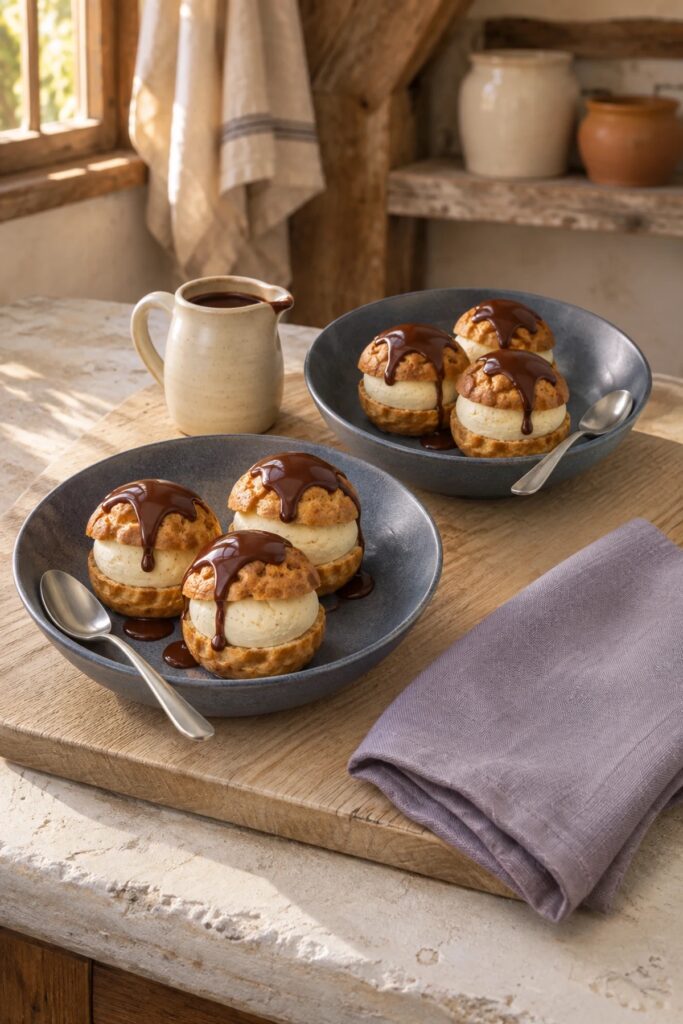
Profiteroles at a Glance
| Flavor | Buttery, toasty pastry, cold vanilla ice cream and warm semisweet chocolate |
| Texture | Thin, crisp, hollow shells, firm frozen centers and a silky sauce |
| Difficulty | Moderate: choux is easy once you know what the paste should look like |
| Prep Time | 30 minutes |
| Cook Time | 40 minutes (both pans in the oven together) |
| Cooling and Filling Time | 40 minutes |
| Total Time | 1 hour 50 minutes, plus an optional 1 hour in the freezer |
| Yield | 24 profiteroles, 8 servings of 3 |
| Oven | 400°F (200°C), then 350°F (175°C) |
| Method | Choux pastry, baked |
| Cuisine | French-inspired |
| Best For | Dinner parties, holiday dessert tables, birthdays and make-ahead entertaining |
Before You Start
Profiteroles need only a few ingredients, so a handful of details decide the result.
Weigh the flour and eggs. A cup of flour can vary by 20 g or more, and the eggs decide how soft the paste is, so a digital scale is the reliable way to match this batch.
Cook the paste until it dries. Keep stirring on the heat until the dough forms a smooth ball and leaves a thin film on the bottom of the pan.
Cool it a little, then add eggs gradually. Beat the paste until just warm, below 125°F (52°C), so the eggs don’t start to cook. Add them a little at a time and stop at a thick V; a spoonful may be left.
Start hot, and don’t peek. Check the oven with a thermometer, and keep the door closed for the first 30 minutes.
Vent the puffs. A small hole and a few minutes in the turned-off oven let the last steam out, so the shells stay crisp.
Plan the ice cream. Scoop firm vanilla ice cream onto a cold, lined tray while the shells bake, and freeze the scoops until you fill.
Follow a make-ahead timeline. Bake the shells up to 2 days ahead or freeze them for a month, and make the sauce up to a week ahead. On the day, fill the puffs and freeze them for at least 1 hour; that optional time isn’t counted in the total.
What Makes These Profiteroles Work
Steam Does the Lifting
Choux has no baking powder or yeast. In a hot oven the water in the dough turns to steam and inflates each mound, while the eggs and cooked flour stretch and set into a hollow shell.
Cooking the Paste Dries It
A few minutes on the stove drives off some water and swells the starch, so the paste can take more egg. More egg means a taller, lighter puff.
Eggs in Small Additions
The paste looks split after each addition, then comes back together. Going slowly lets you stop at the right moment, because a paste with too much egg spreads instead of rising.
A Hot Start, Then a Lower Oven
At 400°F (200°C) the puffs rise fast and set their shape, and 350°F (175°C) then dries and browns the walls. Opening the door early lets in cool air before they’re firm.
Venting Keeps Them Crisp
A puff can look done with steam still trapped inside. A small hole and a short rest in the turned-off oven let it escape, so the inside dries instead of turning soft and eggy.
Cold Ice Cream, Warm Sauce
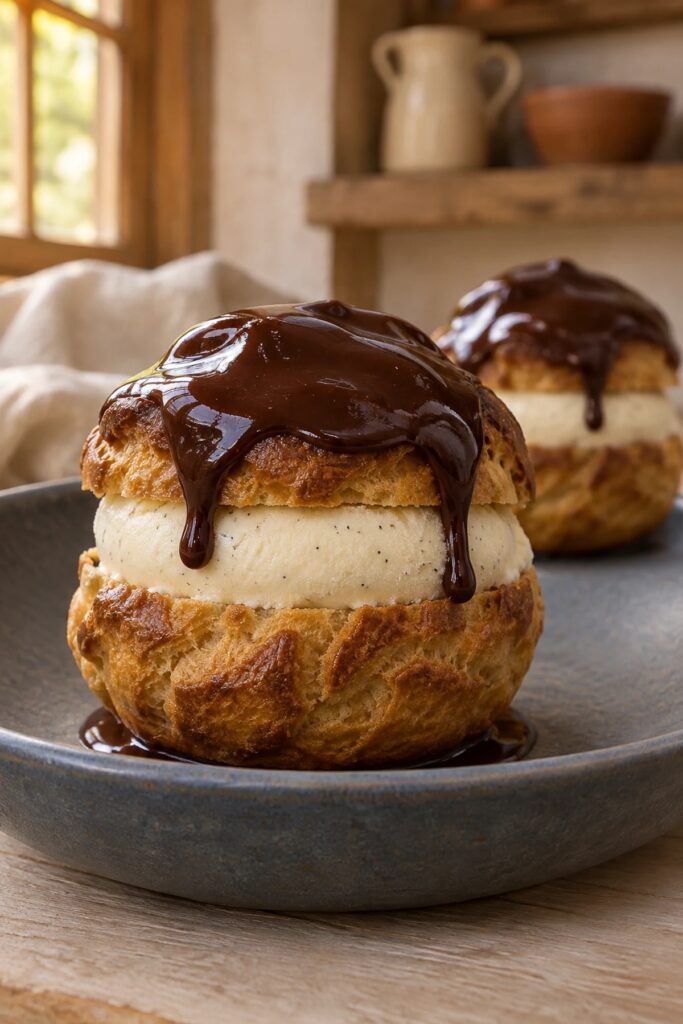
A dry, crisp shell holds a frozen scoop for several minutes, which is why profiteroles with ice cream work so well. The sauce goes on warm, not hot, so it coats the tops without melting the filling into a puddle.
Ingredient Notes and Substitutions
Everything for these profiteroles comes from a regular supermarket.
Flour. All-purpose flour is what most classic choux recipes use. Weigh 125 g; that’s about 1 cup spooned and leveled, but scooped cups often hold more.
Water and milk. Half water and half whole milk gives shells that are crisp and nicely browned. All water makes slightly crisper, paler puffs, and all milk browns them faster.
Butter. Use unsalted butter cut into pieces, so it melts before the water boils away. Well-drained homemade butter works in the same amount.
Eggs. Use 4 large eggs, about 200 g without shells, beaten together. The paste usually takes about 190 g, but flour and humidity change that a little.
Sugar and salt. A teaspoon of sugar helps the shells brown, and the salt keeps the pastry from tasting flat next to the sweet filling.
Ice cream. Firm, good-quality vanilla ice cream scoops cleanly and holds its shape longest.
Chocolate. Chop a semisweet or bittersweet baking bar, about 55 to 65% cacao. Chips contain less cocoa butter so they keep their shape in cookies, and melted into a sauce they turn thicker and a little grainy.
Heavy cream. Heavy cream gives a pourable, glossy sauce. Milk or half-and-half makes it thin and dull, so keep the cream.
Allergens. Chocolate profiteroles contain wheat, eggs and milk, which are all on the FDA’s list of major food allergens, alongside peanuts, tree nuts, soybeans, fish, shellfish and sesame. Check the chocolate and ice cream labels too, and tell your guests.
What not to substitute. Gluten-free or whole wheat flour absorbs liquid differently, and egg replacers can’t give choux its rise, so both bake into dense, flat puffs with these amounts.
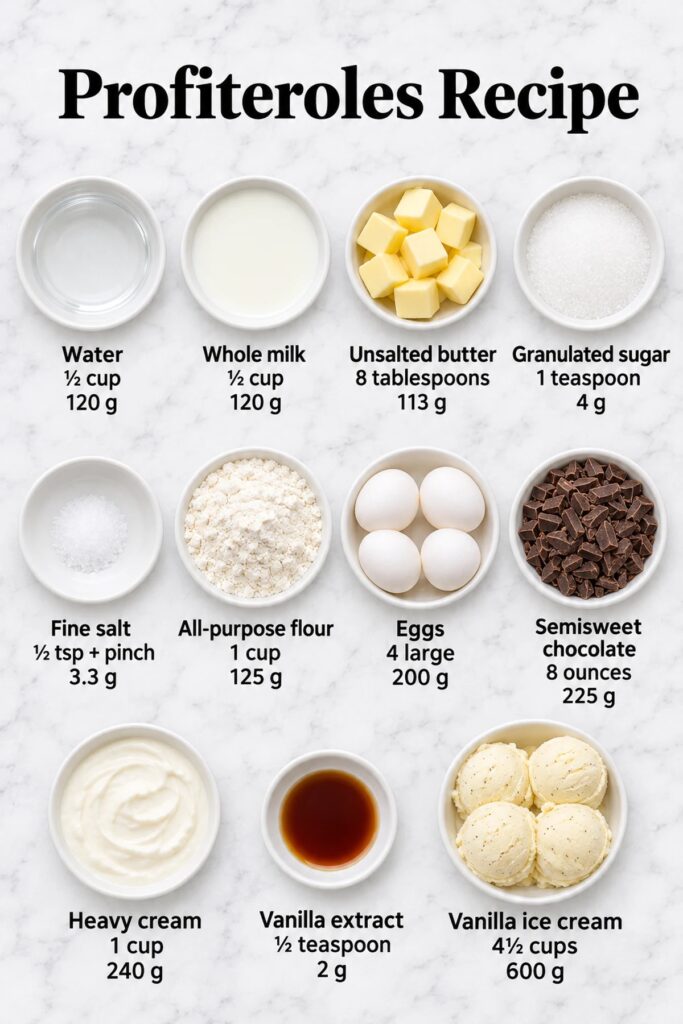
Ingredients for Profiteroles
These amounts make 24 profiteroles, about 26 g of paste each, with enough sauce for 8 servings and a little extra for the jug. Weighing the pastry is the reliable way to make it; the cup measures are only a guide.
For the Choux Puffs
- 120 g (½ cup) water
- 120 g (½ cup) whole milk
- 113 g (8 tablespoons) unsalted butter, cut into pieces
- 4 g (1 teaspoon) granulated sugar
- 3 g (½ teaspoon) fine salt
- 125 g (1 cup, spooned and leveled) all-purpose flour
- 4 large eggs (about 200 g without shells), lightly beaten (you’ll use about 190 g)
For the Chocolate Sauce
- 225 g (8 ounces) semisweet or bittersweet chocolate, finely chopped
- 240 g (1 cup) heavy cream
- ½ teaspoon (2 g) pure vanilla extract
- 1 pinch fine salt
For Filling
- 600 g (about 4½ cups) firm vanilla ice cream, from one 1½-quart (48-ounce) carton
Kitchen Equipment Needed
• Digital kitchen scale – weigh the flour and eggs
• Oven thermometer – check for a true 400°F (200°C)
• Medium heavy saucepan and a wooden spoon or sturdy spatula – cook the paste
• Hand or stand mixer (optional) – beat in the eggs; a wooden spoon works with more effort
• Piping bag with a ½-inch (1.3 cm) plain round tip – a zip-top bag with a corner snipped off also works, with less even mounds
• 2 rimmed half sheet pans (13 x 18 inches) and parchment paper
• Skewer and wire rack – vent and cool the shells
• 3-tablespoon (#20) cookie scoop – portion the ice cream
• Serrated knife – split the puffs
• Small saucepan, heatproof bowl and a small jug – for the sauce
How to Make Profiteroles
This profiteroles recipe moves quickly at the egg stage, so read it through once before you start.
Step 1: Heat the Oven and Line the Pans
Set racks in the upper and lower thirds of the oven and heat it to 400°F (200°C), thermometer inside. Line 2 half sheet pans with parchment, fit the bag with the tip and beat the eggs in a spouted measuring cup.
What you should see: Two lined pans, a bag ready in a tall glass and about 200 g of evenly yellow beaten egg.
Step 2: Bring the Liquid to a Boil
Put the water, milk, butter, sugar and salt in the saucepan over medium heat. Let the butter melt completely, then bring it all to a full, rolling boil.
What you should see: No butter pieces left and big bubbles across the whole surface, not just at the edges.
Step 3: Add the Flour and Cook the Paste
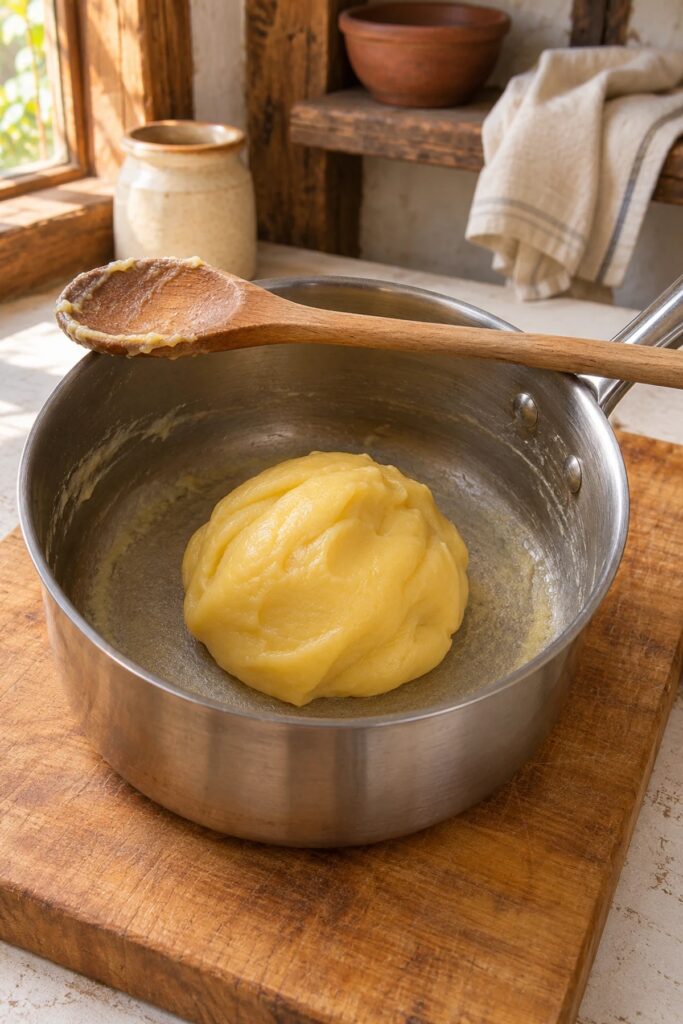
Off the heat, add all the flour at once and stir hard until no dry flour remains. Return the pan to medium-low heat and keep stirring and pressing the dough against the pan for 2 to 3 minutes.
What you should see: A smooth, glossy, pale yellow-cream ball pulling away from the sides, with a thin film of cooked dough on the bottom of the pan.
Step 4: Cool the Paste
Move the paste to a large bowl and beat it on low speed, or with the spoon, for 2 to 3 minutes to release the steam.
What you should see: Only a wisp of steam and a paste that feels warm but comfortable, below 125°F (52°C) on an instant-read thermometer.
Step 5: Beat in the Eggs Gradually
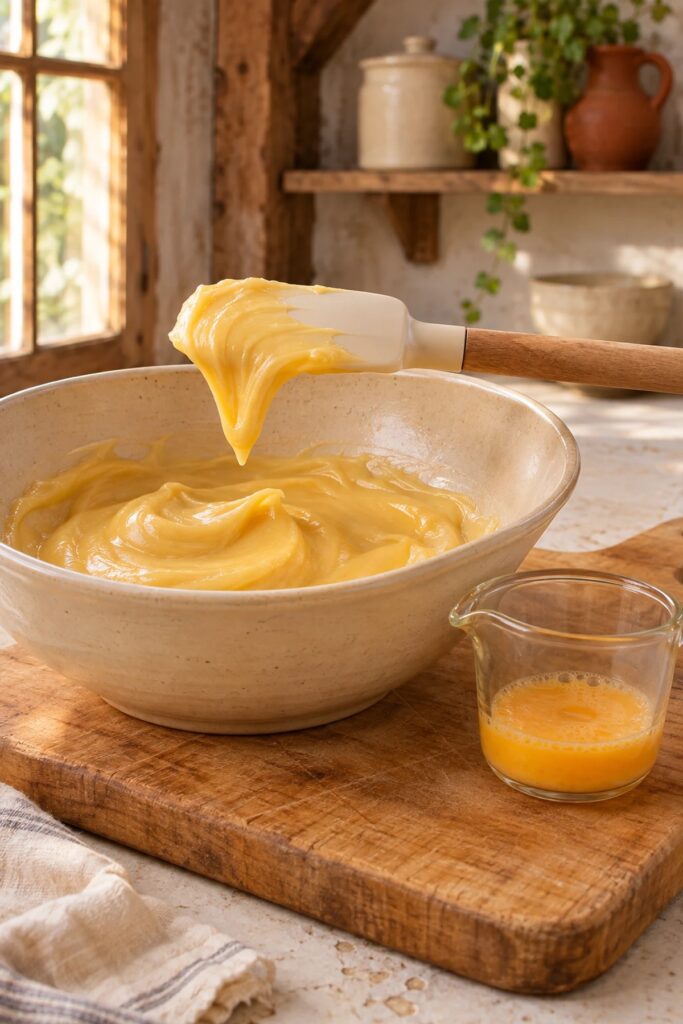
Add the egg in 4 or 5 additions, beating until each one disappears. After about three-quarters, lift the spatula after every spoonful and stop as soon as the paste hangs in a thick V.
What you should see: A smooth, glossy, pale golden paste that falls slowly from the spatula and leaves a thick, V-shaped ribbon hanging from its edge.
Step 6: Pipe the Mounds
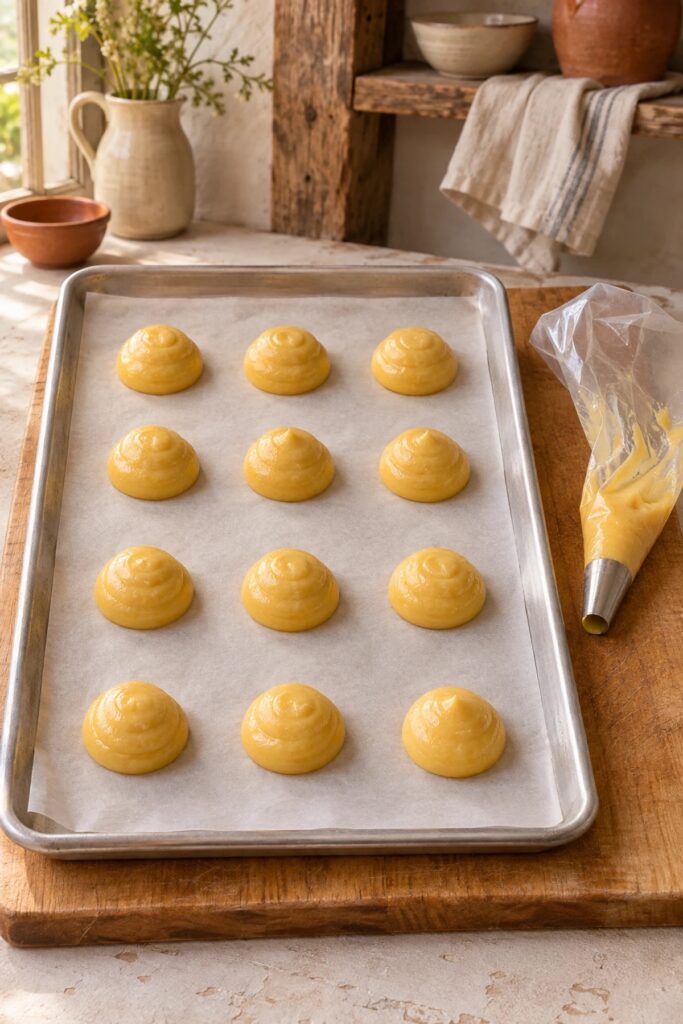
Dab a little paste under the parchment corners to hold them down. Holding the bag straight up, pipe 12 mounds per pan in 4 rows of 3, each about 1¾ inches (4.5 cm) wide, just under 1 inch (2.5 cm) tall and 26 g, about 2 inches (5 cm) apart. Press down each point with a damp fingertip.
What you should see: 24 smooth, round, even mounds with softly rounded tops and plenty of room between them.
Step 7: Bake Hot, Then Lower
Bake both pans for 15 minutes at 400°F (200°C). Without opening the door, lower the oven to 350°F (175°C) and bake 20 to 25 minutes more, until deep golden all over, even in the creases.
What you should see: Round shells about 2½ inches (6 cm) across, deep golden brown with a few darker crags, and firm sides that don’t give when pressed lightly.
Step 8: Vent, Dry and Cool
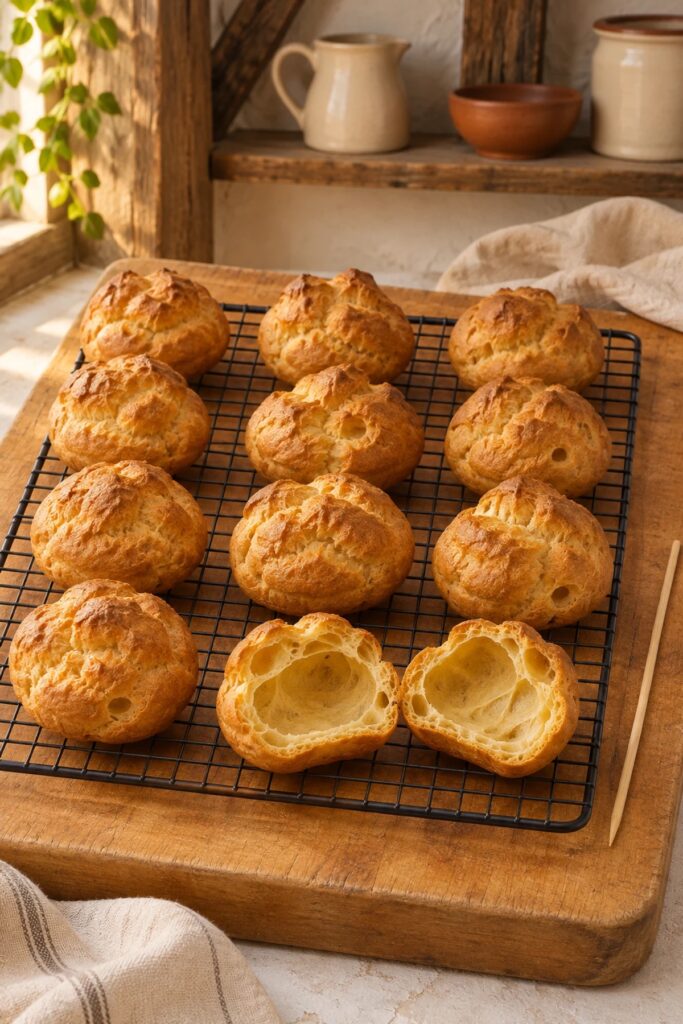
Turn off the oven. Poke a small hole in the side of each puff with a skewer, switch the pans between racks and return them to the oven, door propped open, for 10 minutes. Cool on a wire rack for about 20 minutes.
What you should see: Shells that keep their shape, sound hollow when tapped underneath and, split open, show a hollow inside with thin, dry walls.
Step 9: Scoop the Ice Cream
While the puffs bake, chill a parchment-lined tray in the freezer for 10 minutes. Scoop 24 level balls of ice cream with the 3-tablespoon scoop, about 25 g each, and freeze them on the tray for at least 30 minutes.
What you should see: 24 round, firm scoops with clean edges, with no melted ring on the parchment.
Step 10: Make the Chocolate Sauce
Put the chocolate and salt in a heatproof bowl. Heat the cream until it steams and small bubbles form at the edge, pour it over the chocolate, wait 3 to 5 minutes, then stir from the center until smooth and add the vanilla.
What you should see: A dark, glossy sauce with no streaks or flecks, thick enough to coat a spoon and still pourable.
Step 11: Split and Fill
Cut each shell in half crosswise with the serrated knife, a little above the middle. Set a frozen scoop on each base, press the lid on gently and return the filled profiteroles to the cold tray. Serve now, or freeze them for at least 1 hour, up to 1 day.
What you should see: A ring of ivory ice cream showing between golden halves, with level lids.
Step 12: Sauce and Serve
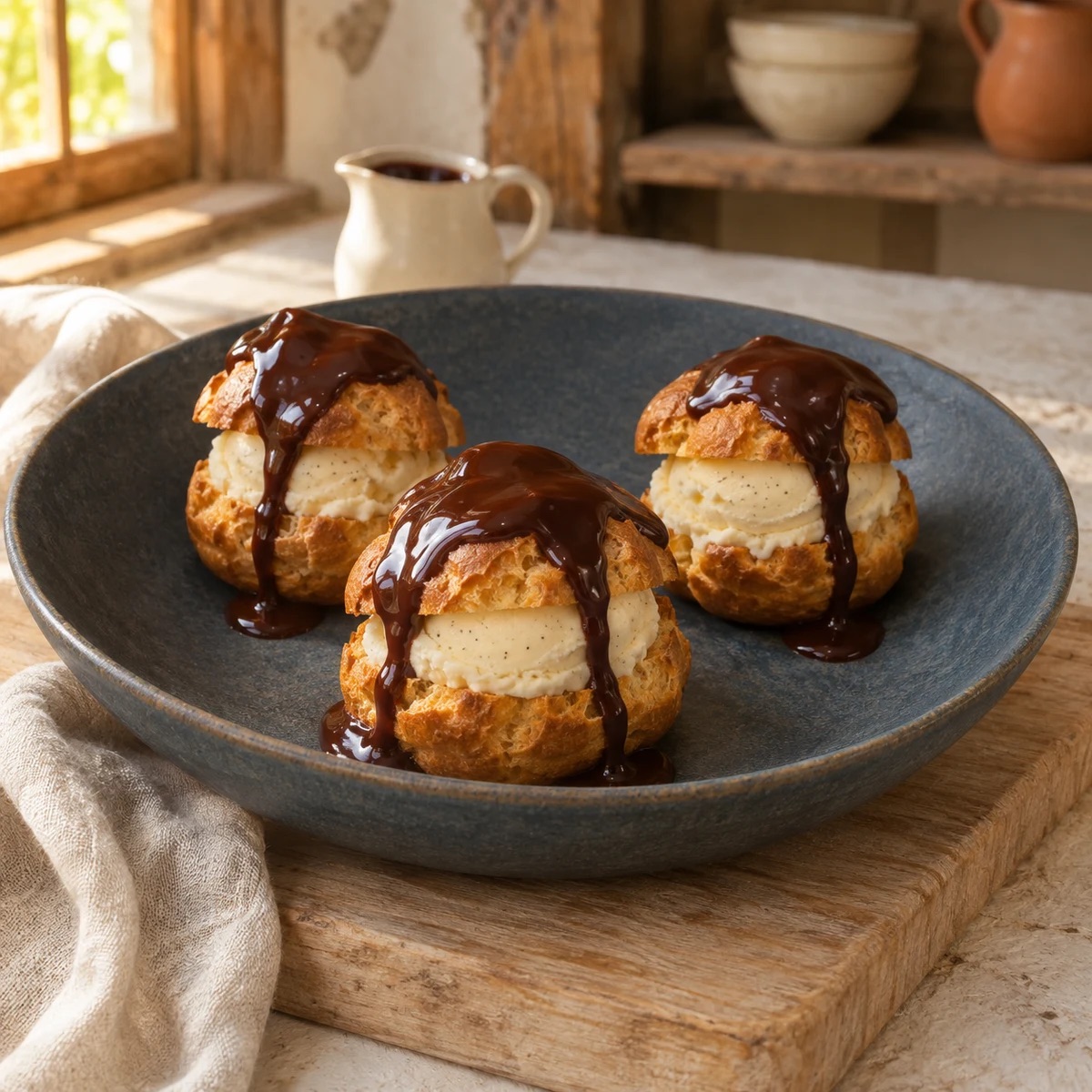
Let frozen puffs stand at room temperature for about 5 minutes. Set 3 in each shallow bowl, spoon about 3 tablespoons (50 g) of warm sauce over the tops and serve the profiteroles right away, with the rest of the sauce in a jug.
What you should see: Glossy sauce coating the lids and running partway down the sides, with the ice cream still firm inside.
How to Know It’s Done
Profiteroles give clear signs at each stage, so use them along with the times.
| What to Check | Ready When |
|---|---|
| The cooked paste | A smooth ball that leaves the sides, with a thin film on the bottom of the pan |
| The finished dough | Glossy, hanging from the spatula in a thick V that slowly drops |
| The baked puffs | Deep golden even in the creases, light in the hand, firm at the sides |
| After drying | Hollow inside with thin, dry walls |
| The sauce | Dark, glossy and smooth, coating a spoon but still pouring |
| The filled profiteroles | Ice cream firm at the seam, lids level, shells still crisp |
If the creases still look pale after 25 minutes at 350°F, bake 5 minutes more, since pale shells sink as they cool. If a split shell is damp inside, give the batch 5 more minutes at 350°F, then dry it again.
Tips for the Best Profiteroles
Pour the eggs from a spouted cup. It lets you add the last of the egg a spoonful at a time, which is where the paste goes from right to too soft.
Weigh a few mounds. At about 26 g each, the puffs bake at the same speed.
Switch pans only once they’re firm. Moving the pans after the shells have set evens out the color without risking a collapse.
Keep everything cold. A chilled tray, frozen scoops and quick work keep the filling firm; fill in batches of 6 or 8 and return each batch to the freezer.
Serve the sauce warm, not hot. Let it cool for a few minutes so it feels pleasantly warm on a fingertip, glossy enough to coat the profiteroles without melting the ice cream.
Common Mistakes and How to Fix Them
These are the problems that come up most often with profiteroles, with the usual cause and the fix.
| Mistake | How to Fix It |
|---|---|
| Puffs collapse after baking They rise, then sink and wrinkle as they cool. | Bake until deep golden even in the creases, keep the door shut for the first 30 minutes, and vent only once the shells feel firm. |
| Puffs spread flat The mounds slump into low discs. | Stop adding egg at a thick V, cook the paste until it leaves a film, and check that the oven really reads 400°F (200°C). |
| Soggy or eggy inside The walls are thick, damp and taste of raw egg. | Vent every puff and dry it in the turned-off oven, bake 5 minutes more if a split shell is wet, and fill only cool, crisp shells. |
| Lopsided or cracked puffs Some lean, split at the side or brown unevenly. | Pipe straight down into even 26 g mounds, press down every point with a damp fingertip and switch the pans only after the shells set. |
| Sauce seizes or turns too thick It looks grainy and stiff, or sets as it cools. | Melt it gently and keep stray drops of water out. If it turns grainy, whisk in warm water a teaspoon at a time; rewarm a thick sauce over barely simmering water. |
Variations
The shells and method stay the same; only the filling, the sauce or the size of your profiteroles changes.
Whipped Cream Filling
Whip 2 cups (480 g) cold heavy cream with ¼ cup (50 g) sugar and 1 teaspoon vanilla to stiff peaks, stopping while it still looks smooth. Fill just before serving, since cream softens the shells faster than ice cream.
Pastry Cream Filling
Make the vanilla pastry cream from the choux au craquelin recipe and chill it well. One batch fills all 24 puffs with about 1½ tablespoons each through a small hole in the base, and the craquelin from that recipe can top these smaller puffs too.
Mocha Sauce
Stir 2 tablespoons (30 g) of strong brewed coffee into the finished sauce with the vanilla. It pairs well with vanilla, coffee or toasted almond ice cream, scooped the same way.
Bite-Size Profiteroles
Pipe about 48 mounds 1¼ inches (3 cm) wide and 13 g each, 24 per pan in 6 rows of 4. Bake 12 minutes at 400°F (200°C), then 10 to 15 minutes at 350°F (175°C), and fill each with about 1½ tablespoons of ice cream.
Serving Suggestions
Serve three profiteroles per person in shallow bowls or rimmed dessert plates, so the sauce has somewhere to go, and pass the jug for extra.
For a French dessert spread, add buttery madeleines, crisp palmiers and sugar-rimmed French sablés. A plate of French macarons makes a pastel contrast to the dark chocolate, and the French recipes page has more.
If your crowd loves frozen desserts, try brownie ice cream sandwiches or a make-ahead ice cream cake next, and browse the recipe index for the rest of the menu.
Make Ahead
Each part of these profiteroles keeps on its own schedule.
Shells: Keep cooled shells airtight at room temperature for up to 2 days. Crisp them at 300°F (150°C) for about 5 minutes and cool before filling.
Ice cream scoops: Freeze them uncovered for up to 2 hours, or cover the tray with plastic wrap for longer.
Sauce: Make it up to 1 week ahead and refrigerate it covered; warm it gently before serving.
Filled puffs: Fill them up to 1 day ahead, freeze on the tray until solid, then cover.
Storage
Filled profiteroles belong in the freezer, never the refrigerator, where the ice cream melts and soaks the shells. Keep leftovers in a single layer in an airtight container in the freezer; the shells are crispest within a day and keep up to 2 weeks.
Chocolate sauce: Refrigerate it in a covered jar for up to 1 week. Rewarm it over barely simmering water, stirring, or in the microwave in 15-second bursts.
Freezing
Baked shells: Freeze cooled, unfilled shells in a single layer until firm, then in a freezer bag for up to 1 month. As a guide, unfilled baked puffs keep for 2 days in an airtight container, and frozen baked puffs crisp up in a 300°F oven in 5 to 8 minutes. Cool them before filling.
Filled profiteroles: Frozen on a tray and wrapped airtight, they keep up to 2 weeks, though the shells soften a little with time. Don’t freeze the sauce on them; add it warm at serving.
Frequently Asked Questions
What is the difference between profiteroles, cream puffs and éclairs?
All three use the same choux pastry. Profiteroles are small round puffs, often filled with ice cream and served with chocolate sauce; cream puffs are usually larger and filled with whipped cream or pastry cream; éclairs are long fingers filled with pastry cream and glazed with chocolate.
Why are my profiteroles dense instead of hollow?
They were most likely underbaked, or the oven ran cool, so the inside set before it could puff and dry. Bake at a true 400°F, then 350°F, until deep golden in the creases, and dry them in the turned-off oven.
How do I know the paste is ready for the oven?
It should be glossy and hang from the spatula in a thick V that slowly drops. If it breaks off in a stiff clump, beat in a little more egg; if it runs off in a thin stream, it has too much.
Can I use whipped cream or pastry cream instead of ice cream?
Yes. Whipped cream goes in just before serving, while pastry cream can be piped in an hour or two ahead and kept refrigerated. Both are in the Variations section.
Can I make them without a piping bag?
Yes. Snip a ½-inch (1.3 cm) corner off a zip-top bag, or drop 26 g mounds with a cookie scoop or two spoons and smooth them with a damp fingertip. They come out a little less round but bake the same way.
Can I fill them hours ahead and keep them in the refrigerator?
No. In the refrigerator the ice cream melts and soaks into the shells. Fill them ahead only if they go straight into the freezer.
How do I keep the sauce warm during dinner?
Leave it in its heatproof bowl over a pan of hot water with the heat off, and stir before serving. If it thickens, stir in a teaspoon or two of warm cream.
Final Thoughts
A paste cooked until it leaves a film, eggs added just until the V appears, a hot oven with the door closed and a few minutes of drying give you crisp, hollow shells. Firm ice cream and a warm, glossy sauce do the rest.
Because every part waits happily in the freezer or refrigerator, these profiteroles turn dessert for guests into a few calm minutes of assembly. Once the vanilla version feels easy, try the mocha sauce or the bite-size puffs.
Tell me in the comments how far ahead you baked your shells and which ice cream ended up inside them, because it helps the next person planning a dinner party.
If you try this recipe, please leave a star rating along with your comment below. It takes a few seconds and helps other readers find the recipe.
Profiteroles
These profiteroles are small, crisp, hollow choux puffs filled with cold vanilla ice cream and finished with a warm, glossy chocolate sauce. The pastry is cooked on the stove, beaten with eggs to a thick V and baked at 400°F, then 350°F, until dry and crisp. The recipe makes 24 profiteroles, 8 servings of 3, and every part can be made ahead for dinner parties and holiday tables.
Ingredients
For the Choux Puffs
- 120 g (½ cup) water
- 120 g (½ cup) whole milk
- 113 g (8 tablespoons) unsalted butter, cut into pieces
- 4 g (1 teaspoon) granulated sugar
- 3 g (½ teaspoon) fine salt
- 125 g (1 cup, spooned and leveled) all-purpose flour
- 4 large eggs (about 200 g without shells), lightly beaten (you’ll use about 190 g)
For the Chocolate Sauce
- 225 g (8 ounces) semisweet or bittersweet chocolate, finely chopped
- 240 g (1 cup) heavy cream
- ½ teaspoon (2 g) pure vanilla extract
- 1 pinch fine salt
For Filling
- 600 g (about 4½ cups) firm vanilla ice cream, from one 1½-quart (48-ounce) carton
Instructions
- Heat the oven to 400°F (200°C) with racks in the upper and lower thirds. Line 2 half sheet pans with parchment and fit a piping bag with a ½-inch (1.3 cm) round tip.
- Bring 120 g (½ cup) water, 120 g (½ cup) milk, 113 g (8 tablespoons) butter, 4 g (1 teaspoon) sugar and 3 g (½ teaspoon) salt to a full boil, with the butter melted.
- Off the heat, stir in 125 g (1 cup) flour all at once. Cook over medium-low heat, stirring and pressing, for 2 to 3 minutes, until a smooth ball forms and a film coats the pan.
- Beat the paste in a bowl for 2 to 3 minutes, until just warm, below 125°F (52°C).
- Beat in the 4 beaten eggs (about 200 g) in 4 or 5 additions, stopping when the paste is glossy and hangs from the spatula in a thick V (about 190 g).
- Pipe 12 mounds per pan, 4 rows of 3, each about 1¾ inches (4.5 cm) wide and 26 g, 2 inches (5 cm) apart. Press down the points with a damp fingertip.
- Bake both pans 15 minutes at 400°F (200°C), then, without opening the door, 20 to 25 minutes at 350°F (175°C), until deep golden and firm.
- Turn off the oven. Poke a hole in the side of each puff, switch the pans and dry them in the oven with the door propped open for 10 minutes. Cool on a rack about 20 minutes.
- While the puffs bake, scoop 24 balls of vanilla ice cream (3 tablespoons, about 25 g each) onto a chilled, parchment-lined tray and freeze at least 30 minutes.
- Heat 240 g (1 cup) heavy cream until steaming, pour over 225 g (8 ounces) chopped chocolate and a pinch of salt, wait 3 to 5 minutes and stir until smooth. Stir in ½ teaspoon vanilla.
- Split the shells crosswise with a serrated knife, set a frozen scoop in each and replace the tops. Serve, or freeze on the tray at least 1 hour, up to 1 day.
- Serve 3 per person with about 3 tablespoons (50 g) of warm chocolate sauce spooned over the top.
Notes
- Weigh the pastry: Weigh the flour and the beaten eggs; cup measures of flour vary enough to change the paste.
- Eggs: Add the eggs gradually and stop when the paste falls in a thick V; you may have about 10 g left over.
- Oven: Check the oven with a thermometer and keep the door closed for the first 30 minutes. Bake until deep golden, even in the creases, so the shells don’t sink.
- Venting: Vent and dry the puffs in the turned-off oven, so the inside stays dry and crisp under the ice cream.
- Sauce: Use chopped bar chocolate for the smoothest sauce. If it turns grainy, whisk in warm water a teaspoon at a time; rewarm a thick sauce over barely simmering water.
- Make ahead: Shells keep 2 days airtight or 1 month frozen (crisp at 300°F/150°C for 5 to 8 minutes). The sauce keeps 1 week refrigerated. Filled puffs can be frozen on a tray up to 1 day ahead (up to 2 weeks wrapped airtight); this optional freezer time is not included in the total time.
- Storage: Keep filled profiteroles in the freezer, never the refrigerator, and let them stand 5 minutes before adding warm sauce.
- Nutrition: Values are per serving (3 filled profiteroles, 1 of 8). They count the whole batch of choux pastry with all 4 eggs (an upper estimate), 3 tablespoons (about 25 g) of regular vanilla ice cream per puff and about 50 g of chocolate sauce per serving; the sauce left in the jug is not counted. A premium, denser ice cream adds more per scoop.
Nutrition Information:
Yield: 8 Serving Size: 3 profiterolesAmount Per Serving: Calories: 578Total Fat: 39gSaturated Fat: 24gCholesterol: 188mgSodium: 274mgCarbohydrates: 46gFiber: 3gSugar: 29gProtein: 10g