Croque Monsieur
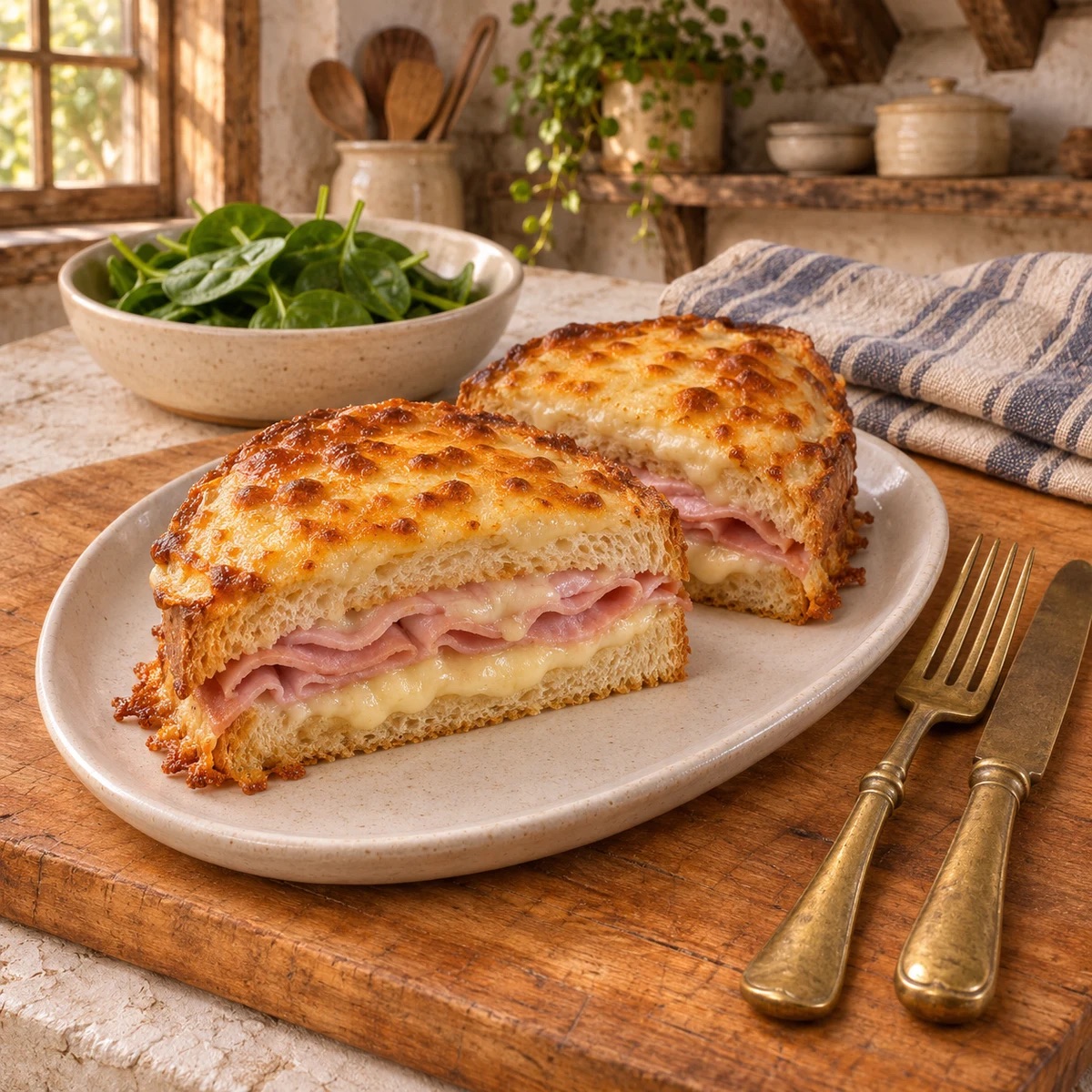
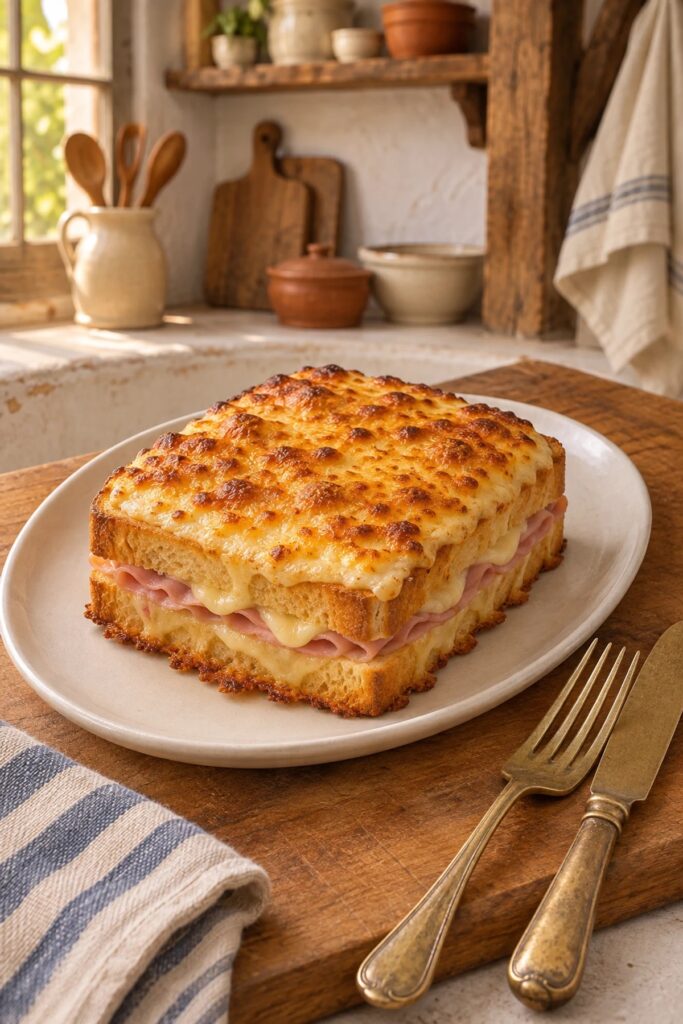
Golden, bubbling and freckled with brown spots, the top of a croque monsieur hides a creamy layer of béchamel over toasted bread, thin-sliced ham, a swipe of Dijon and melted Gruyère.
Think of it as a French ham and cheese sandwich that went to the oven instead of the skillet. The bread is toasted first, the sauce goes on top, and a couple of minutes under the broiler turn the cheese into a crisp, nutty crust.
The shopping list for a croque monsieur comes from a regular supermarket: sturdy white sandwich bread, deli ham, a block of Gruyère, butter, flour, whole milk and a little nutmeg. The only real cooking is a five-minute white sauce.
This croque monsieur recipe makes 4 sandwiches on one sheet pan, one per person for lunch with a salad, or cut in half as a lighter bite. Each step below ends with what you should see, so you know when to move on.
Why You’ll Love This Croque Monsieur
A crisp, golden top. The broiler browns the béchamel and Gruyère into a bubbling, speckled crust that you eat with a knife and fork.
Four sandwiches at once. All 4 croque monsieur sandwiches toast, bake and broil on a single rimmed sheet pan, so nobody waits at the stove for the next batch.
Bread that stays crisp. Toasting the slices with a brush of butter before assembly keeps the bottom firm under the sauce and the melted cheese.
Simple, familiar ingredients. Ham, Gruyère, Dijon and a basic white sauce are all it takes, and leftover holiday ham works as well as deli ham.

Perfect For
A croque monsieur fits easily into a weekend brunch, next to a quiche Lorraine or a plate of cream cheese stuffed French toast for anyone who wants something savory.
For lunch, one croque monsieur and a lightly dressed green salad make a full plate. On a cold weeknight, it turns a bowl of soup into dinner, and a tray of halves works well for casual entertaining.
It is also one of the best ways to use up leftover ham after a big meal, and you’ll find more ideas for those menus in the holiday recipes collection.
Croque Monsieur at a Glance
| Flavor | Salty ham, nutty Gruyère, a little bite of Dijon and a mild, creamy béchamel with a hint of nutmeg |
| Texture | Crisp toasted bread, soft melted cheese inside and a bubbling, browned, slightly chewy top |
| Difficulty | Easy (the white sauce is the only step that needs attention) |
| Prep Time | 15 minutes |
| Cook Time | 20 minutes (toast, bake and broil) |
| Rest Time | 5 minutes |
| Total Time | 40 minutes |
| Servings | 4 sandwiches, 1 per person |
| Oven | 400°F (200°C), rack about 6 inches (15 cm) below the broiler, then broil |
| Cuisine | French-inspired |
| Best For | Brunch, lunch with a salad, soup nights and using leftover ham |
Before You Start
A croque monsieur has only a handful of parts, so the choices you make before you turn on the oven decide most of the result.
Choose thick, sturdy bread. Look for a firm white sandwich loaf or pain de mie sliced about ½ inch (1.3 cm) thick. Thin, airy bread bends under the sauce and turns soft.
Buy thin-sliced ham. Plain deli ham sliced thin folds neatly and warms through in the oven. Skip honey-glazed or heavily smoked ham, which can taste sweet or overpower the cheese.
Grate the Gruyère yourself. A block grated on the large holes of a box grater melts smoothly and browns evenly, while bagged shreds can turn grainy.
Make the béchamel thick but spreadable. For a croque monsieur with béchamel on top, the sauce should hold soft ridges when you spread it, like thick yogurt. A thin sauce runs off the bread, and a stiff one drags and tears the toast.
Use a rimmed sheet pan. A rim catches any cheese that slides off the edges. Skip parchment, which can scorch under the broiler; a bare pan or a sheet of foil works best.
Set the rack before you start. Place it about 6 inches (15 cm) below the broiler element, so the same position works for toasting, baking and the final broil.
What Makes This Croque Monsieur Work
The Béchamel Goes on Top
Spread over the top slice, the sauce bakes into a creamy layer and then browns under the broiler with the cheese. Inside the sandwich it would only soak into the bread.
Gruyère for Flavor and Melt
Gruyère melts smoothly without turning oily, browns well and has a nutty, savory flavor that stands up to salty ham. A little of it in the sauce makes the béchamel richer and helps the topping hold together.
The Bread Is Toasted First
A few minutes in the oven dries and crisps the surface of each slice, so it holds up against the mustard, the melting cheese and the sauce on top. Untoasted bread steams under all that and goes soft.
A Short Bake, Then the Broiler
The bake warms the ham and melts the cheese inside a croque monsieur, while the broiler does the browning. Broiling alone would scorch the top before the center gets hot.
A Few Minutes of Rest
Five minutes on the pan lets the topping set slightly, so the cheese doesn’t slide off in one sheet when you cut the croque monsieur in half.

Ingredient Notes and Substitutions
Every ingredient for this croque monsieur is a regular supermarket item, and most have an easy swap.
Bread. A sturdy white sandwich loaf or pain de mie sliced about ½ inch (1.3 cm) thick works best, crust on. Brioche turns too sweet and soft, while a homemade sourdough loaf makes a chewier, tangier version.
Ham. Thin-sliced deli ham, about 2 ounces (57 g) per sandwich, is the base. Leftover glazed ham works too: slice it thin and trim off most of the sweet crust, so the sandwich stays savory.
Gruyère, Swiss, Emmental or Comté. Gruyère gives a croque monsieur the deepest flavor and browns best. Comté tastes similar and a little milder, Emmental is mild and stretchy, and regular Swiss melts well but tastes lighter.
Milk. Whole milk makes a creamy béchamel that thickens properly. Two percent milk works with a slightly thinner result.
Nutmeg and pepper. A small pinch of nutmeg, freshly grated if you can, gives the sauce its warm note. Black pepper is fine; white pepper keeps the sauce spotless.
Dijon mustard. A teaspoon per sandwich adds a gentle bite that cuts through the cheese. Whole-grain mustard works the same way with more texture.
What Not to Substitute
Pre-shredded cheese. Bagged shreds are coated with starch to keep them apart, so they melt less smoothly and can look grainy on top. Grating a block takes two minutes.
Thin or soft bread. Thin sandwich slices bend, tear and go soggy under the sauce, so the sandwich falls apart on the fork.
Wet, water-added ham. Shaved ham packed in liquid releases water as it heats and makes the bottom slice soft. Pat any moist ham dry with a paper towel.
Skim or low-fat milk. The sauce turns thin and pale and browns less under the broiler.
Ingredients for Croque Monsieur
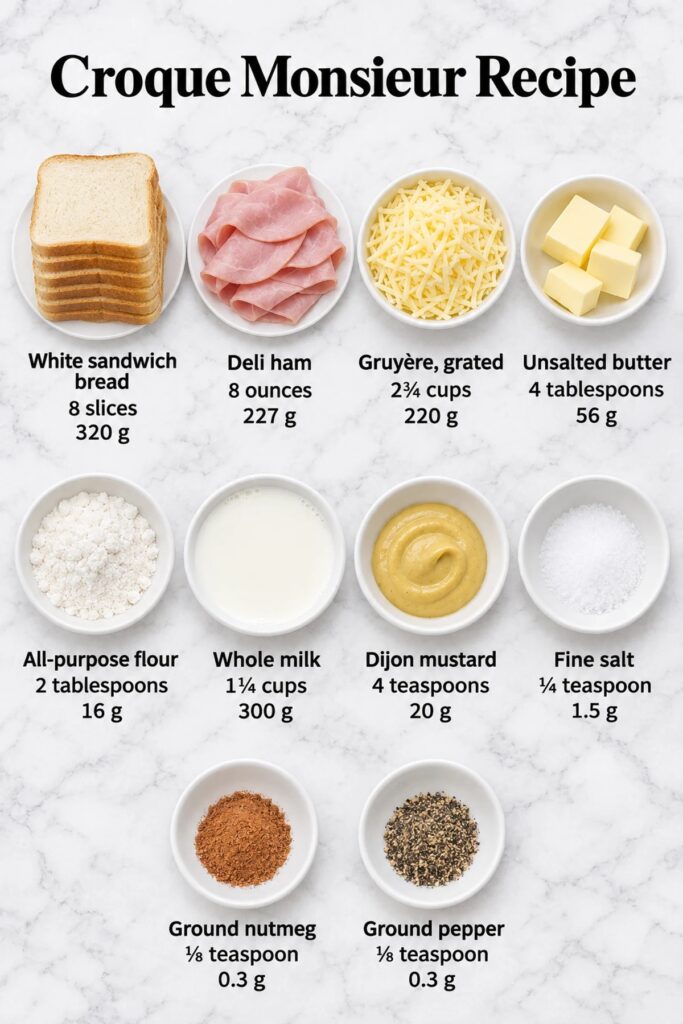
These amounts make 4 sandwiches. Buy one 8-ounce (227 g) block of Gruyère and grate it all at once: it gives about 2¾ cups (220 g), divided among the sauce, the filling and the topping.
For the Béchamel
- 2 tablespoons (28 g) unsalted butter
- 2 tablespoons (16 g) all-purpose flour
- 1¼ cups (300 ml / 300 g) whole milk, warmed
- ½ cup (40 g) grated Gruyère
- ¼ teaspoon (1.5 g) fine salt
- ⅛ teaspoon (0.3 g) ground nutmeg, preferably freshly grated
- ⅛ teaspoon (0.3 g) ground black or white pepper
For the Sandwiches
- 8 slices (about 320 g) sturdy white sandwich bread or pain de mie, about ½ inch (1.3 cm) thick
- 2 tablespoons (28 g) unsalted butter, melted
- 4 teaspoons (20 g) Dijon mustard
- 8 ounces (227 g) thin-sliced deli ham
- 1 cup (80 g) grated Gruyère
For the Topping
- 1¼ cups (100 g) grated Gruyère
Kitchen Equipment Needed
• Rimmed, broiler-safe sheet pan – toast, bake and broil all 4 sandwiches
• Pastry brush and a small bowl – brush the bread with melted butter
• Box grater – grate the Gruyère
• Small saucepan and a whisk – make the béchamel
• Measuring cups and spoons, or a kitchen scale
• Offset spatula or the back of a spoon – spread the sauce
• Wide metal spatula – flip the toast and move the sandwiches
• Serrated knife – cut the sandwiches in half
• Oven mitts – for the hot pan under the broiler
How to Make Croque Monsieur
Here is the full method for a croque monsieur, from plain bread to the first cut.
Step 1: Heat the Oven and Grate the Cheese
Set a rack about 6 inches (15 cm) below the broiler element and heat the oven to 400°F (200°C). Grate the Gruyère and divide it into ½ cup (40 g) for the sauce, 1 cup (80 g) for the filling and 1¼ cups (100 g) for the topping.
What you should see: Three loose, fluffy piles of pale yellow cheese, with no clumps.
Step 2: Toast the Bread
Brush one side of each bread slice lightly with the melted butter and lay them buttered side down on the rimmed sheet pan. Toast for 5 minutes, flip and toast for 2 minutes more.
What you should see: Dry, firm slices that are pale gold on both sides and a little deeper gold on the buttered side, still soft enough to press with a finger.
Step 3: Cook the Roux
While the bread toasts, melt the butter for the béchamel in a small saucepan over medium-low heat. Whisk in the flour and cook, whisking, for 2 minutes.
What you should see: A smooth, bubbling paste the color of pale sand, with a toasty smell and no brown spots.
Step 4: Whisk In the Milk
Pour in about a third of the warm milk, whisking until smooth, then add the rest. Bring to a gentle simmer and cook, whisking often, for 3 to 4 minutes.
What you should see: A smooth sauce that coats the back of a spoon and leaves a clear line when you run a finger through it.
Step 5: Finish the Béchamel
Take the pan off the heat and whisk in ½ cup (40 g) of the Gruyère, the salt, nutmeg and pepper until the cheese melts. Let it stand while you build the sandwiches; it thickens a little as it cools.
What you should see: A thick, glossy, ivory sauce with tiny flecks of nutmeg that falls from the whisk in a slow ribbon and holds soft ridges for a few seconds.

Step 6: Build the Sandwiches
Arrange 4 toasted slices buttered side down on the sheet pan and spread 1 teaspoon of Dijon over each. Fold 2 ounces (57 g) of ham onto each slice, sprinkle with ¼ cup (20 g) of Gruyère and top with the remaining toast, buttered side up.
What you should see: Four neat, even sandwiches about 1¼ inches (3 cm) tall, with folds of pink ham and a little cheese peeking out at the edges.

Step 7: Spread the Sauce and Add the Topping
Spread about ⅓ cup (90 g) of béchamel over the top of each sandwich, right to the edges. Scatter the remaining 1¼ cups (100 g) of Gruyère over the sauce.
What you should see: An even, creamy layer about ¼ inch (6 mm) thick covering every corner of the bread, under a loose, generous blanket of grated cheese.

Step 8: Bake
Bake the croque monsieur sandwiches for 8 to 10 minutes, until the cheese on top has melted and the sauce bubbles at the edges.
What you should see: Melted, pale cheese with small bubbles breaking through, and a few beads of sauce at the corners of the bread.
Step 9: Broil Until Golden
Switch the oven to broil and leave the pan on the same rack. Broil for 2 to 3 minutes, watching closely and turning the pan once if one side browns faster.
What you should see: A deep golden top speckled with brown spots, bubbling at the edges, and crisp, browned cheese where it has run down onto the pan.

Step 10: Rest and Cut
Let the croque monsieur sandwiches rest on the pan for 5 minutes, then move them to plates with a wide spatula. Cut each one in half with a serrated knife and serve with a knife and fork.
What you should see: A clean cut through the crisp toast, showing layers of ham and melted cheese inside and a creamy, browned cap on top that stays in place.
How to Know It’s Done
A croque monsieur gives clear signs on the top and in the first cut, so use them together with the timer.
| What to Check | Ready When |
|---|---|
| Cheese on top | Deep golden with brown spots and bubbling at the edges, never pale or blackened |
| Béchamel | Bubbling around the edges and set into a creamy layer that doesn’t run when the pan tilts |
| Bread | Crisp and golden on the bottom when you lift a corner with a spatula, not soft or pale |
| Inside | Ham warm all the way through and the cheese in the middle fully melted |
If the top of your croque monsieur is golden but the cheese inside is still firm, turn off the broiler and give the pan 3 to 4 minutes more on the center rack at 400°F (200°C).
Tips for the Best Croque Monsieur
Stay at the oven while it broils. The top can go from golden to scorched in under a minute, so keep the door in sight and the timer close.
Fold the ham. Loose folds instead of flat slices give each bite more texture and keep the ham from sliding out when you cut it.
Spread the sauce to the edges. Bare corners of toast burn under the broiler, while sauce that covers the whole slice browns evenly.
Keep the béchamel warm and loose. If it stiffens while you assemble, whisk in a tablespoon of milk until it spreads easily again.
Salt lightly. Ham, Gruyère and Dijon already bring plenty of salt to a croque monsieur, so taste the sauce before adding more than the ¼ teaspoon in the recipe.
Common Mistakes and How to Fix Them
These are the problems that come up most often with a homemade croque monsieur, with a fix for each one.
| Mistake | How to Fix It |
|---|---|
| Soggy bottom The bread under the ham turns soft and falls apart. | Use thick, sturdy bread, toast every slice before assembly and pat any wet ham dry with a paper towel. |
| Lumpy or thin béchamel The sauce has small lumps, or it runs off the bread. | Add the warm milk a little at a time and whisk constantly. Simmer for the full 3 to 4 minutes, until it coats a spoon, and whisk out any lumps off the heat. |
| Cheese greasy or not melting The topping looks oily or stays in dry shreds. | Grate a block of Gruyère yourself instead of using bagged shreds, and bake the full 8 minutes before you broil. |
| Burnt top with a cold inside The cheese blackens before the center is warm. | Bake first and broil only at the end, with the rack about 6 inches (15 cm) below the element, for no more than 2 to 3 minutes. |
| Bland sandwich It tastes of bread and milk. | Use flavorful Gruyère, don’t skip the Dijon and nutmeg, and season the béchamel with salt before it goes on. |
Variations
Once you’ve made the classic croque monsieur, the same method takes well to a few changes.
Croque Madame
While the sandwiches bake, melt 1 teaspoon (5 g) of butter in a large nonstick skillet over medium heat and fry 4 large eggs (200 g). Cover the pan for the last minute, cook until both the yolk and the white are firm, as food safety guidance recommends, and set one egg on each sandwich.
A runny yolk is a popular choice for a croque madame, but it isn’t fully cooked. The FDA lists children, older adults, pregnant women and people with weakened immune systems among those at greater risk from Salmonella, so serve them firm-yolked eggs.
Mustard Béchamel or Herb Topping
For a sharper sauce, whisk 1 tablespoon (15 g) of Dijon into the finished béchamel. For an herb version, stir in 1 tablespoon (3 g) of finely chopped chives or 1 teaspoon (1 g) of fresh thyme leaves instead.
Open-Faced Croque
For a lighter croque monsieur, use only 4 slices of toast. Top each with ½ teaspoon of Dijon, 1 ounce (28 g) of ham and 2 tablespoons (10 g) of Gruyère, then the sauce and the topping, and bake and broil as written, checking a minute early.
Spinach and Ham
Wilt 2 packed cups (60 g) of baby spinach in a dry skillet for 1 to 2 minutes, squeeze out the liquid and divide it over the ham. The spinach adds color and keeps the filling from tasting too heavy.
Turkey and Swiss
Replace the ham with 8 ounces (227 g) of thin-sliced deli turkey and use Swiss or Gruyère. Turkey is milder than ham, so add a pinch more salt to the béchamel.
Serving Suggestions
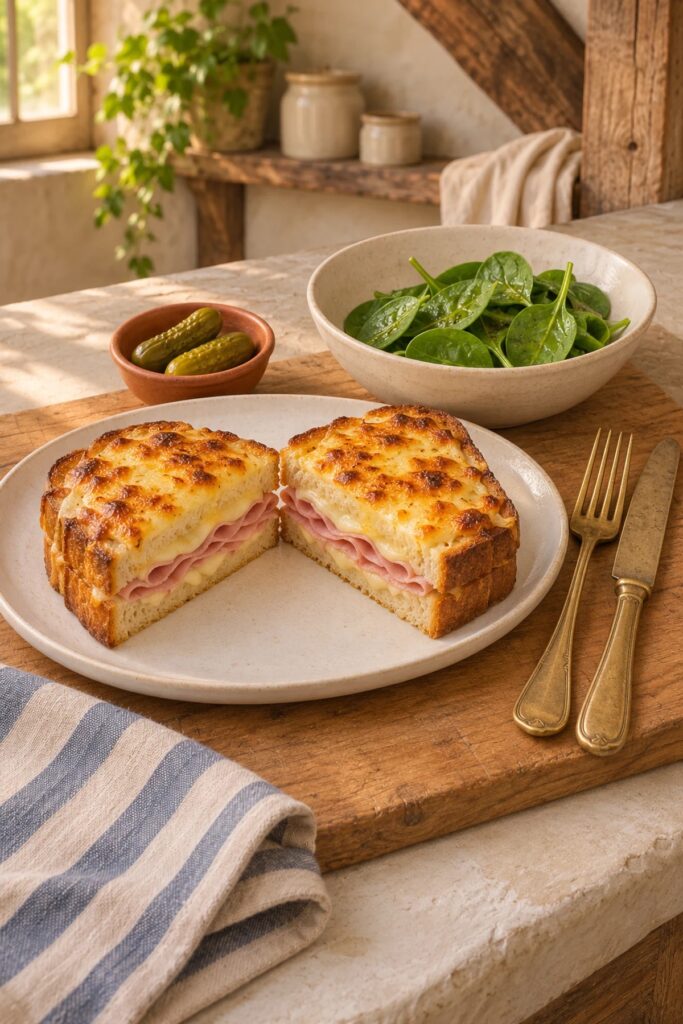
A small green salad with a sharp vinaigrette is the simplest partner for a croque monsieur, and this spinach salad works well. A few cornichons on the side add a crisp, sour bite against the rich cheese, and quick-pickled red onions do the same.
For a soup night, set each croque monsieur beside a bowl of butternut squash soup or French onion soup, which shares the same nutty Gruyère.
It is a different sandwich from a skillet grilled cheese with tomato soup or a quick breakfast sandwich: this one is baked, topped with sauce and eaten with a fork. More savory ideas are waiting in the recipe index.
Make Ahead
Béchamel: Make it up to 3 days ahead, press plastic wrap directly onto the surface so no skin forms and refrigerate it. Warm it gently with a tablespoon or two of milk until it spreads easily.
Cheese: Grate all the Gruyère up to 3 days ahead and keep it in a covered container in the refrigerator, already divided into its three portions.
On the day: Toast the bread, assemble, top and bake. With the sauce and cheese ready, four croque monsieur sandwiches reach the table in about 25 minutes.
Storage
A croque monsieur is at its best straight from the oven, but leftovers keep well enough for a second lunch.
Refrigerator: Wrap cooled leftovers or keep them in an airtight container in the refrigerator and eat them within 3 to 4 days. As a guide, cooked meat leftovers keep 3 to 4 days in the refrigerator and an opened package of deli-sliced ham 3 to 5 days.
Reheating: Warm leftovers uncovered on a sheet pan at 350°F (175°C) for 10 to 12 minutes, until hot in the center. The microwave makes the toast soft and the topping rubbery.
Freezing
You can freeze croque monsieur sandwiches assembled but untopped: toasted bread with the mustard, ham and cheese inside. Wrap each one tightly in plastic wrap and foil and freeze for up to 2 months.
Thaw them overnight in the refrigerator, then spread with fresh béchamel, add the topping and bake and broil as written. Baked leftovers with the sauce on top don’t freeze well, since the toast turns soggy as it thaws.
Frequently Asked Questions
What is the difference between a croque monsieur and a croque madame?
A croque madame is the same sandwich with a fried egg on top. Everything else, from the ham and Gruyère to the béchamel and the broiled cheese, stays the same.
What cheese is best for a croque monsieur?
Gruyère is the classic choice because it melts smoothly, browns well and tastes nutty. Comté and Emmental work well too, and regular Swiss is a milder option.
Can you make it ahead?
Partly. Make the béchamel and grate the cheese up to 3 days ahead, then toast, assemble and bake on the day. For longer storage, freeze the assembled sandwiches without the topping.
What bread is best?
For a croque monsieur, choose a sturdy white sandwich loaf or pain de mie about ½ inch (1.3 cm) thick. It stays soft inside, toasts crisp and holds the sauce; thin, airy slices go soggy.
Can I make it in a skillet without an oven?
Yes, with a softer top. Spread a thin layer of béchamel inside the sandwich instead of on top, brush the outsides with butter and cook in a covered skillet over medium-low heat for 3 to 4 minutes per side, until golden and melted. Without a broiler, you won’t get the browned cheese crust.
Can I use leftover ham?
Yes. Slice it thin, trim off any thick, sweet glaze and use about 2 ounces (57 g) per sandwich, the same as deli ham.
How do I reheat leftovers?
Reheat them uncovered on a sheet pan at 350°F (175°C) for 10 to 12 minutes, until hot in the center. Skip the microwave, which makes the bread soft and the cheese rubbery.
Final Thoughts
Thick toast, thin ham, freshly grated Gruyère, a béchamel that holds its ridges and a watchful eye on the broiler are all it takes to bring a café-style sandwich to your own table.
Make this croque monsieur as written the first time, then add a fried egg for a croque madame or try the spinach or turkey version once you know how golden the top should look.
When you cut the first sandwich in half, how far had the cheese crept down the sides, and did an egg end up on top? Drop a line in the comments about the ham you layered inside and how many minutes your broiler needed.
If you try this recipe, please leave a star rating along with your comment below. It takes a few seconds and helps other readers find the recipe.

Croque Monsieur
This croque monsieur layers thin-sliced ham, Dijon and Gruyère between slices of oven-toasted white bread, then covers the top with nutmeg béchamel and more cheese. It bakes at 400°F until the sauce bubbles, then broils for 2 to 3 minutes until golden and speckled with brown spots. Ready in 40 minutes, this croque monsieur makes 4 sandwiches for brunch, lunch with a salad or a cozy soup night.
Ingredients
For the Béchamel
- 2 tablespoons (28 g) unsalted butter
- 2 tablespoons (16 g) all-purpose flour
- 1¼ cups (300 ml / 300 g) whole milk, warmed
- ½ cup (40 g) grated Gruyère
- ¼ teaspoon (1.5 g) fine salt
- ⅛ teaspoon (0.3 g) ground nutmeg, preferably freshly grated
- ⅛ teaspoon (0.3 g) ground black or white pepper
For the Sandwiches
- 8 slices (about 320 g) sturdy white sandwich bread or pain de mie, about ½ inch (1.3 cm) thick
- 2 tablespoons (28 g) unsalted butter, melted
- 4 teaspoons (20 g) Dijon mustard
- 8 ounces (227 g) thin-sliced deli ham
- 1 cup (80 g) grated Gruyère
For the Topping
- 1¼ cups (100 g) grated Gruyère
Instructions
- Set a rack about 6 inches (15 cm) below the broiler and heat the oven to 400°F (200°C). Grate the Gruyère and divide it: ½ cup (40 g) for the sauce, 1 cup (80 g) for the filling and 1¼ cups (100 g) for the topping.
- Brush one side of 8 bread slices with 2 tablespoons (28 g) melted butter and place buttered side down on a rimmed sheet pan. Toast for 5 minutes, flip and toast 2 minutes more.
- Meanwhile, melt 2 tablespoons (28 g) butter in a small saucepan over medium-low heat. Whisk in 2 tablespoons (16 g) flour and cook, whisking, for 2 minutes without browning.
- Gradually whisk in 1¼ cups (300 ml) warm whole milk. Simmer gently, whisking often, for 3 to 4 minutes, until the sauce coats a spoon.
- Off the heat, whisk in the ½ cup (40 g) Gruyère, ¼ teaspoon salt, ⅛ teaspoon nutmeg and ⅛ teaspoon pepper until smooth.
- Arrange 4 toasted slices buttered side down on the pan. Spread each with 1 teaspoon (5 g) Dijon, add 2 ounces (57 g) folded ham and ¼ cup (20 g) Gruyère, and top with the remaining toast, buttered side up.
- Spread about ⅓ cup (90 g) béchamel over each sandwich, right to the edges, and sprinkle with the remaining 1¼ cups (100 g) Gruyère.
- Bake for 8 to 10 minutes, until the cheese melts and the sauce bubbles at the edges.
- Switch to broil and broil on the same rack for 2 to 3 minutes, watching closely, until golden and speckled with brown spots.
- Rest on the pan for 5 minutes, then cut each sandwich in half and serve.
Notes
- Bread: Use sturdy white sandwich bread or pain de mie about ½ inch (1.3 cm) thick; thin, soft bread turns soggy.
- Cheese: Grate a block of Gruyère yourself; one 8-ounce (227 g) block gives about 2¾ cups (220 g). Comté, Emmental or Swiss can replace it.
- Ham: Use thin-sliced deli ham or thinly sliced leftover ham with the glaze trimmed off; pat moist ham dry.
- Broiling: Broil with the rack about 6 inches (15 cm) below the element and watch closely; the top can scorch in under a minute.
- Croque madame: Top each sandwich with a fried egg cooked until the white and yolk are firm.
- Make ahead: Make the béchamel up to 3 days ahead with plastic wrap pressed on the surface and refrigerate; loosen with a little milk. Freeze assembled, untopped sandwiches up to 2 months and thaw overnight in the refrigerator before topping and baking.
- Storage: Refrigerate leftovers in an airtight container for 3 to 4 days; reheat uncovered at 350°F (175°C) for 10 to 12 minutes.
- Nutrition: Values are per serving (1 whole sandwich), counting the 320 g bread, about 24 g of the 28 g brushing butter (the rest stays on the brush and pan), 227 g ham, 20 g Dijon, all 220 g Gruyère, the full béchamel (28 g butter, 16 g flour, 300 g whole milk) and the salt as written. Nutmeg, pepper and optional sides such as salad or cornichons are not included.
Nutrition Information:
Yield: 4 Serving Size: 1 sandwichAmount Per Serving: Calories: 689Total Fat: 39gSaturated Fat: 21gCholesterol: 128mgSodium: 1495mgCarbohydrates: 49gFiber: 2gSugar: 8gProtein: 35g