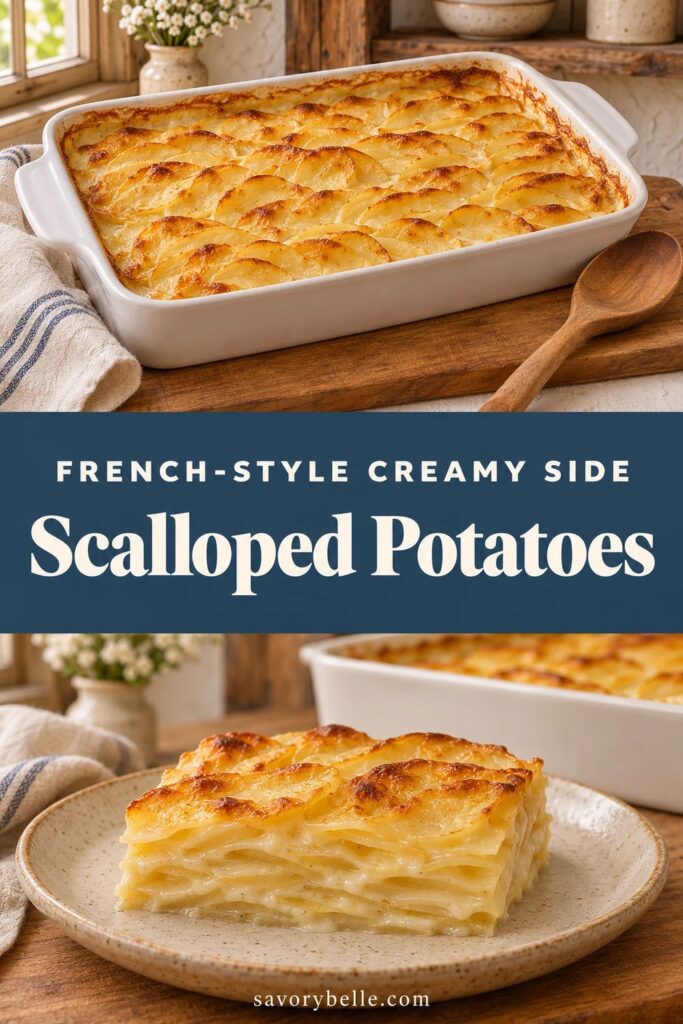
Scalloped Potatoes
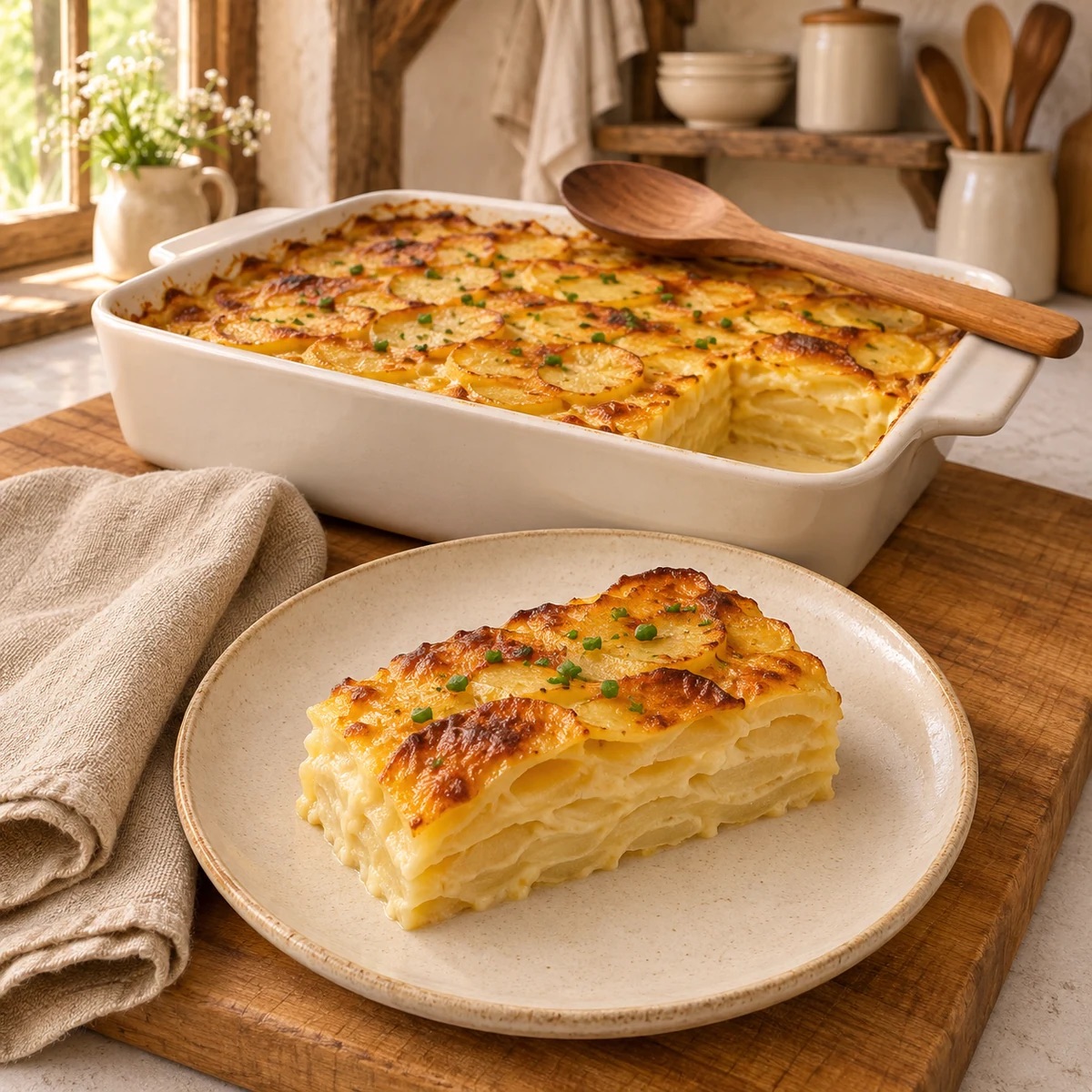
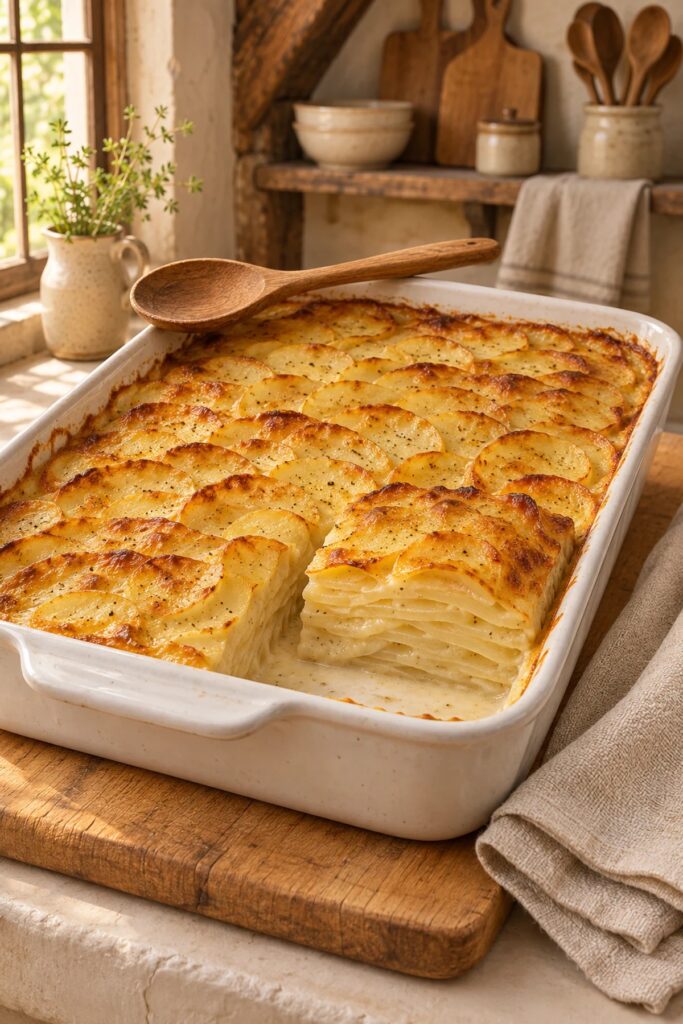
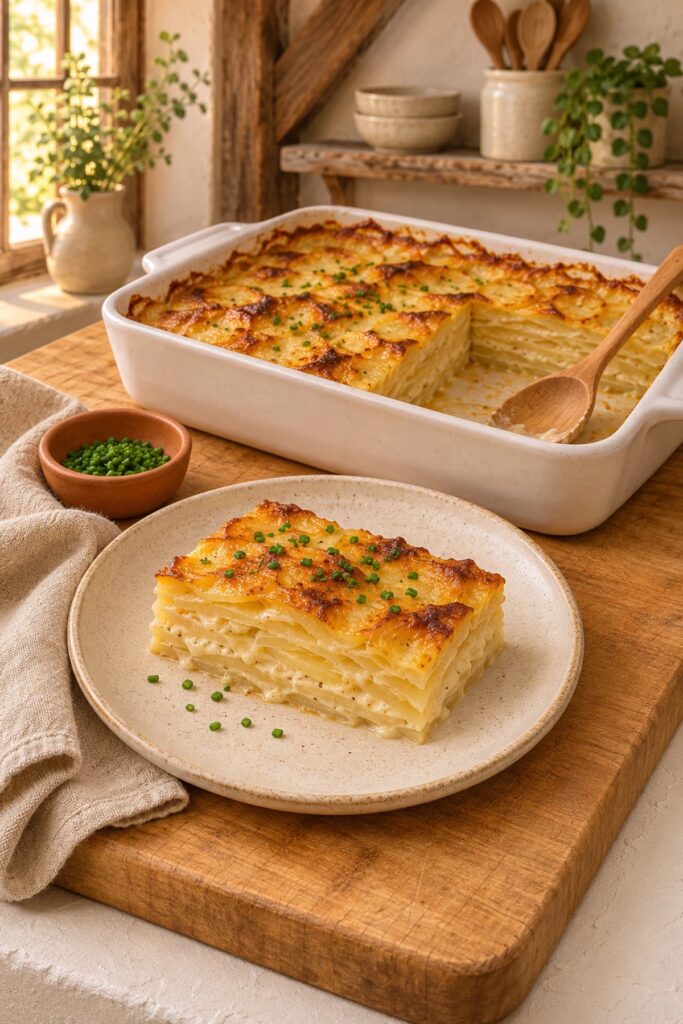
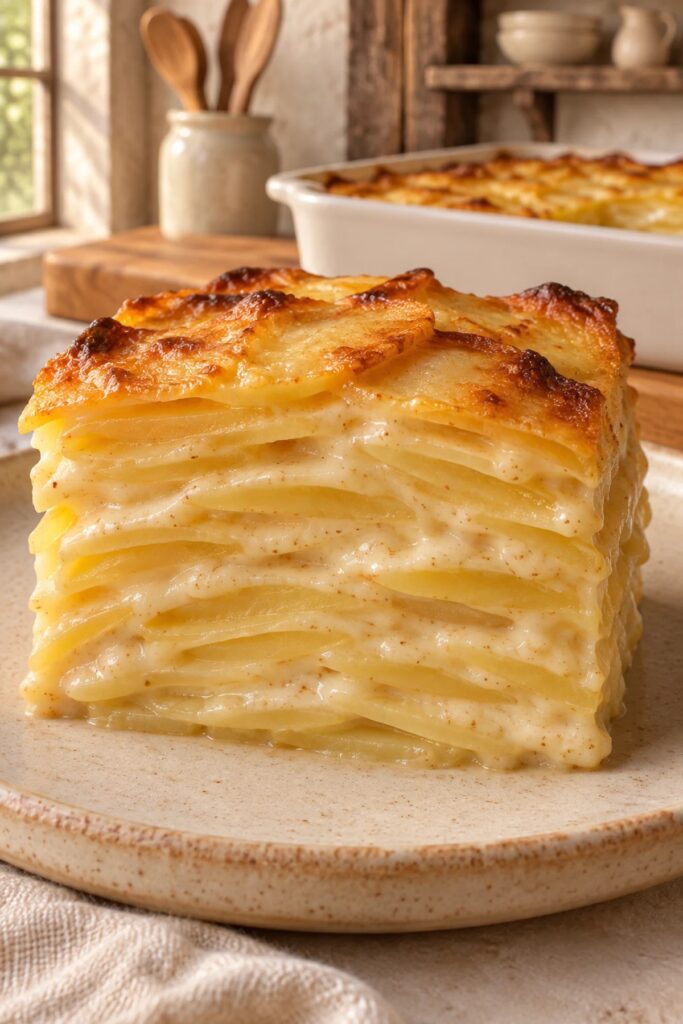
Scalloped potatoes come out of the oven as a golden, gently blistered sheet of thin potato slices layered in a creamy, garlicky sauce, soft enough to cut with the edge of a spoon.
In the US, the name scalloped potatoes stands for thinly sliced potatoes baked in a creamy sauce. In France, the same idea is called gratin dauphinois, named after the Dauphiné, a former province in the southeast of the country.
This version follows the French method. The slices simmer for a few minutes in cream and milk seasoned with garlic, nutmeg and salt, then finish in the oven, and their own starch thickens the sauce, so there’s no flour to cook and no cheese needed.
One 9×13-inch dish of these scalloped potatoes serves 10 as a side. It can also be baked a day ahead, which helps when the oven is busy with a ham or a roast.
Why You’ll Love These Scalloped Potatoes
Creamy, not soupy. Simmering the slices in the cream before baking lets the potato starch thicken the sauce, so it clings to every layer instead of pooling at the bottom of the dish.
Tender all the way through. The potatoes get a head start on the stove, so the slices in the middle are as soft as the ones on top, with no raw, crunchy center.
Short list, regular store. Potatoes, cream, milk, garlic, butter, salt, pepper and nutmeg are all you need, and you’ll find every one of them at any supermarket.
Ready ahead of time. These scalloped potatoes can be baked the day before and warmed through, which frees the oven for the main course on a busy holiday.
Perfect For
Scalloped potatoes belong on the table for Christmas dinner, a New Year’s Day meal and Easter lunch, and they’re just as welcome at an ordinary Sunday roast. The dish travels well in its baking dish, so it also works for potlucks and family gatherings.
Scalloped potatoes are a classic partner for a glazed ham, and they fit easily into a Thanksgiving side dish lineup. For more ideas for the season, browse my holiday recipes.
Scalloped Potatoes at a Glance
| Flavor | Mild, buttery potatoes, sweet cream, gentle garlic and a warm hint of nutmeg |
| Texture | Tender, neat layers in a thick, creamy sauce under a golden, lightly blistered top |
| Difficulty | Easy (the only careful part is slicing thin and even) |
| Prep Time | 25 minutes |
| Cook Time | 1 hour 10 minutes (about 20 minutes on the stove, 50 in the oven) |
| Rest Time | 15 minutes |
| Total Time | 1 hour 50 minutes |
| Servings | 10 pieces, about 2½ x 4½ inches (6 x 11 cm) |
| Oven | 375°F (190°C), covered, then uncovered |
| Dish | 9×13-inch (23 x 33 cm) baking dish, about 3 quarts (2.8 liters) |
| Cuisine | French-inspired |
| Best For | Christmas, New Year, Easter, Sunday roasts and potlucks |
Before You Start
Scalloped potatoes have only a few ingredients, so a handful of choices decide how the dish turns out.
Slice thin and even. Aim for 1/8 inch (3 mm). A mandoline or the slicing disc of a food processor gives the most even rounds; a sharp chef’s knife works too but takes longer.
Pick the right potato. Yukon Golds hold their shape in neat layers and still release enough starch to thicken the sauce. Russets work but soften more and can turn the layers mushy.
Use the right dish. A 9×13-inch (3-quart) ceramic or glass dish holds 3 pounds of potatoes in a layer about 1 inch (2.5 cm) deep. Set it on a rimmed sheet pan in case the cream bubbles over.
Plan your timeline. Count on about 1 hour 50 minutes from peeling to serving, including the 15-minute rest. For a holiday, bake the gratin the day before and reheat it while the main dish rests.
What Makes These Scalloped Potatoes Work
Thin, Even Slices
Slices of the same thickness cook at the same rate, so every layer turns tender at once. At 1/8 inch (3 mm), the heat reaches the center of each slice quickly, while thicker or uneven pieces stay firm when the rest are done.
A Short Simmer in the Cream
As the slices simmer, they release starch into the cream and milk, and that starch thickens the sauce without any flour. Many tested recipes use the same stovetop step for another reason: a long, slow bake from raw slices can leave the potatoes unevenly cooked in a heavy, curdled sauce.
Cream Does Most of the Work
Heavy cream has enough fat to stay smooth in the oven, while milk on its own is more likely to separate when it boils. A ratio of two parts cream to one part milk keeps the sauce rich but not heavy.
Covered First, Then Uncovered
Foil holds in the moisture for the first 20 minutes, so the potatoes finish cooking through without the top drying out. Once the foil comes off, the cream reduces and the surface turns golden and blistered.
A Rest Before Cutting
Straight from the oven, the sauce in scalloped potatoes is loose and bubbling. Fifteen minutes on the counter lets it thicken and settle around the slices, so the pieces hold their layers when you cut them.
Ingredient Notes and Substitutions
Everything for these scalloped potatoes comes from a regular grocery store, and a few ingredients have honest swaps.
Potatoes. Russets are the classic mealy potato and tend to break apart, while waxy potatoes hold their shape after cooking, which is what you want in scalloped potatoes. Yukon Golds sit in between: they keep their layers and still give off enough starch for a creamy sauce.
Heavy cream and milk. Use heavy cream (also sold as heavy whipping cream) and whole milk. Half-and-half works in the Variations below, but the sauce comes out thinner, and low-fat milk makes it watery and more likely to curdle.
Garlic. Three fresh cloves give a gentle garlic flavor: one rubbed over the dish, then all three minced into the cream. Garlic powder tastes flat here, so skip it if you can.
Nutmeg. Freshly grated whole nutmeg is the classic French touch and tastes brighter than ground. Ground nutmeg works in the same amount; keep it subtle, since too much tastes medicinal.
Salt. Fine sea salt or table salt dissolves quickly in the cream. Potatoes need more salt than you’d expect, so taste the cream before the slices go in the dish.
Butter. Unsalted butter greases the dish and melts over the top to help it brown. Softened homemade butter works just as well.
Cheese (optional). The French classic is usually made without cheese. If you like a cheesy top, Gruyère or Swiss melts smoothly and browns well, and it turns the dish into something closer to potatoes au gratin.
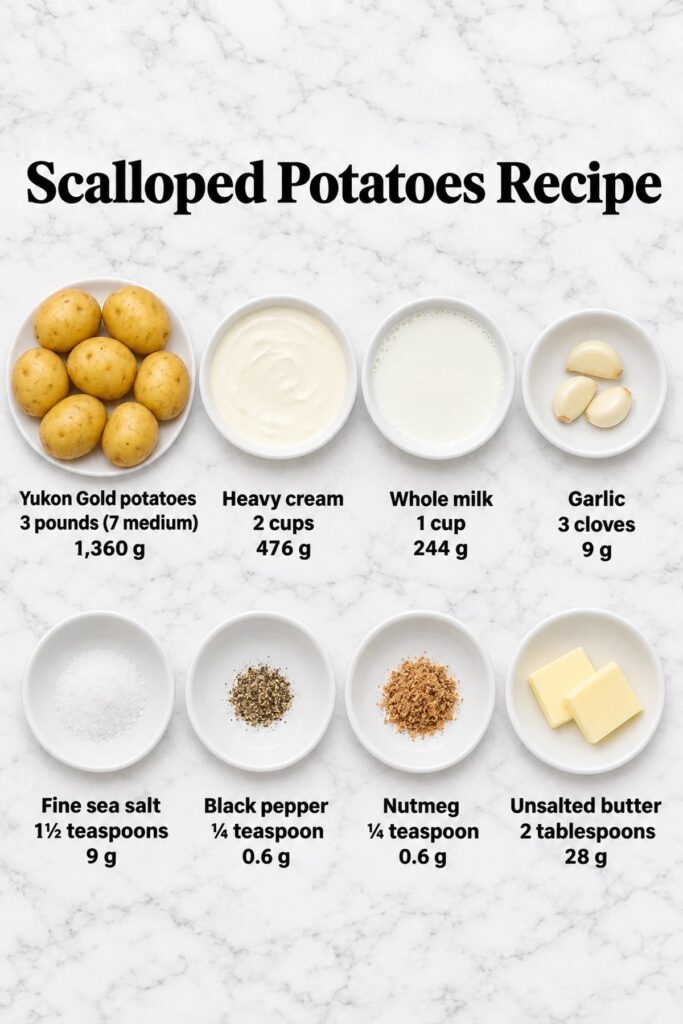
Ingredients for Scalloped Potatoes
These amounts fill one 9×13-inch dish of scalloped potatoes and make 10 servings. Three pounds of potatoes is about 7 medium Yukon Golds and gives roughly 2¾ pounds (1.23 kg) once peeled, or about 4 ounces (120 g) of potato per serving.
For the Potatoes
- 3 pounds (1.36 kg) Yukon Gold potatoes, about 7 medium
- 2 cups (476 g) heavy cream
- 1 cup (244 g) whole milk
- 3 garlic cloves (9 g), peeled, 1 of them halved
- 1½ teaspoons (9 g) fine sea salt
- ¼ teaspoon (0.6 g) freshly ground black pepper
- ¼ teaspoon (0.6 g) freshly grated nutmeg
- 2 tablespoons (28 g) unsalted butter, softened, divided
To Finish (Optional)
- 1 cup (113 g) shredded Gruyère or Swiss cheese
- 1 tablespoon (3 g) finely chopped fresh chives or 1 teaspoon (1 g) fresh thyme leaves
Kitchen Equipment Needed
• Vegetable peeler and a sharp chef’s knife – peel the potatoes and trim the ends
• Mandoline with a hand guard, or a food processor with a 1/8-inch (3 mm) slicing disc – cut even slices
• Large Dutch oven or wide heavy pot (5 to 6 quarts) with a lid – simmer the potatoes in the cream
• Heatproof silicone spatula – stir gently and scrape the bottom of the pot
• 9×13-inch (3-quart) ceramic or glass baking dish – bake and serve the gratin
• Aluminum foil and a rimmed sheet pan – cover the dish and catch any drips
• Paring knife – test the potatoes for doneness
• Kitchen scale – weigh the potatoes
How to Make Scalloped Potatoes
Here’s the full method, from slicing to the first clean cut. Each step ends with what you should see.
Step 1: Heat the Oven and Prepare the Dish
Set a rack in the middle of the oven and heat it to 375°F (190°C). Rub the inside of the baking dish with the cut sides of the halved garlic clove, then grease it with 1 tablespoon of the butter.
What you should see: A dish with a thin, even film of butter on the bottom and sides, and a faint garlic smell when you lean over it.
Step 2: Peel and Slice the Potatoes
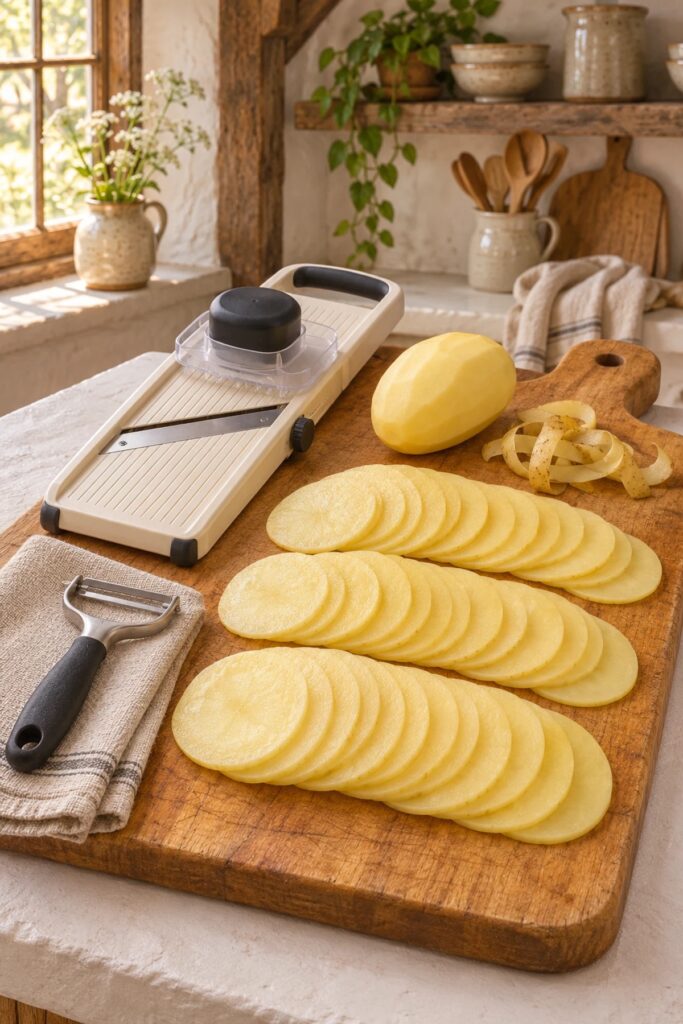
Peel the potatoes and slice them into rounds 1/8 inch (3 mm) thick with a mandoline or food processor. Don’t rinse or soak the slices, since their surface starch is what thickens the sauce.
What you should see: A pile of pale yellow, evenly thin rounds that bend slightly without breaking, slick and a little sticky with starch.
Step 3: Warm the Seasoned Cream
Mince the halved clove with the other two. Put the garlic, cream, milk, salt, pepper and nutmeg in the Dutch oven and warm over medium heat, stirring now and then, for about 5 minutes.
What you should see: Ivory cream flecked with nutmeg and garlic, with small bubbles around the edge and wisps rising from the surface, not a rolling boil.
Step 4: Simmer the Potatoes in the Cream
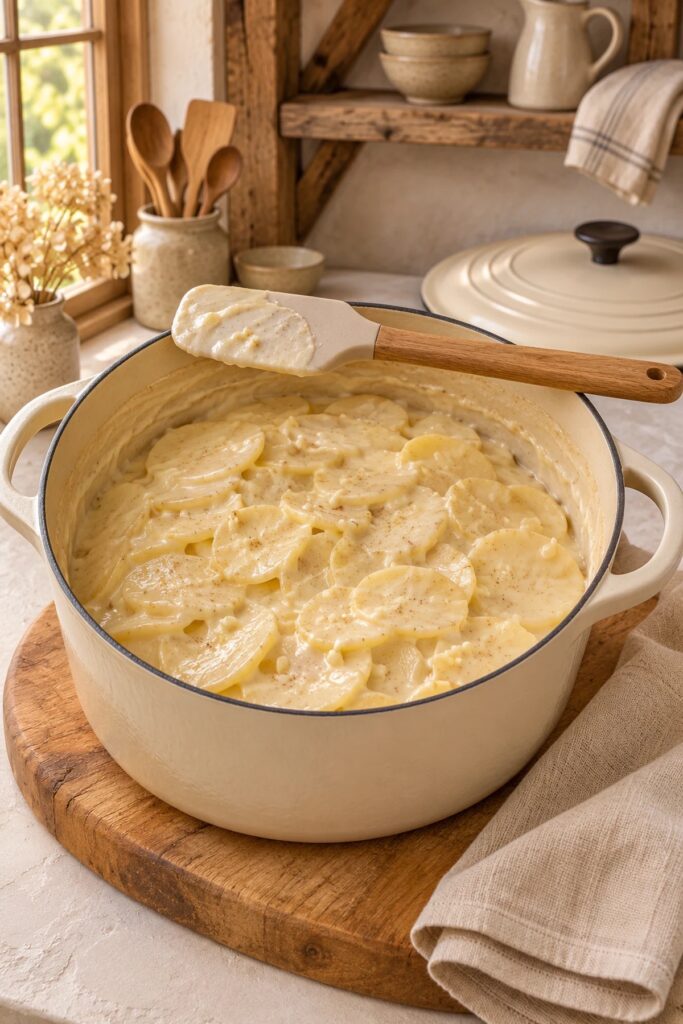
Add the slices and stir gently to separate them. Bring back to a gentle simmer, cover, lower the heat to medium-low and cook for 10 to 12 minutes, stirring carefully every few minutes and scraping the bottom so nothing sticks.
What you should see: Slices that look slightly translucent at the edges, a paring knife that slides into a slice with some resistance, and cream thick enough to coat the spatula.
Step 5: Taste and Adjust
Turn off the heat and taste the sauce. Add a pinch more salt if it tastes flat, since the potatoes will soak up seasoning as they bake.
What you should see: A thick, glossy, cream-colored sauce wrapped around soft but whole slices, with only a few broken pieces.
Step 6: Layer the Potatoes in the Dish
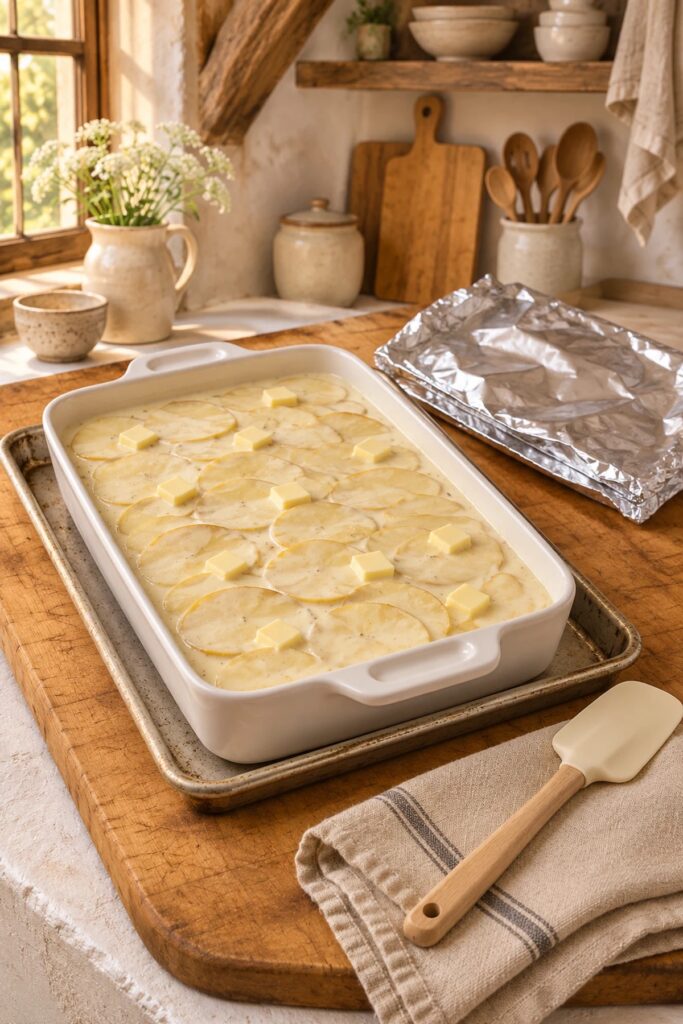
Spoon the potatoes into the dish and pour in all of the sauce from the pot. Use the spatula to press the slices into flat, slightly overlapping layers and smooth the top, then dot it with the remaining 1 tablespoon of butter.
What you should see: An even layer about 1 inch (2.5 cm) deep, the top slices just peeking out of the cream, with small pieces of butter scattered over the surface.
Step 7: Bake Covered
Cover the dish tightly with foil, set it on a rimmed sheet pan and bake for 20 minutes.
What you should see: When you lift a corner of the foil, cream bubbling gently around the edges and slices that look softer and more translucent, still pale on top.
Step 8: Uncover and Bake Until Golden
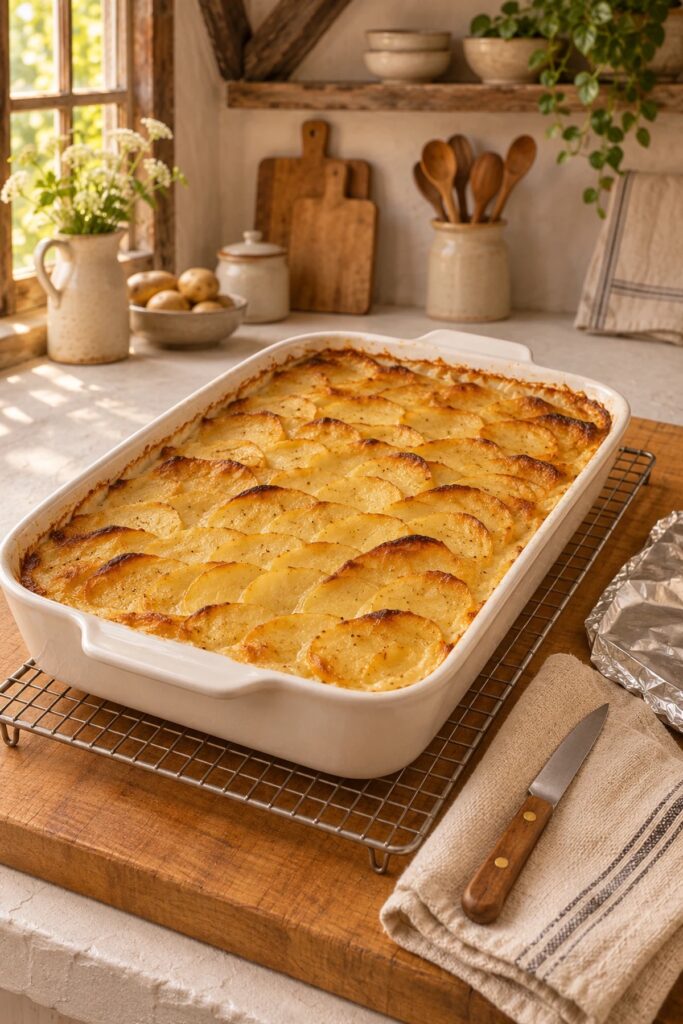
Remove the foil and bake for 25 to 30 minutes more. If you’re using the cheese, scatter it over the top when you remove the foil.
What you should see: A golden-brown top with darker blisters on the highest slices, thick cream bubbling slowly at the edges, and a paring knife that slides through the center with no resistance.
Step 9: Rest Before Serving
Move the dish to a wire rack or a folded towel and let it rest for 15 minutes. Sprinkle with chives or thyme leaves just before serving, if you like.
What you should see: Bubbling that has stopped, a sauce that has settled around the slices, and no thin liquid pooling when you tilt the dish slightly.
Step 10: Cut and Serve
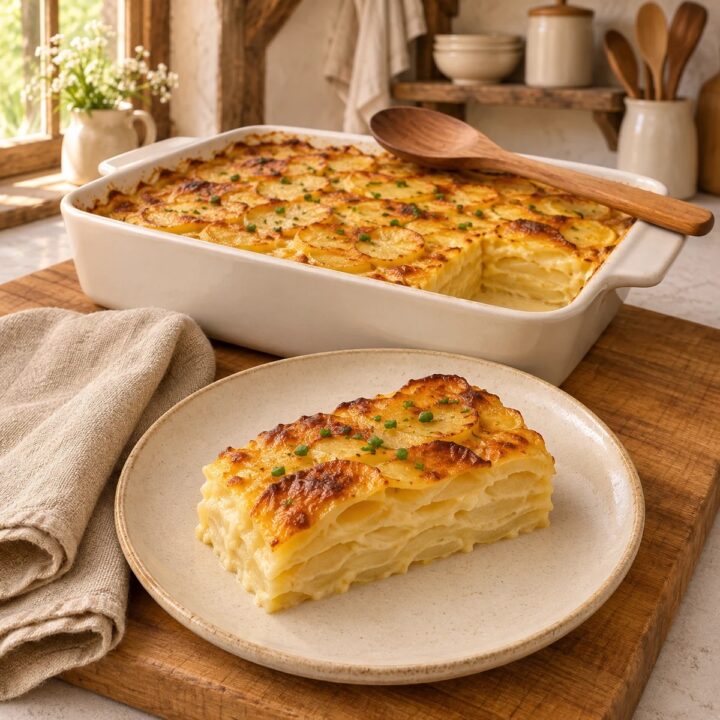
Cut the scalloped potatoes into 10 pieces, two rows of five, with a thin knife, and lift them out with a wide spatula or serving spoon.
What you should see: Pieces that hold their shape, with clear, thin layers of tender potato and creamy sauce on the cut side, and a golden top.
How to Know They’re Done
Scalloped potatoes give clear signs at each stage, so use these cues along with the times.
| What to Check | Ready When |
|---|---|
| Sliced potatoes | Even rounds about 1/8 inch (3 mm) thick, bendy but not breaking |
| After the simmer | A knife slides into a slice with some resistance, and the cream coats the spatula |
| After 20 minutes covered | Cream bubbling at the edges, slices softer but the top still pale |
| Top | Golden brown, with darker blisters on the highest slices |
| Center | A paring knife slides through all the layers with no resistance |
| After resting | No bubbling, the sauce thick and settled, no liquid pooling |
If your scalloped potatoes still feel firm in the center after 30 minutes uncovered, cover the dish loosely with foil and bake 10 minutes more. If the top browns before the potatoes are tender, tent it with foil for the rest of the bake.
Tips for the Best Scalloped Potatoes
Weigh the potatoes. Three pounds fills a 9×13-inch dish to the right depth. More potatoes need more cream and more time, and fewer turn the sauce soupy.
Keep the simmer gentle. A hard boil can scorch the cream on the bottom of the pot and break the slices. Small, lazy bubbles are all you need.
Stir with a spatula, not a spoon. A flexible spatula reaches the bottom of the pot and lifts the slices without tearing them.
Season the cream boldly. Potatoes absorb a lot of salt, so the sauce for scalloped potatoes should taste a little too salty on the stove. After baking, it usually tastes just right.
Give it the full rest. Scalloped potatoes cut straight from the oven run all over the plate. After 15 minutes, the layers hold.
Common Mistakes and How to Fix Them
These are the problems that come up most often with scalloped potatoes, along with a fix for each one.
| Mistake | How to Fix It |
|---|---|
| Potatoes still firm in the center The top is golden, but the middle layers crunch. | Slice evenly to 1/8 inch (3 mm), simmer until a knife meets only some resistance and bake covered first; add 10 minutes under foil if needed. |
| Watery or curdled sauce Thin liquid pools in the dish, or the cream looks grainy. | Don’t rinse the slices, use heavy cream and whole milk, keep the simmer gentle and rest the dish 15 minutes before cutting. |
| Greasy, separated top Yellow fat collects on the surface. | Keep the oven at 375°F (190°C), don’t add extra butter and avoid long broiling, which can split the cream. |
| Uneven slices Some pieces are mushy while others stay hard. | Use a mandoline or slicing disc set to 1/8 inch (3 mm) and discard very thin end pieces. |
| Soupy pieces on the plate The sauce runs out when you cut it. | Let the dish rest at least 15 minutes, and cut with a thin knife before lifting each piece with a wide spatula. |
Variations
Once you know how the classic version should look, scalloped potatoes take well to a few additions.
Au Gratin with Gruyère
Use 1½ cups (170 g) shredded Gruyère. Sprinkle ½ cup (57 g) over the potatoes halfway through layering them in the dish, and scatter the remaining 1 cup (113 g) over the top when you remove the foil.
Thyme and Onion
Melt 1 extra tablespoon (14 g) butter in the Dutch oven and cook 1 small yellow onion (150 g), thinly sliced, over medium heat for about 6 minutes, until soft but not brown. Add the Step 3 ingredients with 1 teaspoon (1 g) fresh thyme leaves and continue as written.
Lighter with Half-and-Half
Replace the cream and milk with 2 cups (484 g) half-and-half and 1 cup (238 g) heavy cream. The sauce will be thinner and slightly less glossy, so keep the simmer very gentle and give the dish the full 15-minute rest.
With Ham
Layer 1½ cups (225 g) diced cooked ham between the potatoes as you fill the dish, and cut the salt to 1 teaspoon (6 g), since ham is already salty. Leftover holiday ham works well here.
Smaller Batch
Halve every ingredient and use an 8-inch (20 cm) square dish. Simmer for 8 to 10 minutes, then bake covered for 15 minutes and uncovered for 20 to 25 minutes, until golden and tender; it makes about 4 to 5 servings.
Serving Suggestions
Scalloped potatoes are rich, so they pair best with something roasted and something fresh. Serve them with roast chicken, beef or pork, or alongside a slow-cooked coq au vin for a French-style dinner.
For a holiday table, add a green vegetable such as green bean casserole, a bright spinach salad and a spoonful of tart cranberry sauce. Warm buttermilk biscuits help with the last of the sauce.
To keep the French theme going through dessert, finish with choux au craquelin, or look through the recipe index for more sides and mains.
Make Ahead
Bake a day ahead: Bake and rest the scalloped potatoes as directed and let them cool, then cover the dish and refrigerate it within 2 hours, for up to 1 day. Reheat covered with foil at 350°F (175°C) for 30 to 40 minutes, until hot in the center, and uncover for the last 10 minutes to refresh the top.
Assemble a day ahead: Simmer the potatoes, layer them in the dish and let it cool, then cover and refrigerate it within 2 hours, for up to 1 day. Bake straight from the refrigerator, covered, for about 40 minutes at 375°F (190°C), then uncovered for 25 to 30 minutes, until golden and tender.
Storage
Refrigerator: Cover the dish or move leftover scalloped potatoes to a shallow airtight container. As a guide, casseroles keep for 3 to 4 days in the refrigerator, as long as they were refrigerated within 2 hours of cooking.
Reheating: Warm single pieces in the microwave, covered, in 1-minute bursts, or reheat a larger amount covered at 350°F (175°C) for 20 to 30 minutes. Add a spoonful of milk if the sauce looks tight, and heat until it reaches 165°F (74°C) in the center.
Freezing
Freezing isn’t the best choice for scalloped potatoes. Extension food-storage guides list cooked potatoes among the foods that turn soft, crumbly and watery after freezing, and milk-based sauces may curdle or separate.
If you need to freeze leftovers, wrap them tightly and use them within 1 month, thawed overnight in the refrigerator and reheated covered. Expect a softer, slightly grainy texture, and plan to bake fresh for the holiday table.
Frequently Asked Questions
What’s the difference between scalloped potatoes, gratin dauphinois and potatoes au gratin?
In the US, the name scalloped potatoes usually refers to sliced potatoes baked in a cream or milk sauce, while potatoes au gratin usually adds cheese, sometimes with breadcrumbs. Gratin dauphinois is the French dish from the Dauphiné, usually made with potatoes, milk or cream and garlic, and traditionally without cheese. Recipes use these names loosely, so treat them as general labels rather than strict rules.
Can I make scalloped potatoes ahead of time?
Yes. Bake them the day before and reheat covered at 350°F (175°C), or assemble the dish, refrigerate it overnight and bake it straight from the refrigerator with a little extra time. The Make Ahead section has both timelines.
Which potatoes are best?
Yukon Golds are the most reliable choice: they hold their layers and still release enough starch to thicken the cream. Russets work but break down more, and red potatoes keep their shape but give a thinner sauce.
Can I make them without cheese?
Yes. Scalloped potatoes don’t need cheese, and the classic French version has none. The cream, garlic and nutmeg carry the flavor, and the browned top gives the dish its color, so cheese is only an optional finish.
Why did my sauce curdle?
Usually the dairy boiled too hard, the sauce had too little fat, or the dish stayed in a very hot oven or under the broiler too long. Use heavy cream and whole milk, keep the simmer gentle and bake at 375°F (190°C).
Can I use only milk?
You can use 3 cups (732 g) of whole milk instead of the cream and milk, as some French recipes do. The sauce will be lighter and thinner, and it’s more likely to look slightly grainy, so keep the simmer very gentle and don’t skip the rest.
Do I need to rinse the potato slices?
No. Rinsing washes away the surface starch that thickens the sauce. Slice the potatoes just before you need them, and if they wait, cover them with the cream rather than water.
Final Thoughts
Thin, even slices, a short simmer in seasoned cream, a covered start in the oven and a patient rest are what turn a few pounds of potatoes and a carton of cream into a dish that cuts neatly and still tastes creamy.
Keep the classic, cheese-free version of these scalloped potatoes for your first batch, then try the Gruyère, the thyme and onion or a little ham once you know how the finished dish should look.
Did your gratin come out with a pale gold top or deep brown blisters at the corners, and what did it share the table with? Leave a note below about the tool you used for slicing and how thin your rounds turned out.
If you try this recipe, please leave a star rating along with your comment below. It takes a few seconds and helps other readers find the recipe.
Scalloped Potatoes
These scalloped potatoes are thin Yukon Gold slices simmered in garlicky cream with nutmeg, then baked until tender, golden and bubbling, the French way known as gratin dauphinois. No flour and no cheese needed, and they serve 10.
Ingredients
For the Potatoes
- 3 pounds (1.36 kg) Yukon Gold potatoes, about 7 medium
- 2 cups (476 g) heavy cream
- 1 cup (244 g) whole milk
- 3 garlic cloves (9 g), peeled, 1 of them halved
- 1½ teaspoons (9 g) fine sea salt
- ¼ teaspoon (0.6 g) freshly ground black pepper
- ¼ teaspoon (0.6 g) freshly grated nutmeg
- 2 tablespoons (28 g) unsalted butter, softened, divided
To Finish (Optional)
- 1 cup (113 g) shredded Gruyère or Swiss cheese
- 1 tablespoon (3 g) finely chopped fresh chives or 1 teaspoon (1 g) fresh thyme leaves
Instructions
- Heat the oven to 375°F (190°C). Rub a 9x13-inch (3-quart) baking dish with the cut sides of 1 halved garlic clove, then grease it with 1 tablespoon (14 g) of the butter.
- Peel 3 pounds (1.36 kg) Yukon Gold potatoes and slice them 1/8 inch (3 mm) thick with a mandoline or food processor. Don’t rinse the slices.
- Mince all 3 garlic cloves (9 g). Warm them in a large Dutch oven with 2 cups (476 g) heavy cream, 1 cup (244 g) whole milk, 1½ teaspoons (9 g) fine sea salt, ¼ teaspoon (0.6 g) pepper and ¼ teaspoon (0.6 g) nutmeg over medium heat, about 5 minutes, until steaming.
- Add the potatoes, return to a gentle simmer, cover and cook over medium-low heat for 10 to 12 minutes, stirring gently and scraping the bottom, until a knife slides into a slice with some resistance.
- Taste the sauce and add a pinch more salt if needed.
- Spoon the potatoes and all of the sauce into the dish, press into flat, even layers and dot with the remaining 1 tablespoon (14 g) butter.
- Cover tightly with foil, set on a rimmed sheet pan and bake for 20 minutes.
- Uncover and bake for 25 to 30 minutes more, until golden and bubbling and a knife slides through the center easily. Add the cheese, if using, when you remove the foil.
- Rest for 15 minutes. Sprinkle with chives or thyme, if you like.
- Cut into 10 pieces, two rows of five, and serve.
Notes
- Potatoes: Yukon Golds hold their layers and still thicken the sauce; russets work but soften more.
- Slicing: Cut every slice 1/8 inch (3 mm) thick and don’t rinse them, since the starch thickens the cream.
- Simmer: Keep the cream at a gentle simmer, not a hard boil, so it doesn’t scorch or curdle.
- Resting: Rest the dish 15 minutes before cutting so the sauce sets and the pieces hold their layers.
- Make ahead: Bake up to 1 day ahead and reheat covered at 350°F (175°C) for 30 to 40 minutes, or assemble a day ahead and bake from cold, about 40 minutes covered and 25 to 30 uncovered.
- Storage: Refrigerate leftovers within 2 hours, covered, for 3 to 4 days; reheat until hot in the center.
- Freezing: Not recommended: the potatoes turn soft and watery and the sauce can separate.
- Nutrition: Values are per serving (1 piece, 1/10 of the dish), with the peeled weight of the potatoes (about 1,225 g), all of the cream, milk, butter, garlic, salt, pepper and nutmeg counted. The optional cheese, chives and thyme are not included.
Nutrition Information:
Yield: 10 Serving Size: 1 piece (1/10 of the dish)Amount Per Serving: Calories: 293Total Fat: 20gSaturated Fat: 13gCholesterol: 62mgSodium: 380mgCarbohydrates: 24gFiber: 3gSugar: 4gProtein: 5g