Basque Burnt Cheesecake
Basque burnt cheesecake is a crustless cheesecake baked at a high 400°F until the top turns deep mahogany, while the center stays creamy, soft and only just set. It needs seven ingredients and one bowl, and the dark, caramelized top is exactly how it is supposed to look.
The idea comes from San Sebastián, in Spain’s Basque Country, and it ignores most of the usual cheesecake rules. There is no crust, no water bath and no fear of cracks, because the crinkled parchment, the sunken middle and the burnished surface are what give a Basque burnt cheesecake its character.
The key is the heat. A very hot oven caramelizes the sugar on top into a slightly bittersweet crust while the middle barely cooks, so you get a flavor that sits somewhere between classic cheesecake and crème brûlée, with a silky, almost custard-like texture.
Hands-on work takes about 20 minutes, the cake bakes for about an hour, and then it needs time to cool and chill. One 9-inch pan serves 12 slices, which makes it an easy make-ahead dessert for dinner parties and holidays.

Why You’ll Love This Basque Burnt Cheesecake
No crust and no water bath. There is nothing to press, pre-bake or wrap in foil. You line the pan with parchment and pour in the batter.
One bowl, seven ingredients. Cream cheese, sugar, eggs, heavy cream, vanilla, flour and salt are all you need, and a mixer does most of the work.
Cracks are welcome. A dark top, a crinkled edge and a sunken center are what a Basque burnt cheesecake should look like, so there is nothing to hide or fix.
A creamy center with a caramel top. The middle stays soft and silky, almost like a baked custard, and the dark surface adds a deep caramel note that a pale cheesecake never has.

Perfect For
Basque burnt cheesecake suits dinner parties, birthdays and holiday tables, anywhere you want a showpiece dessert without a long list of steps. The dark top looks dramatic on a platter, and the slices need no toppings or frosting.
Because Basque burnt cheesecake has to cool and chill anyway, you can bake it the day before and keep the oven free on the day of the party. If you are planning a full holiday menu, you will find more ideas on my Holiday Recipes page.

Basque Burnt Cheesecake at a Glance
| Flavor | Rich, creamy and tangy, with a caramelized, slightly bittersweet top |
| Texture | Silky and custard-like in the center, with a dark, firm top |
| Difficulty | Easy |
| Prep Time | 20 minutes |
| Bake Time | 50 to 60 minutes |
| Cooling and Chilling Time | 6 hours (2 hours cooling and 4 hours chilling) |
| Total Time | 7 hours 20 minutes |
| Servings | 12 slices |
| Method | Baking |
| Cuisine | Spanish (Basque) |
| Best For | Dinner parties, holidays and make-ahead desserts |
Before You Start
Bring everything to room temperature. Leave the cream cheese, eggs and heavy cream on the counter for about 1 hour. Cold cream cheese leaves small lumps in the batter that never beat out.
Choose the right pan. Use a 9-inch springform pan, or a 9-inch round pan with sides at least 3 inches tall. The batter fills the pan almost to the top and puffs as it bakes.
Line it generously. Press two 16-inch sheets of parchment crosswise into the pan and let them rise at least 2 inches above the rim. They do not need to be smooth, because the wrinkles create the rustic edge.
Heat the oven fully. Preheat to 400°F (200°C) with a rack in the center, and set the pan on a baking sheet to catch any drips.
What Makes This Basque Burnt Cheesecake Work
A Very Hot Oven
At 400°F (200°C) the sugar on the surface caramelizes in under an hour, while the middle barely sets. A lower temperature would bake the cake evenly all the way through, and you would lose both the dark top and the creamy center.
Plenty of Cream and Eggs
Two cups of heavy cream and five eggs make a loose, custard-like batter. That is why the center stays soft and silky instead of dense and firm like a classic baked cheesecake.
Just a Little Flour
Only ¼ cup of flour gives the batter enough structure to hold a clean slice, without turning it cakey. It is a small amount, but it is the reason the cake does not slump into a puddle.

Ingredient Notes and Substitutions
A Basque burnt cheesecake has only seven ingredients, so each one matters. Here is what to look for and which swaps work.
Cream cheese. Use full-fat, brick-style cream cheese, and skip whipped or spreadable tubs, which contain more water and do not set the same way. You need four 8-ounce blocks, and they should be fully softened.
Heavy cream. Heavy cream gives the rich, silky texture. Half-and-half or milk makes the batter too loose to set properly, so do not substitute a lighter cream.
Sugar. Granulated sugar caramelizes into the dark top. For a deeper, slightly molasses-like flavor, you can replace ½ cup of the granulated sugar with light brown sugar.
Eggs. Five large eggs at room temperature blend smoothly into the cream cheese. Add them one at a time so the batter stays glossy instead of curdled.
Flour, vanilla and salt. The flour adds structure, pure vanilla extract rounds out the flavor and ½ teaspoon of fine salt balances the sugar.
Ingredients for Basque Burnt Cheesecake
These amounts make one 9-inch Basque burnt cheesecake, enough for 12 slices.
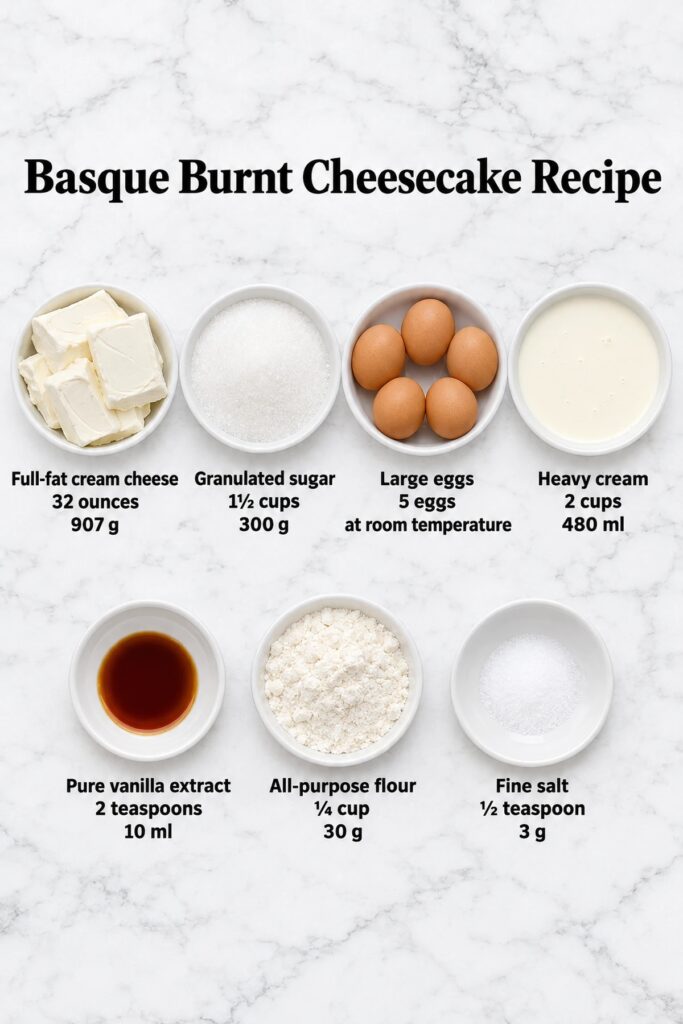
- 32 ounces (907 g) full-fat cream cheese (four 8-ounce blocks), softened
- 1½ cups (300 g) granulated sugar
- 5 large eggs, at room temperature
- 2 cups (480 ml) heavy cream, at room temperature
- 2 teaspoons pure vanilla extract
- ¼ cup (30 g) all-purpose flour
- ½ teaspoon fine salt
Kitchen Equipment Needed
• 9-inch springform pan – holds the tall batter and releases cleanly
• Parchment paper – two 16-inch sheets line the pan and create the rustic edge
• Baking sheet – catches drips under the pan
• Stand mixer or hand mixer – beats the cream cheese until perfectly smooth
• Large mixing bowl – for the one-bowl batter
• Fine-mesh sieve – sifts the flour so it blends in without lumps
• Wire rack – lets the cheesecake cool evenly in the pan
• Sharp knife – run under hot water and wiped dry for clean slices
How to Make Basque Burnt Cheesecake
Here is how to make Basque burnt cheesecake from the first sheet of parchment to the final slice.
Step 1: Heat the Oven and Line the Pan
Heat the oven to 400°F (200°C) with a rack in the center. Lightly grease a 9-inch springform pan, then press two 16-inch sheets of parchment into it, crossing them like a plus sign. Let the paper rise at least 2 inches above the rim and leave the wrinkles in place, then set the pan on a baking sheet.

Step 2: Beat the Cream Cheese and Sugar
Beat the softened cream cheese and sugar in a large bowl on medium speed for 2 to 3 minutes, scraping the bowl once, until the mixture is completely smooth and the sugar has dissolved.
Step 3: Add the Eggs, Cream and Vanilla
Add the eggs one at a time, beating on low speed until each one disappears before adding the next. Pour in the heavy cream and vanilla and mix on low until just combined, which keeps extra air out of the batter.
Step 4: Add the Flour and Salt
Sift the flour and salt over the batter, then mix on low speed until no streaks of flour remain. The batter should look smooth, glossy and pourable, similar to thick heavy cream.

Step 5: Pour and Bake
Pour the batter into the prepared pan and tap the pan gently on the counter to settle it. Bake for 50 to 60 minutes, until the top is a very dark brown and the center still jiggles noticeably when you nudge the pan.

Step 6: Cool in the Pan
Set the pan on a wire rack and let the Basque burnt cheesecake cool for 2 hours. It will sink and wrinkle as it cools, and that is exactly what you want.
Step 7: Chill and Slice
Refrigerate the cheesecake for at least 4 hours, or overnight. Release the springform ring, peel away the parchment, and let the cake stand at room temperature for 30 minutes. Slice with a knife dipped in hot water and wiped dry between cuts.
How to Know It’s Done
Use these checkpoints from the mixing bowl to the cutting board.
| What to Check | Ready When |
|---|---|
| Batter | Smooth, glossy and pourable, with no lumps or streaks of flour |
| Top | Deep brown to nearly black in spots, like dark mahogany, without any bitter smell |
| Edges | Puffed, set and slightly pulling away from the parchment |
| Center | Jiggles like set gelatin when you nudge the pan, but does not ripple like liquid |
| After cooling | Sunk, wrinkled and firm to the touch, then fully set after 4 hours in the refrigerator |
If the center ripples like liquid, bake it for 5 to 10 more minutes and check again. A little jiggle is normal, because the middle keeps setting as the cake cools.
Tips for the Best Basque Burnt Cheesecake
Leave the parchment wrinkled. Press it in without smoothing it flat. Keep the parchment ridged instead of flattening it, because those ridges form the craggy, rustic edge.
Beat the base well, then mix gently. Take your time with the cream cheese and sugar so the batter is perfectly smooth, then keep the mixer on low once the eggs and cream go in.
Trust the jiggle. Pull the Basque burnt cheesecake when the center wobbles like gelatin. It keeps setting as it cools, and waiting for a firm center makes it dry.
Cool it slowly in the pan. Leaving the Basque burnt cheesecake on a wire rack until it is completely cool lets it settle gently and keeps the delicate center from tearing.
Slice with a hot knife. Dip the blade in hot water and wipe it dry between cuts for clean, creamy edges.
Common Mistakes and How to Fix Them
These are the mistakes that most often hurt a Basque burnt cheesecake, along with the quick fix for each one.
| Using cold ingredients The batter stays lumpy, with small bits of cream cheese in the finished cake. | Let the cream cheese, eggs and cream sit out for about 1 hour, and beat the cream cheese and sugar until completely smooth. |
| Mixing too much after adding the eggs Extra air makes the cake puff high and collapse into a deep crater. | Mix on low speed once the eggs and cream go in, and stop as soon as the batter is smooth. |
| Pulling it out too early The top stays pale and the center is runny. | Bake until the top is a very dark brown and the center jiggles like gelatin, not like liquid. |
| Baking until the center is firm The cheesecake turns dry and grainy instead of creamy. | Take it out while the center still wobbles, and let the leftover heat finish the job. |
| Slicing too soon The soft center smears and the slices fall apart. | Chill for at least 4 hours, then use a hot, dry knife for each cut. |
Variations
Once you know the base Basque burnt cheesecake, these easy changes add a new twist.
Brown Sugar Caramel
Replace ½ cup of the granulated sugar with light brown sugar. The top turns a shade deeper, and the flavor takes on a soft molasses note.
Citrus Zest
Stir 1 tablespoon of finely grated lemon or orange zest into the batter along with the vanilla. The bright zest cuts through the richness of the cream cheese.
Berry Topping
Spoon fresh berries or a few tablespoons of homemade strawberry jam over each slice just before serving. The tart fruit is a good contrast to the dark, caramelized top.
Serving Suggestions
Slice the Basque burnt cheesecake and serve it plain to taste the pure caramel flavor, or add whipped cream and fresh berries. A cup of strong coffee or a small glass of sherry makes a classic pairing.
If you love cheesecake, you will also like New York cheesecake, chocolate cheesecake and crème brûlée cheesecake, which has its own crackly caramel top. Matcha cheesecake, strawberry swirl cheesecake, red velvet cheesecake and pumpkin cheesecake bars are good choices when you want a different flavor.
For a lighter finish after a big meal, try panna cotta or lemon posset instead.
Storage
Cover the Basque burnt cheesecake and refrigerate it for up to 4 days. Let slices stand at room temperature for about 30 minutes before serving, since the texture is creamiest when it is not ice cold.
Wait until the cake is completely cool before covering it, because trapped warmth makes the surface damp and sticky.
Basque cheesecake is baked with eggs and cream cheese, so refrigerate it once it has cooled. The USDA recommends keeping cooked egg dishes at 40°F or below.
Freezing
Basque burnt cheesecake freezes well. Chill the whole cake first, then wrap it tightly in plastic wrap followed by heavy-duty foil. It keeps for several months, although it tastes best within about a month.
Label the package with the date and thaw the cheesecake overnight in the refrigerator, still wrapped. Wait until it is completely thawed before slicing.
Frequently Asked Questions
Is Basque burnt cheesecake supposed to be burnt?
Yes, but only on top. The dark, caramelized surface is the signature of a Basque burnt cheesecake and tastes deeply caramelized and slightly bittersweet, not acrid. If it smells truly burnt, the oven is running too hot.
My cheesecake is liquid in the center. Is it done?
It should have a noticeable jiggle, like gelatin, but not a liquid wave. If the center ripples when you nudge the pan, bake it for 5 to 10 more minutes.
Why did my Basque burnt cheesecake rise and then fall?
This is normal. The high heat makes it puff up dramatically in the oven, then it deflates and wrinkles as it cools.
Can I make Basque burnt cheesecake without a springform pan?
Yes. Use a 9-inch round cake pan with sides at least 3 inches tall, and line it with parchment so the cheesecake lifts out easily.
Should I serve Basque burnt cheesecake warm or cold?
Chill it for clean slices, then let it stand for 30 minutes at room temperature. That gives the creamiest texture and the best flavor.
Why isn’t the top of my Basque burnt cheesecake dark enough?
Make sure the oven is fully preheated to 400°F and the rack is in the center. If the top is still pale at the end of the bake, you can leave the cheesecake in a few more minutes, watching closely.
Can I make Basque burnt cheesecake ahead?
Yes. The cake needs 6 hours of cooling and chilling anyway, so it is easy to bake the day before. It keeps in the refrigerator for up to 4 days.
Final Thoughts
This Basque burnt cheesecake proves that a dessert does not have to be perfect to be memorable. A dark top, a crinkled edge and a soft, creamy center are all the decoration it needs.
Once you have baked it, you will know exactly how the batter should look and when the center should jiggle, and it becomes a dependable dessert for birthdays, holidays and dinner parties.
Plain, with fresh berries or under a spoonful of jam: how did your slice end up? Tell me in the comments, along with how dark you took the top.
If you try this recipe, please leave a star rating along with your comment below. It takes a few seconds and helps other readers find the recipe.

Basque Burnt Cheesecake
Basque burnt cheesecake is a crustless cheesecake baked at 400°F until the top turns deep mahogany while the center stays creamy and soft. This easy Basque burnt cheesecake needs just seven ingredients and one bowl, with no water bath and no crust to press. Bake it for about 1 hour, let it cool for 2 hours and chill it for 4, then slice it into 12 silky, caramelized wedges.
Ingredients
- 32 ounces (907 g) full-fat cream cheese (four 8-ounce blocks), softened
- 1½ cups (300 g) granulated sugar
- 5 large eggs, at room temperature
- 2 cups (480 ml) heavy cream, at room temperature
- 2 teaspoons pure vanilla extract
- ¼ cup (30 g) all-purpose flour
- ½ teaspoon fine salt
Instructions
- Heat the oven to 400°F (200°C) with a rack in the center. Lightly grease a 9-inch springform pan and press two 16-inch sheets of parchment into it, crossing them. Let the paper rise at least 2 inches above the rim, leave the wrinkles and set the pan on a baking sheet.
- Beat the softened cream cheese and sugar in a large bowl on medium speed for 2 to 3 minutes, until completely smooth.
- Add the eggs one at a time, beating on low speed after each. Mix in the heavy cream and vanilla on low until just combined.
- Sift in the flour and salt and mix on low until smooth with no streaks of flour.
- Pour the batter into the pan and tap it gently. Bake for 50 to 60 minutes, until the top is very dark brown and the center still jiggles.
- Cool the cheesecake in the pan on a wire rack for 2 hours. It will sink and wrinkle as it cools.
- Refrigerate for at least 4 hours or overnight. Release the ring, peel off the parchment, let stand 30 minutes at room temperature and slice with a hot, dry knife.
Notes
- Use room-temperature ingredients: Let the cream cheese, eggs and heavy cream sit out for about 1 hour so the batter mixes smooth.
- Line the pan well: Use a 9-inch springform pan with two crumpled parchment sheets rising at least 2 inches above the rim, and set it on a baking sheet.
- Watch the doneness: Bake until the top is very dark brown and the center jiggles like gelatin. It keeps setting as it cools.
- Cool and chill: Cool in the pan for 2 hours, then chill for at least 4 hours. Let slices stand 30 minutes before serving.
- Storage: Cover and refrigerate for up to 4 days.
- Freezing: Wrap the chilled cheesecake tightly in plastic wrap and foil and freeze for up to 3 months (best within 1 month). Thaw overnight in the refrigerator.
- Nutrition: Values are per slice (1 of 12), without any toppings.
Nutrition Information:
Yield: 12 Serving Size: 1 sliceAmount Per Serving: Calories: 531Total Fat: 42gSaturated Fat: 24gCholesterol: 215mgSodium: 384mgCarbohydrates: 32gFiber: 0gSugar: 29gProtein: 9g