French Onion Soup
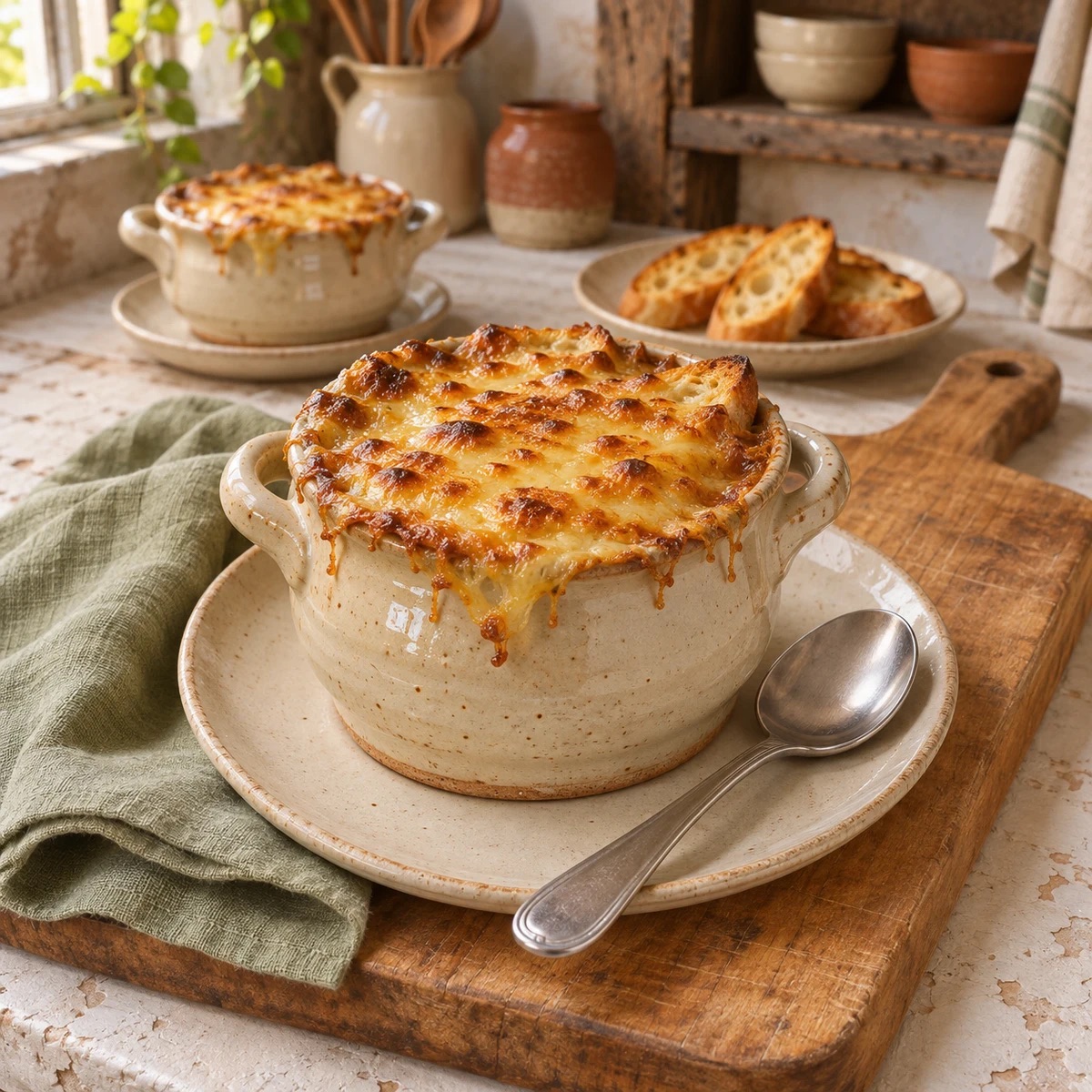
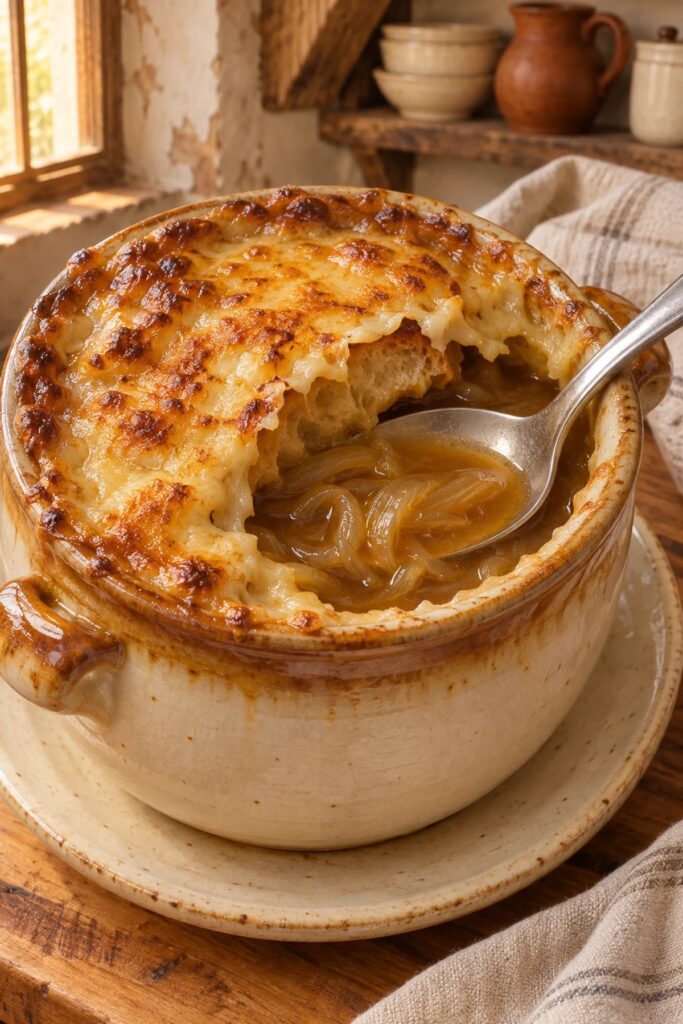
A crock of French onion soup comes out from under the broiler wearing a bubbling, browned lid of Gruyère, and underneath it sit soft, sweet onions in a deep amber broth.
The flavor of French onion soup comes almost entirely from the onions. Cooked slowly in butter for about an hour, they lose their sharp bite, turn sweet and jammy, and leave a brown layer on the bottom of the pot that becomes the backbone of the broth.
This version follows the familiar bistro formula: yellow onions, a splash of dry white wine, thyme, bay leaf and low-sodium beef broth, finished with a slice of toasted baguette and plenty of Gruyère. Everything comes from a regular supermarket.
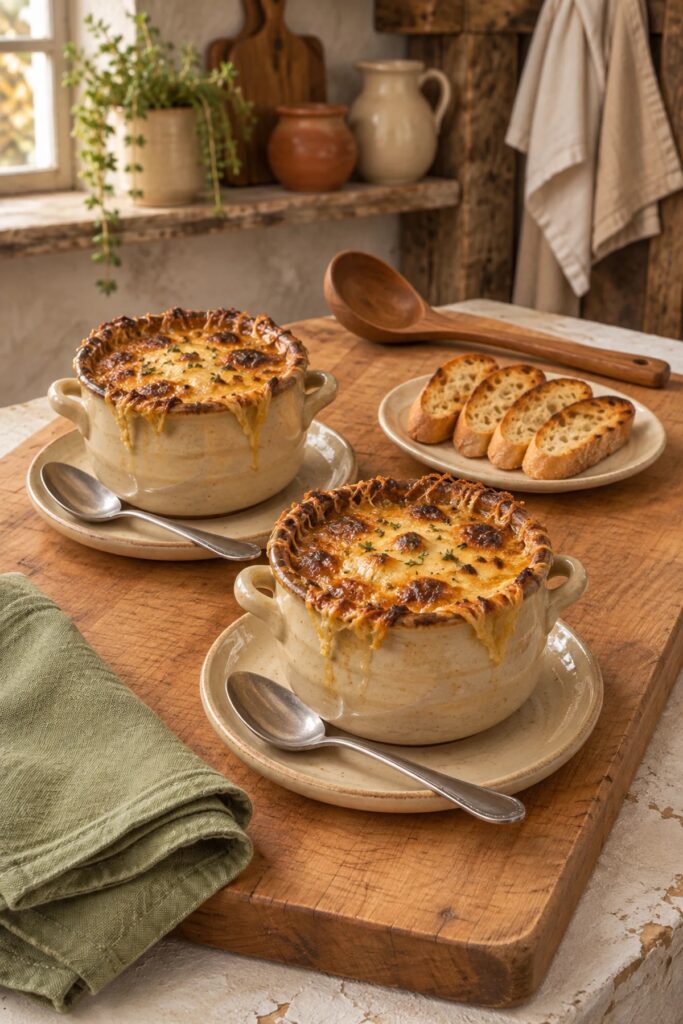
The recipe makes 6 crocks of French onion soup, about 1½ cups each. The base can be made days ahead, so on serving night all that’s left is reheating, topping and a few minutes under the broiler.
Why You’ll Love This French Onion Soup
Deep flavor from simple ingredients. Onions, butter, broth, wine and a little thyme are the whole base, and patience at the stove does the rest.
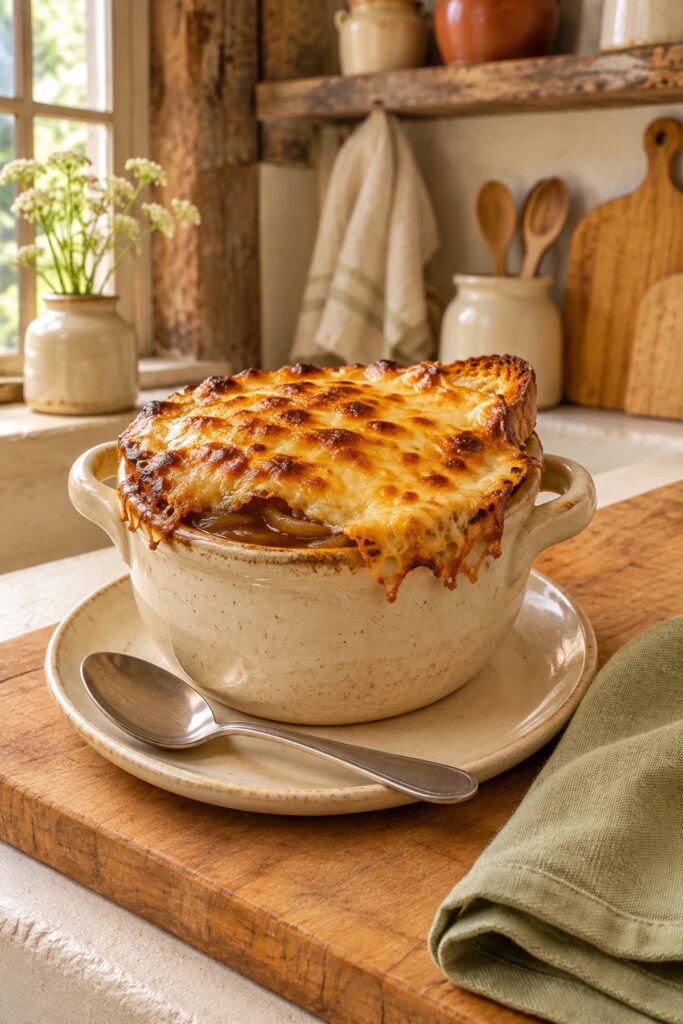
The cheese lid everyone waits for. A thick layer of Gruyère melts over a sturdy toast and browns in spots under the broiler, sealing the crock like a golden cap.
Made for making ahead. The base of this French onion soup keeps for several days in the refrigerator and tastes rounder the next day.
Flexible where it counts. There’s a no-wine version, a mushroom-broth version and a fallback for bowls that can’t go under the broiler.

Perfect For
French onion soup fits cold winter dinners, cozy weeknights when the base is already in the refrigerator, and make-ahead entertaining when you want the work done before guests arrive.
It also makes a warm starter for Christmas Eve or a New Year’s dinner. You’ll find more ideas for the season in my holiday recipes, and if your family likes a soup night, a pot of butternut squash soup makes a mild, creamy partner for another evening.
French Onion Soup at a Glance
| Flavor | Sweet, deeply browned onions in a savory beef broth, with thyme, a little wine and nutty Gruyère |
| Texture | Silky, soft onions in a glossy broth under a crisp-edged toast and a stretchy, browned cheese cap |
| Difficulty | Easy (the only demand is patience while the onions brown) |
| Prep Time | 20 minutes |
| Cook Time | 1 hour 55 minutes (about 70 minutes for the onions, 40 for the broth, 5 under the broiler) |
| Rest Time | 5 minutes |
| Total Time | 2 hours 20 minutes |
| Servings | 6 crocks, about 1½ cups (355 ml) of soup each |
| Broiler | High, rack about 6 inches (15 cm) below the element |
| Pot | 5½- to 7-quart (5.2 to 6.6 liter) Dutch oven |
| Cuisine | French-inspired |
| Best For | Winter dinners, Christmas Eve, New Year and make-ahead entertaining |
Before You Start
French onion soup has a short ingredient list, so a few choices decide whether it turns out deep and savory or pale and thin.
Give the onions real time. Real caramelization takes about an hour, sometimes longer. Deep brown onions in 20 minutes would need heat high enough to scorch them.
Use a wide, heavy pot. A 5½- to 7-quart Dutch oven holds 3 pounds of sliced onions, spreads the heat evenly and gives them room to brown rather than steam.
Check your bowls and broiler. You’ll need 6 crocks or bowls labeled broiler-safe, about 14 to 16 ounces each, and a rimmed sheet pan. Without them, see the workaround in the FAQ.
Buy the bread a day early. Slightly stale baguette toasts dry and firm, so it holds up under the cheese instead of dissolving into the broth.
Plan a make-ahead timeline. Cook the base up to 3 days ahead. On serving day, toast the bread, shred the cheese, reheat the soup and broil.
What Makes This French Onion Soup Work
Slow, Patient Caramelizing
Onions are full of water, so they first soften and release liquid, and only once that cooks off do their natural sugars begin to brown. A short covered start speeds up the softening, and a long uncovered stretch at medium to medium-low heat turns them deep amber without burning.
The Brown Layer on the Bottom of the Pot
As the onions cook, a thin brown film called fond builds up on the bottom of the pot. Scraping it back into the onions again and again is what gives French onion soup its dark color and savory depth.
Deglazing with Wine
A little wine loosens the last of the fond and adds a gentle acidity that balances the sweet onions. It reduces almost completely in a few minutes, leaving flavor rather than a boozy taste.
Low-Sodium Broth and Salt at the End
The broth in French onion soup reduces as it simmers, and the Gruyère on top is salty too. Starting with low-sodium broth and seasoning only after the simmer lets you control the final salt level.
Toast First, Then Broil the Cheese
A dry, toasted slice of bread soaks up broth slowly, so it stays sturdy enough to hold the cheese. The broiler then melts and browns the Gruyère in a few minutes, before the bread has time to turn to mush.
Ingredient Notes and Substitutions
Every ingredient for this French onion soup is easy to find, and most have an honest swap.
Onions. Plain yellow onions are the classic choice, since they are the most common and least costly onions, and they become sweeter with cooking. Sweet onions such as Vidalia also caramelize but can make the soup one-note sweet, so use them for no more than half of the weight.
Butter. Unsalted butter adds a rich, rounded flavor and keeps the salt under your control. Softened homemade butter works too, and you can swap 1 tablespoon of the butter for olive oil.
Broth. Use low-sodium or reduced-sodium beef broth, since regular broth can make the finished soup too salty once it reduces. The better your broth tastes on its own, the better your French onion soup will taste.
Wine. A dry white wine you’d drink, such as Sauvignon Blanc or Pinot Grigio, adds brightness. Dry sherry or dry vermouth works in the same amount, and the Variations include a no-wine version.
Thyme and bay leaf. Fresh thyme and one dried bay leaf give a gentle herbal background. For dried thyme, use ½ teaspoon (0.5 g).
Worcestershire sauce. One teaspoon deepens the savory flavor of store-bought broth. It contains anchovies, so skip it or use a vegetarian brand for the mushroom version.
Bread. A day-old baguette sliced on the diagonal gives a wide, sturdy toast. A rustic loaf like homemade sourdough works too, as long as the slices fit inside your crocks.
Gruyère and fallbacks. Gruyère melts smoothly, browns well and has a nutty, savory flavor. Swiss cheese is the easiest supermarket swap and tastes milder, while provolone melts well but browns less and has a softer flavor.
Ingredients for French Onion Soup
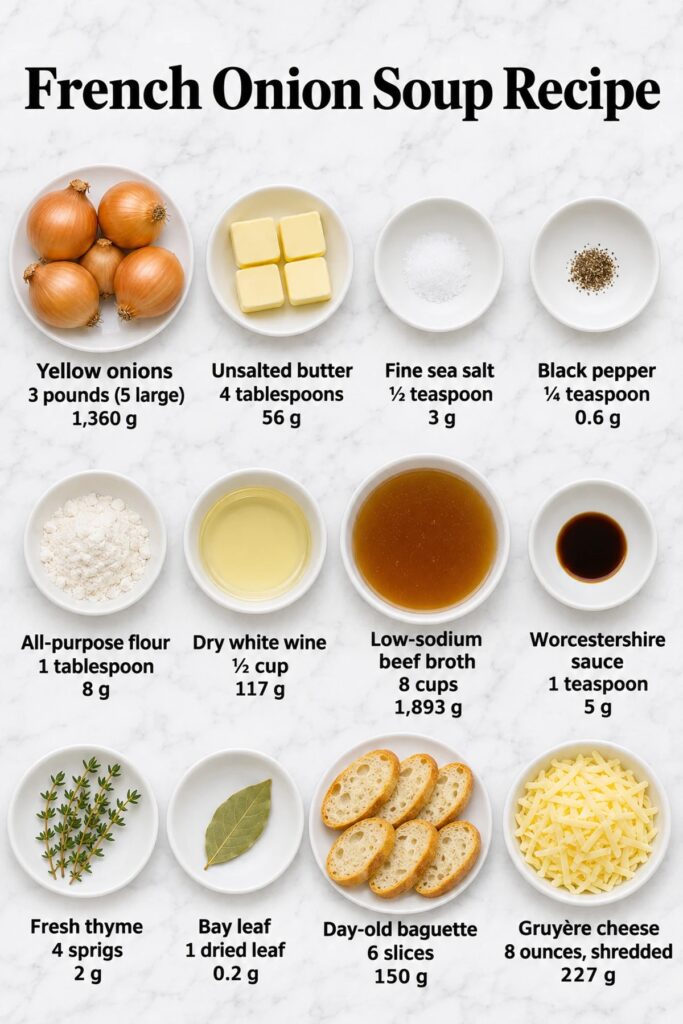
These amounts make 6 crocks of French onion soup. Three pounds of onions sounds like a mountain when sliced, about 10 cups, but it cooks down to roughly 2 cups of soft, amber onions, or ½ pound (227 g) of raw onion per serving.
For the Soup
- 3 pounds (1.36 kg) yellow onions, about 5 large
- 4 tablespoons (56 g) unsalted butter
- ½ teaspoon (3 g) fine sea salt, plus more to taste
- ¼ teaspoon (0.6 g) freshly ground black pepper
- 1 tablespoon (8 g) all-purpose flour
- ½ cup (118 ml, 117 g) dry white wine (or see the no-alcohol version)
- 8 cups (1.9 liters, 1,893 g) low-sodium beef broth
- 1 teaspoon (5 g) Worcestershire sauce
- 4 sprigs fresh thyme (2 g)
- 1 dried bay leaf (0.2 g)
For the Toasts and Topping
- 6 slices day-old baguette, cut on the diagonal ¾ inch (2 cm) thick (about 5 ounces, 150 g)
- 8 ounces (227 g) Gruyère cheese, coarsely shredded (about 2½ cups)
Kitchen Equipment Needed
• Sharp chef’s knife and a large cutting board – slice the onions
• 5½- to 7-quart (5.2 to 6.6 liter) Dutch oven with a lid – caramelize the onions and simmer the soup
• Flat-edged wooden spatula – scrape the fond from the bottom of the pot
• 6 oven-safe soup crocks or bowls labeled broiler-safe, 14 to 16 ounces (415 to 475 ml) each – broil and serve the soup
• Rimmed sheet pan – toast the bread and carry the crocks in and out of the oven
• Box grater – shred the Gruyère
• Ladle – fill the crocks
• Thick, dry oven mitts and a trivet or plate for each crock – handle and serve the hot crocks
• Kitchen scale – weigh the onions
How to Make French Onion Soup
Here’s the full method for French onion soup, from slicing the onions to the browned cheese cap. Each step ends with what you should see.
Step 1: Slice the Onions
Cut off the tops and root ends, halve the onions from top to root and peel them. Lay each half flat and slice it from pole to pole, along the lines on the onion, about ¼ inch (6 mm) thick.
What you should see: A large pile of even, crescent-shaped slivers, about 10 cups, with no thick chunks or paper-thin shreds.
Step 2: Soften the Onions Under a Lid
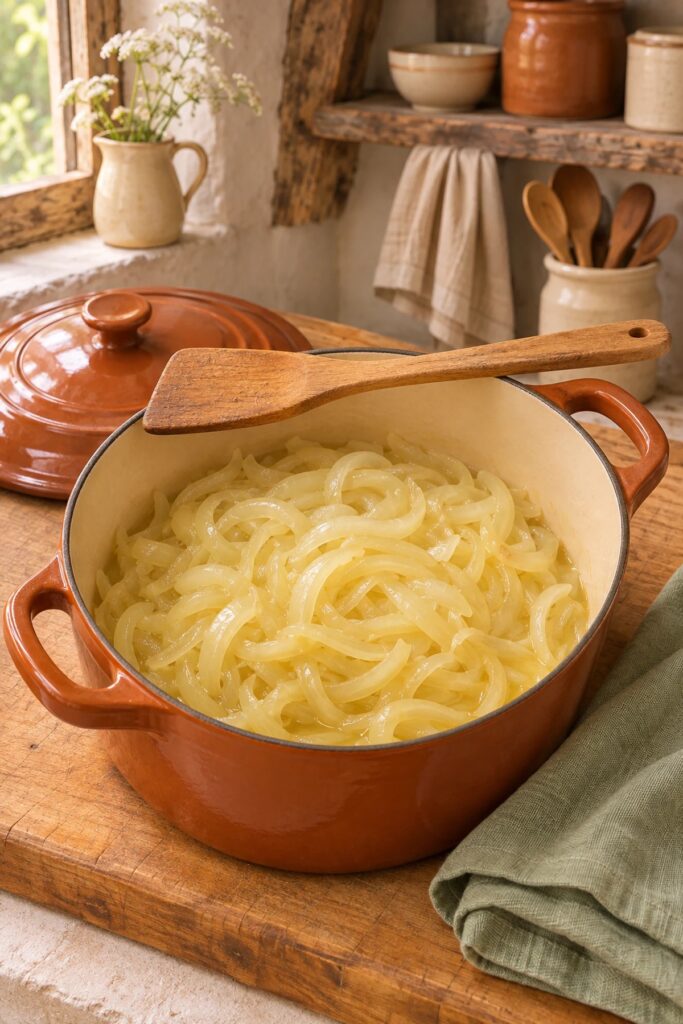
Melt the butter in the Dutch oven over medium heat. Add the onions, salt and pepper, toss to coat, then cover and cook for 15 minutes, stirring once or twice.
What you should see: Slices that have slumped to about two-thirds of their height, glossy, soft and translucent, in a little pale liquid.
Step 3: Caramelize Until Deep Amber
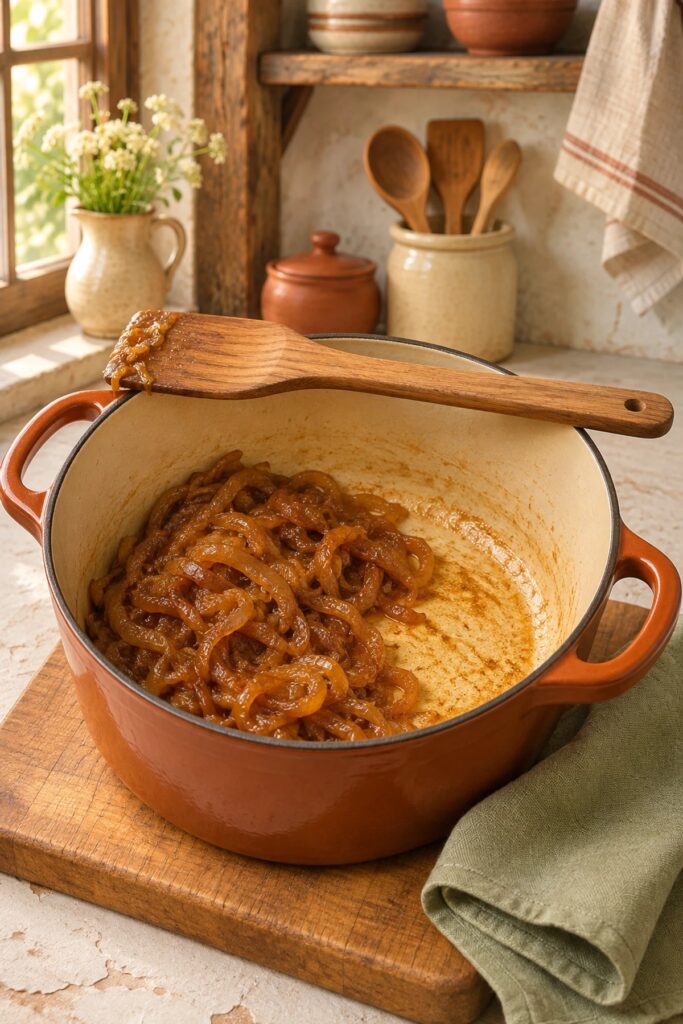
Uncover and cook for 45 to 55 minutes more, stirring every few minutes at first and more often as they brown, scraping the bottom each time. If the fond starts to look very dark, lower the heat to medium-low and stir in 1 to 2 tablespoons (15 to 30 ml) of water to loosen it.
What you should see: A soft, jammy tangle of onions the color of strong tea or caramel, shrunk to about 2 cups, over an even brown film on the bottom of the pot with no black spots.
Step 4: Toast the Flour
Sprinkle the flour over the onions and stir for about 1 minute.
What you should see: No dry white patches left, and onions that look slightly matte and cling together a little.
Step 5: Deglaze with the Wine
Raise the heat to medium-high, pour in the wine and scrape the bottom of the pot with the spatula. Let it bubble for 2 to 3 minutes, until it has almost disappeared.
What you should see: A clean pot bottom with the fond dissolved into the onions, and only a thin, syrupy film of liquid left.
Step 6: Simmer the Soup
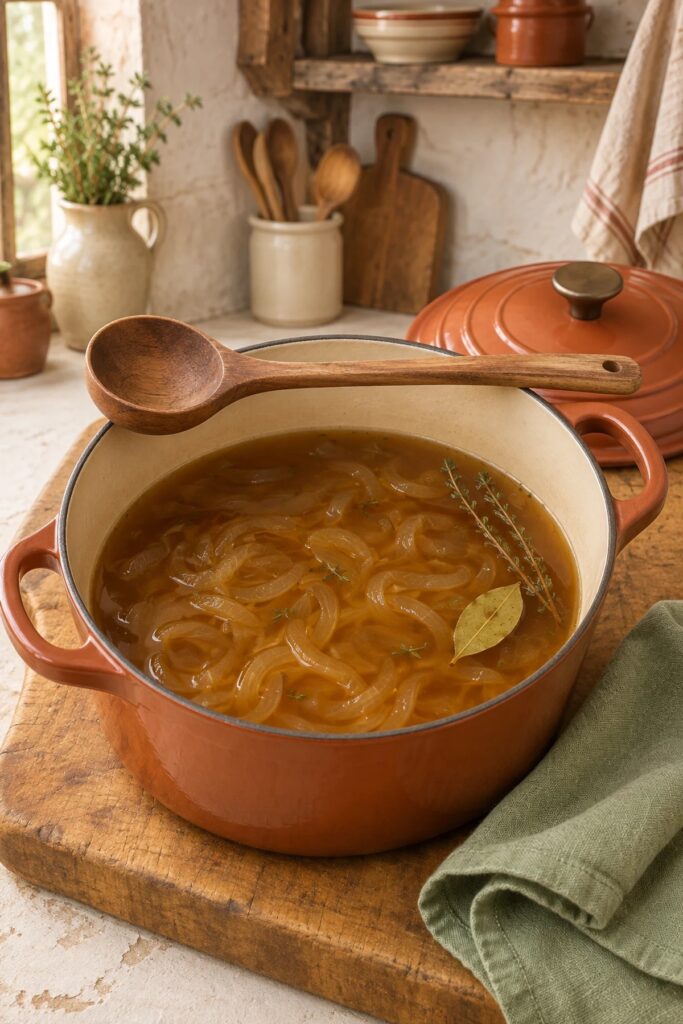
Add the broth, Worcestershire sauce, thyme sprigs and bay leaf and bring to a boil. Lower the heat, set the lid ajar and simmer gently for 30 minutes.
What you should see: A glossy, clear amber-brown broth with the soft onions suspended in it and the thyme leaves fallen off their stems.
Step 7: Toast the Bread
While the soup simmers, heat the oven to 400°F (200°C). Bake the baguette slices on the sheet pan for about 10 minutes, turning them once, and move them to a plate. Switch the oven to broil on high with a rack about 6 inches (15 cm) below the element.
What you should see: Slices that are dry and firm all the way through and lightly golden at the edges, not dark brown.
Step 8: Season the Soup
Remove the thyme stems and bay leaf. Taste the broth and add salt a pinch at a time, keeping it just a little under-seasoned, since the cheese will add more.
What you should see: About 9 cups of French onion soup with no stems or leaves floating on top, and a broth that tastes savory and gently sweet.
Step 9: Fill and Top the Crocks
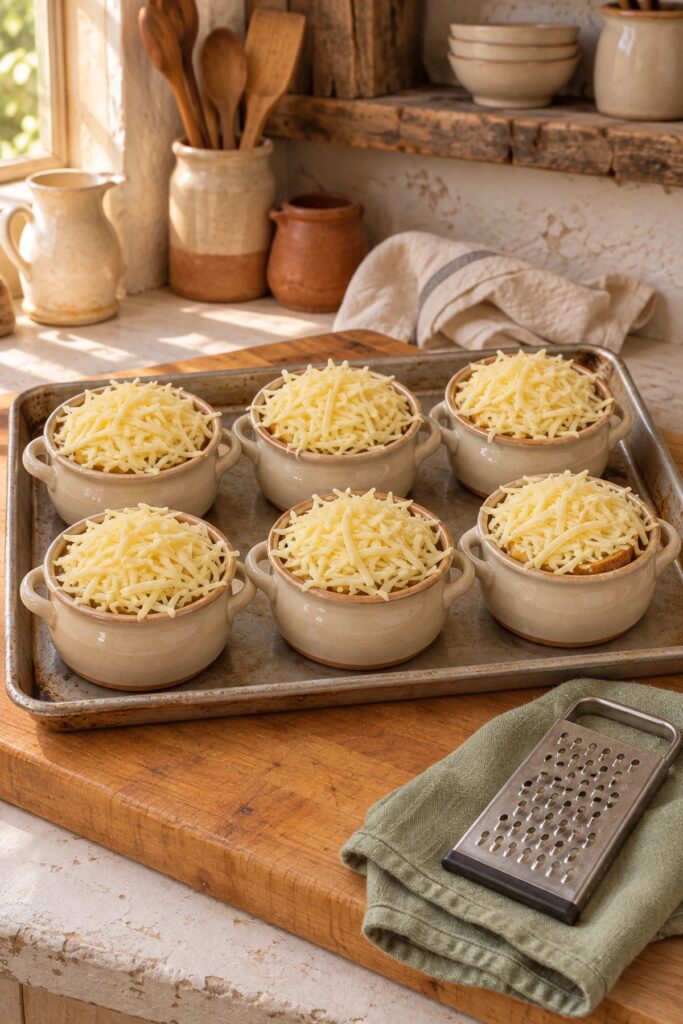
Set the crocks on the rimmed sheet pan and ladle about 1½ cups (355 ml) of very hot soup into each, leaving at least ½ inch (1.3 cm) of space at the top. Float one toast on each and pile the Gruyère over the toast all the way to the edges, letting it touch the rim of the crock.
What you should see: Six crocks with the toast hidden under a thick, even mound of shredded cheese, and no bare bread showing at the edges.
Step 10: Broil and Rest
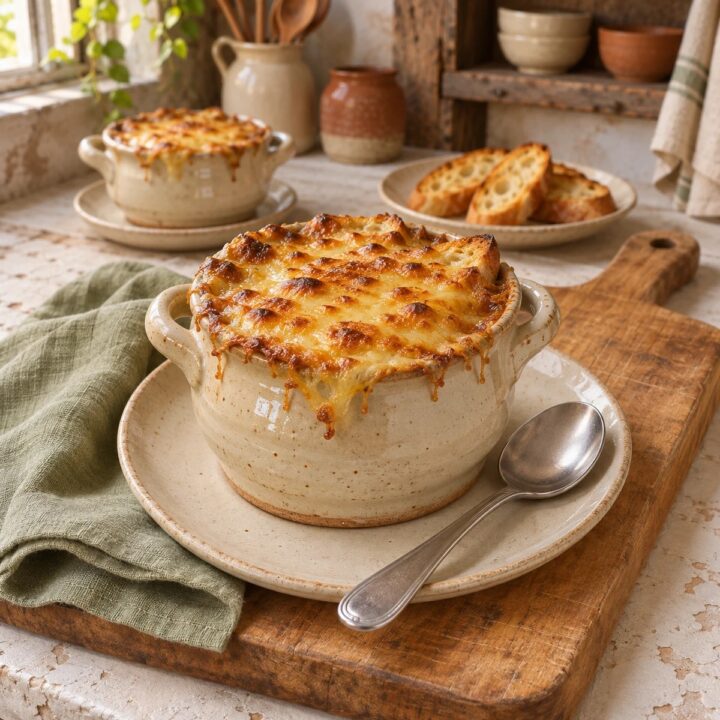
Slide the sheet pan under the broiler and broil for 3 to 5 minutes, turning the pan once and watching closely. Lift the pan out with thick oven mitts, set each crock on a plate or trivet and let it rest for 5 minutes before serving.
What you should see: Melted, bubbling cheese with golden-brown blisters across the top and darker, crisp edges where it touches the rim.
How to Know It’s Done
French onion soup gives clear visual cues at each stage, so trust them along with the times.
| What to Check | Ready When |
|---|---|
| Onions after the lid | Soft, translucent and slumped, with some pale liquid in the pot |
| Caramelized onions | Deep amber, jammy and reduced to about 2 cups, over an even brown fond |
| Broth | Glossy, clear amber-brown and savory, with the onions suspended in it |
| Toast | Dry and firm through the center, golden at the edges |
| Cheese cap | Melted and bubbling, with golden-brown blisters and crisp edges at the rim |
If your onions are still light gold after 55 minutes uncovered, keep going in 10-minute stretches, since pots and stoves vary. If the cheese is still pale after 5 minutes, move the rack one notch higher and broil 1 minute more.
Tips for the Best French Onion Soup
Slice the onions evenly. Even slices brown at the same rate, so you won’t get burnt slivers next to pale ones.
Stay near the pot in the last 20 minutes. Browning speeds up toward the end, when the fond can go from deep brown to burnt quickly.
Use water as your safety net. A spoonful of water lifts dark fond and cools the bottom of the pot, so you can keep cooking without scorching.
Heat the soup before it goes in. With very hot soup, the broiler only has to melt and brown the cheese, so the bread has less time to go soggy.
Shred the cheese yourself. Freshly shredded Gruyère melts more smoothly than pre-shredded cheese, which is coated to keep it from clumping.
Common Mistakes and How to Fix Them
These are the problems that come up most often with French onion soup, along with a fix for each one.
| Mistake | How to Fix It |
|---|---|
| Onions pale or burnt They stay light gold, or black specks appear on the bottom. | Cook over medium to medium-low heat for the full time, scrape the pot every few minutes and add 1 to 2 tablespoons of water whenever the fond darkens too fast. |
| Soup too salty The broth tastes harsh before the cheese even goes on. | Use low-sodium broth and salt only at the end; if it’s already salty, add 1 to 2 cups of water or unsalted broth and simmer 5 minutes. |
| Bitter or sour taste A sharp, acrid or tart edge in the broth. | Bitterness comes from scorched fond, so lower the heat sooner next time; for a sour edge, let the wine reduce fully and add a pinch of salt or a little more broth. |
| Soggy or dissolved bread The toast falls apart under the cheese. | Use day-old baguette, toast it until dry through the center and float it on very hot soup right before broiling. |
| Cheese not browning, sliding off or burning It stays pale, sinks into the soup or blackens. | Pile the cheese to the rim so it rests on the crock, keep the rack about 6 inches (15 cm) below the element and watch every minute of the broil. |
Variations
Once you know how the classic pot should look and taste, French onion soup takes well to a few changes.
No-Alcohol Version
Skip the wine and deglaze with ½ cup (118 ml) of the broth instead, then stir 1 teaspoon (5 g) of apple cider vinegar into the soup at the end. It loses a little brightness, so taste and adjust the vinegar a few drops at a time.
Vegetarian with Mushroom Broth
Use 8 cups (1.9 liters) of mushroom or vegetable broth and leave out the Worcestershire sauce or use a vegetarian brand. Expect a lighter, sweeter result without the meaty depth of a beef-broth French onion soup.
With Chicken Broth
Replace half or all of the beef broth with low-sodium chicken broth. It turns more golden than brown and tastes milder.
Slow-Cooker Onion Base
Toss the sliced onions, salt and pepper with 2 tablespoons (28 g) of melted butter in a slow cooker and cook on LOW for about 10 hours. Brown them in the Dutch oven with the remaining 2 tablespoons (28 g) of butter over medium-high heat for 10 to 15 minutes, then continue from Step 4; expect a slightly lighter soup than the stovetop version.
With Extra Parmesan
Mix ½ cup (45 g) of finely grated Parmesan into the Gruyère before topping the crocks. The cap browns faster and tastes saltier, so season the soup lightly.
Serving Suggestions
A crock of French onion soup is filling, so it pairs best with something fresh and simple. A crisp spinach salad turns it into a full dinner.
For a French-style evening, serve small crocks before coq au vin, or alongside a slice of quiche Lorraine for lunch. On a holiday table, it also works as a starter before a roast with scalloped potatoes.
A small plate of extra toasted baguette slices or a basket of garlic bread helps with the last of the broth. Finish with choux au craquelin, or browse the recipe index for more soups and mains.
Make Ahead
Soup base: Cook the French onion soup through Step 8, cool it and refrigerate it in airtight containers for up to 3 days.
Toasts and cheese: Toast the bread up to 2 days ahead and keep it airtight at room temperature once cool. Shred the cheese a day ahead and refrigerate it covered.
Serving day: Bring the soup to a simmer until steaming hot, then fill, top and broil as in Steps 9 and 10.
Storage
Cooling: Don’t put the whole hot pot straight into the refrigerator. A large pot of hot food should be divided into small portions in shallow containers before it is refrigerated, and it shouldn’t stay in the 40 to 140°F “Danger Zone” for more than 2 hours.
Refrigerator: Store leftover French onion soup without the bread and cheese in airtight containers for 3 to 4 days. Topped crocks don’t keep well, since the toast turns soft.
Reheating: Warm the soup in a saucepan over medium heat, stirring now and then, until it reaches 165°F (74°C). Add a splash of water or broth if it has reduced, then top and broil fresh.
Freezing
The base of French onion soup freezes well without the bread and cheese. Cool it, pack it into freezer containers with about 1 inch (2.5 cm) of headspace and freeze it for 2 to 3 months for the best quality.
Thaw it overnight in the refrigerator and reheat it on the stove until steaming, then top it with fresh toast and cheese.
Frequently Asked Questions
How long does it take to caramelize onions for French onion soup, and why are mine bitter?
Plan on about an hour: 15 minutes covered, then 45 to 55 minutes uncovered at medium to medium-low heat. Bitterness almost always means the fond or some slivers burned, so lower the heat sooner and add a spoonful of water whenever the bottom of the pot turns very dark.
What are the best onions for French onion soup?
Yellow onions give the most balanced result: sweet after long cooking, with enough savory bite to keep the soup interesting. Sweet onions can make up to half of the weight, while red onions are better used raw or pickled.
Can I make it without wine?
Yes. Deglaze with ½ cup (118 ml) of broth and add 1 teaspoon (5 g) of apple cider vinegar at the end. The soup tastes a little sweeter and less bright, but the caramelized onions still carry the flavor.
Can I make it ahead?
Yes, and French onion soup is one of the best soups for it. Refrigerate the base for up to 3 days, then reheat it until steaming, top with toast and cheese and broil just before serving.
What if I don’t have oven-safe crocks?
Top the toasts with the cheese on the sheet pan and broil them for 2 to 3 minutes, until melted and browned. Ladle the hot soup into regular bowls and float a cheesy toast on each.
What cheese can I use if I can’t find Gruyère?
Swiss cheese is the closest supermarket swap and melts the same way, with a milder flavor. Provolone or a mix of Swiss and a little Parmesan also work.
Can I freeze it?
Yes, freeze the French onion soup base without the bread and cheese for 2 to 3 months. Thaw it in the refrigerator, reheat it on the stove and top it fresh.
Final Thoughts
Even slices, a full hour of slow browning, a pot bottom scraped clean with a splash of wine, and a toast that’s dry before it meets the broth are what turn a bag of onions into something this comforting.
Make this French onion soup as written the first time, then try the no-wine, mushroom or Parmesan versions once you know how deep the color and flavor should be.
When your spoon broke through the cheese, how dark had your onions turned, and how long did they take on your stove? Leave a note below with the broth you used and whether the wine made it into your pot.
If you try this recipe, please leave a star rating along with your comment below. It takes a few seconds and helps other readers find the recipe.
French Onion Soup
This French onion soup cooks 3 pounds of yellow onions slowly in butter until deep amber, then simmers them with white wine, thyme and low-sodium beef broth. Each crock gets a toasted baguette slice and a thick layer of Gruyère that bubbles and browns under the broiler. Made in one Dutch oven, this French onion soup serves 6, and the base keeps for days for winter dinners and Christmas Eve.
Ingredients
For the Soup
- 3 pounds (1.36 kg) yellow onions, about 5 large
- 4 tablespoons (56 g) unsalted butter
- ½ teaspoon (3 g) fine sea salt, plus more to taste
- ¼ teaspoon (0.6 g) freshly ground black pepper
- 1 tablespoon (8 g) all-purpose flour
- ½ cup (118 ml, 117 g) dry white wine (or see the no-alcohol version)
- 8 cups (1.9 liters, 1,893 g) low-sodium beef broth
- 1 teaspoon (5 g) Worcestershire sauce
- 4 sprigs fresh thyme (2 g)
- 1 dried bay leaf (0.2 g)
For the Toasts and Topping
- 6 slices day-old baguette, cut on the diagonal ¾ inch (2 cm) thick (about 5 ounces, 150 g)
- 8 ounces (227 g) Gruyère cheese, coarsely shredded (about 2½ cups)
Instructions
- Halve and peel 3 pounds (1.36 kg) yellow onions and slice them pole to pole, about ¼ inch (6 mm) thick.
- Melt 4 tablespoons (56 g) unsalted butter in a 5½- to 7-quart Dutch oven over medium heat. Add the onions, ½ teaspoon (3 g) fine sea salt and ¼ teaspoon (0.6 g) pepper, cover and cook for 15 minutes, stirring once or twice.
- Uncover and cook for 45 to 55 minutes, stirring and scraping the bottom often, until deep amber and jammy. Lower the heat and add 1 to 2 tablespoons (15 to 30 ml) water if the fond darkens too fast.
- Stir in 1 tablespoon (8 g) all-purpose flour and cook for 1 minute.
- Raise the heat to medium-high, add ½ cup (118 ml) dry white wine and scrape the pot until the wine has almost evaporated, 2 to 3 minutes.
- Add 8 cups (1.9 liters) low-sodium beef broth, 1 teaspoon (5 g) Worcestershire sauce, 4 thyme sprigs (2 g) and 1 bay leaf (0.2 g). Bring to a boil, then simmer gently with the lid ajar for 30 minutes.
- Meanwhile, toast 6 diagonal baguette slices, ¾ inch (2 cm) thick (150 g), on a sheet pan at 400°F (200°C) for about 10 minutes, until dry. Switch the oven to broil on high with a rack about 6 inches (15 cm) below the element.
- Remove the thyme stems and bay leaf and season the soup with salt to taste, keeping it slightly under-seasoned.
- Set 6 broiler-safe crocks on a rimmed sheet pan, fill each with about 1½ cups (355 ml) very hot soup, top with a toast and cover with 8 ounces (227 g) shredded Gruyère, divided, all the way to the rims.
- Broil for 3 to 5 minutes, watching closely, until bubbling and browned. Rest for 5 minutes on plates or trivets before serving.
Notes
- Onions: Yellow onions give the best balance; sweet onions can make up to half of the weight.
- Caramelizing: Plan on about 1 hour; lower the heat and add a spoonful of water if the fond darkens too fast, since burnt fond turns the soup bitter.
- No wine: Deglaze with ½ cup (118 ml) broth and add 1 teaspoon (5 g) apple cider vinegar at the end.
- Salt: Season only after simmering; the broth reduces and the Gruyère is salty.
- No broiler-safe bowls: Broil the cheese-topped toasts on the sheet pan for 2 to 3 minutes and float them on soup in regular bowls.
- Make ahead: Refrigerate the soup base (through step 8) for up to 3 days; reheat until steaming, then top and broil.
- Storage and freezing: Cool in shallow containers and refrigerate within 2 hours for 3 to 4 days, or freeze the base without bread and cheese for 2 to 3 months; reheat to 165°F (74°C).
- Nutrition: Values are per serving (1 crock: about 1½ cups of soup, 1 toast and one-sixth of the Gruyère), counting the trimmed onions (about 1,225 g), butter, flour, wine (alcohol calories at 35% retained after simmering), reduced-sodium beef broth (about 430 mg sodium per cup), Worcestershire, thyme, pepper, ½ teaspoon salt, 150 g baguette and 227 g Gruyère. Extra salt added to taste is not included. With a true low-sodium broth, sodium drops to about 820 mg.
Nutrition Information:
Yield: 6 Serving Size: 1 crock (about 1½ cups soup with 1 toast and cheese)Amount Per Serving: Calories: 401Total Fat: 21gSaturated Fat: 12gCholesterol: 62mgSodium: 1201mgCarbohydrates: 35gFiber: 4gSugar: 11gProtein: 19g